
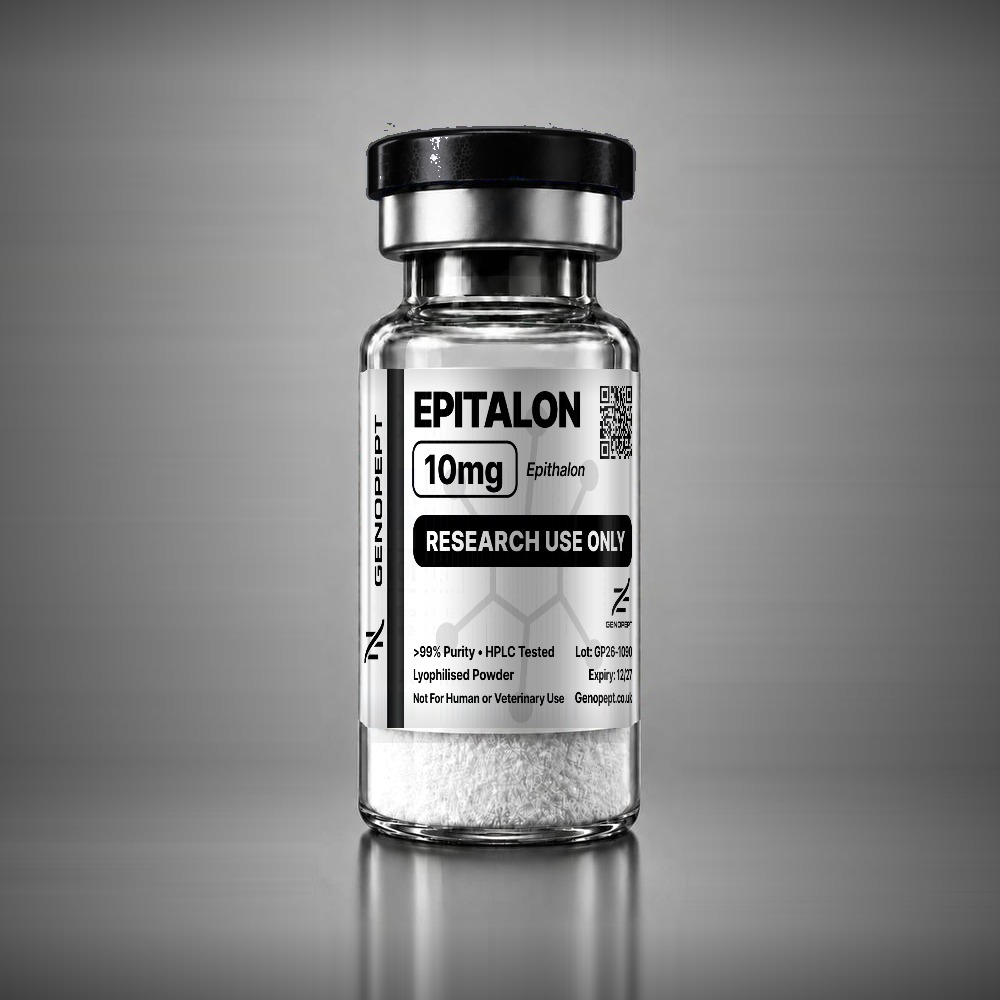
What is Epitalon (Epithalon)?
Epitalon (epithalon, AEDG) is a synthetic tetrapeptide with the sequence Ala-Glu-Asp-Gly. It was developed in St Petersburg by Vladimir Khavinson’s group as a defined, synthetic counterpart to epithalamin, a polypeptide extract of the bovine pineal gland, and it is the best-known member of the Khavinson family of short peptide bioregulators.
Epitalon is studied for its reported ability to activate telomerase expression in cultured human cells, to modulate melatonin secretion and circadian rhythm in animal models, and to influence gene expression in ageing tissue. Because it is only four amino acids long it is small enough to enter cells and, in published work, to interact with DNA in the nucleus.
GenoPept supplies Epitalon in the UK as a lyophilised research peptide in 10mg, 40mg and 50mg vials, each batch verified at ≥99% purity with a Certificate of Analysis, strictly for in-vitro laboratory research. See our Epitalon research guide for a deeper review.
Epitalon (Epithalon) research applications
Epitalon research is concentrated in gerontology, chronobiology and cell biology. The areas below reflect published cell-culture and animal work and are not claims about effects in people.
Telomerase and telomere biology
Cell-culture studies reported that Epitalon induces telomerase activity and telomere elongation in human somatic cells, which is why it is investigated in replicative-senescence models.
Pineal function and circadian rhythm
Animal and primate studies investigated Epitalon for effects on melatonin secretion and restoration of circadian cortisol and melatonin patterns in aged subjects.
Ageing and lifespan models
Rodent and Drosophila studies have examined Epitalon for effects on lifespan, tumour incidence and age-related biomarkers as part of the wider Khavinson bioregulator programme.
Gene expression and chromatin
Epitalon is studied for its reported interaction with DNA and its influence on expression of genes involved in neurogenesis, antioxidant defence and cell differentiation.
Retinal and neuroprotection models
Preclinical work has explored the peptide in models of retinal degeneration and neuronal ageing, linking to its origin as a pineal-derived bioregulator.
Mechanism of action (preclinical)
The proposed mechanism for Epitalon and other Khavinson peptides is epigenetic. The short, charged tetrapeptide is reported to enter the nucleus and bind to specific DNA sequences in gene promoters, altering chromatin accessibility and transcription. In cell culture this has been associated with increased expression of the telomerase catalytic subunit (TERT) and telomere elongation.
Epitalon is also reported to influence pineal melatonin synthesis and to normalise neuroendocrine rhythms in aged animals. These findings come from preclinical and ex-vivo research and the exact molecular targets remain under investigation.
Epitalon (Epithalon) product specifications
| Specification | Detail |
|---|---|
| Compound | Epitalon (Epithalon) |
| Also known as | Epithalon, Epithalone, AEDG peptide, Ala-Glu-Asp-Gly, Epithalamin-derived tetrapeptide |
| Sequence / class | Synthetic 4-amino-acid peptide bioregulator (Ala-Glu-Asp-Gly) |
| CAS number | 307297-39-8 |
| Molecular formula | C14H22N4O9 |
| Molecular weight | 390.3 g/mol |
| Form | Lyophilised (freeze-dried) powder in a sealed sterile glass vial, black cap, lot and expiry on label |
| Available sizes | 10mg, 40mg, 50mg |
| Purity | ≥99% (HPLC) |
| Verification | Batch HPLC purity and LC-MS identity testing by an independent ISO/IEC 17025 laboratory (Puralytix), with Certificate of Analysis |
| Storage (unopened) | −20 °C long term; 2–8 °C short term; protect from light |
| Intended use | In-vitro laboratory research only. Not for human or veterinary use |
Available sizes
Epitalon is available from GenoPept in the following vial sizes:
- Epitalon 10mg vial
- Epitalon 40mg vial
- Epitalon 50mg vial
Laboratories that need larger quantities can order Epitalon in bulk boxes of 10 vials, which save 20–50% against single-vial pricing. Retail baskets also receive automatic discounts at £300, £500 and £1,000, and delivery is free on UK orders of £200 or more.
Reconstitution, handling and storage (laboratory)
Unopened Epitalon vials should be stored at −20 °C for long-term storage, or at 2–8 °C for short periods, and protected from light. Allow the vial to reach room temperature before opening to avoid condensation on the lyophilised cake.
To reconstitute for in-vitro work, add bacteriostatic water or another sterile diluent slowly down the inside wall of the vial, then swirl gently until the powder dissolves. Do not shake. Epitalon is a small, acidic tetrapeptide and dissolves readily in water or buffer. Reconstituted solution should be kept at 2–8 °C and used within the period specified in the laboratory’s own protocol. See our guides on how to reconstitute research peptides and how to store research peptides for step-by-step handling notes.
Quality assurance and Certificate of Analysis
Every batch of Epitalon sold by GenoPept is tested by an independent third-party laboratory (Puralytix, ISO/IEC 17025 accredited) using HPLC for purity and LC-MS for identity confirmation. Results are published in a batch-specific Certificate of Analysis (COA), and each vial is labelled with its lot number and expiry date so the paperwork can be matched to the product on the bench.
Use the “View Certificate of Analysis” button on this page to open the current Epitalon COA, or browse the full COA library. Our article on what a Certificate of Analysis shows explains how to read the chromatogram and mass spectrum.
Related research compounds
- Pinealon: a Khavinson tripeptide bioregulator studied in neuroprotection models.
- Thymalin: a thymic polypeptide bioregulator from the same Khavinson research programme.
- Vilon: the Lys-Glu dipeptide bioregulator studied in immune and ageing models.
- SS-31 (Elamipretide): a mitochondria-targeted peptide for complementary ageing research.
Epitalon (Epithalon) frequently asked questions
What is Epitalon used for in research?
Epitalon is used in gerontology and cell-biology research as a synthetic pineal peptide bioregulator. Laboratories investigate it in cell-culture models of telomerase activation and replicative senescence, in animal models of circadian and pineal function, and in lifespan studies. It is supplied in the UK strictly for in-vitro laboratory research; see our Epitalon research guide for background.
How is Epitalon supplied and what purity is it?
GenoPept supplies Epitalon as a lyophilised powder in sealed sterile glass vials of 10mg, 40mg and 50mg. Every batch is tested at ≥99% purity by HPLC with LC-MS identity confirmation at an independent ISO/IEC 17025 laboratory. The batch-specific Certificate of Analysis can be opened from this page or the COA library.
How should Epitalon be stored?
Store unopened Epitalon vials at −20 °C for long-term storage, or at 2–8 °C for short periods, protected from light. After reconstitution with bacteriostatic water or sterile diluent, keep the solution at 2–8 °C and use it within the period set out in your laboratory protocol, avoiding repeated freeze-thaw cycles.
Is Epitalon for human use?
No. Epitalon sold here is for in-vitro laboratory research only. It is not a medicine, not a supplement and not for human or veterinary use, diagnosis or therapy. This page describes published preclinical research on the peptide and provides no dosing or usage guidance for people.
What is the difference between Epitalon and epithalamin?
Epithalamin is a crude polypeptide extract of bovine pineal gland that was used in early Russian bioregulator research. Epitalon is the defined synthetic tetrapeptide Ala-Glu-Asp-Gly designed to reproduce its activity with a single, characterised molecule. Research laboratories favour Epitalon because it can be synthesised to high purity, verified by HPLC and LC-MS, and dosed precisely in experiments.
Research use only. Epitalon is supplied by GenoPept strictly for in-vitro laboratory research. It is not a medicine, is not for human or veterinary use, and is not intended for diagnostic or therapeutic purposes. Read our research use only policy and UK legal guide before ordering.
Research guides: Epitalon (Epithalon) Research Guide · How to Store Research Peptides · Are Research Peptides Legal in the UK? The 2026 Legal Guide
Reviews
There are no reviews yet.