
What is Adipotide (FTPP)?
Adipotide (FTPP) is a synthetic peptidomimetic with the structure CKGGRAKDC-GG-D(KLAKLAK)2, in which a cyclic homing motif that binds prohibitin and annexin A2 on the blood vessels supplying white adipose tissue is joined to a D-amino-acid pro-apoptotic domain. It is also catalogued as prohibitin-targeting peptide 1 (Prohibitin-TP01).
The compound was designed as a ligand-directed agent: the homing sequence delivers the (KLAKLAK)2 domain to the endothelium of fat-tissue vasculature, where it disrupts mitochondrial membranes and triggers apoptosis in those cells. Published animal research in mice and rhesus monkeys reported reductions in white adipose mass and body weight in these models; clinical development was later discontinued.
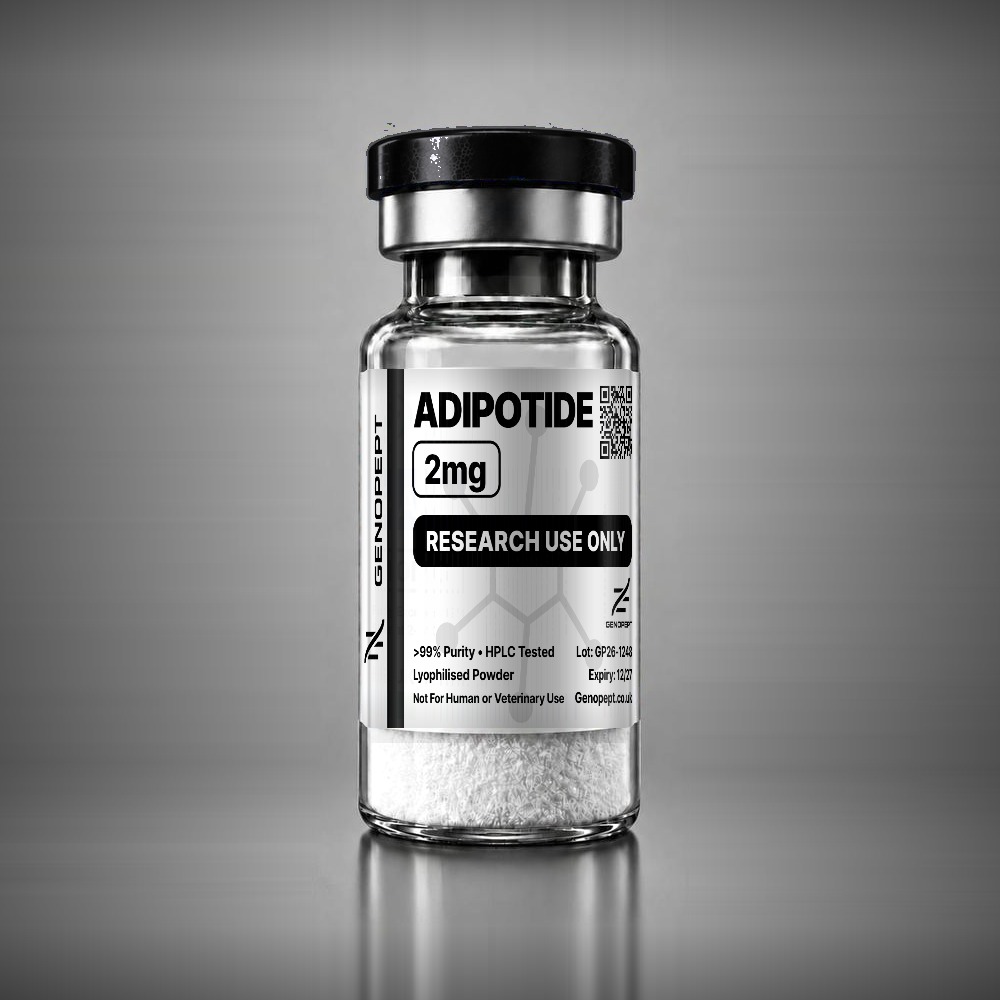
GenoPept supplies Adipotide in the UK in 2mg, 5mg and 10mg lyophilised vials, each batch verified at ≥99% purity with a Certificate of Analysis, strictly for in-vitro laboratory research.
Adipotide (FTPP) research applications
Adipotide is studied as a tool compound for vascular targeting and adipose biology. The research areas below describe preclinical and cell-based work and do not describe any use in people.
Adipose vascular targeting
The defining application is investigation of how a homing peptide can selectively direct a payload to prohibitin-expressing endothelium in white fat, a concept borrowed from tumour vascular-targeting research.
Preclinical obesity and metabolic models
Rodent and non-human primate studies investigated Adipotide for effects on fat mass, food intake and insulin sensitivity, with reported changes attributed to loss of adipose blood supply rather than direct action on adipocytes.
Prohibitin and annexin A2 biology
Adipotide is used to probe the role of the prohibitin and ANXA2 complex on endothelial cells, which is also of interest in cancer and vascular biology.
Pro-apoptotic peptide design
The D(KLAKLAK)2 domain is a well-characterised membrane-disrupting motif, and Adipotide serves as a model for chimeric peptide design in ligand-directed therapeutics research.
Renal safety and dose-response research
Preclinical literature noted reversible renal effects in animal models, and the compound is therefore also studied in the context of off-target toxicity of vascular-targeting agents.
Mechanism of action (preclinical)
Adipotide acts through two linked components. The cyclic CKGGRAKDC motif binds a prohibitin and annexin A2 receptor complex that is enriched on the luminal surface of endothelial cells in white adipose tissue. Binding internalises the peptide into these cells.
Once inside, the amphipathic D(KLAKLAK)2 domain disrupts mitochondrial membranes, initiating apoptosis of the targeted endothelial cells. Loss of the supporting vasculature is reported to lead to ablation of the fat tissue that depended on it. Because the pro-apoptotic domain is built from D-amino acids it resists proteolysis, which extends its activity in biological media.
Adipotide (FTPP) product specifications
| Specification | Detail |
|---|---|
| Compound | Adipotide (FTPP) |
| Also known as | FTPP, Prohibitin-TP01, Prohibitin-targeting peptide 1, TP01, Fat-targeted proapoptotic peptide |
| Sequence / class | Synthetic chimeric peptidomimetic: CKGGRAKDC-GG-D(KLAKLAK)2 (adipose vascular homing motif linked to a D-amino-acid pro-apoptotic domain) |
| CAS number | 859216-15-2 |
| Molecular formula | C111H206N36O28S2 |
| Form | Lyophilised (freeze-dried) powder in a sealed sterile glass vial, black cap, lot and expiry on label |
| Available sizes | 2mg, 5mg, 10mg |
| Purity | ≥99% (HPLC) |
| Verification | Batch HPLC purity and LC-MS identity testing by an independent ISO/IEC 17025 laboratory (Puralytix), with Certificate of Analysis |
| Storage (unopened) | −20 °C long term; 2–8 °C short term; protect from light |
| Intended use | In-vitro laboratory research only. Not for human or veterinary use |
Available sizes
Adipotide is available from GenoPept in the following vial sizes:
- Adipotide 2mg vial
- Adipotide 5mg vial
- Adipotide 10mg vial
Laboratories that need larger quantities can order Adipotide in bulk boxes of 10 vials, which save 20–50% against single-vial pricing. Retail baskets also receive automatic discounts at £300, £500 and £1,000, and delivery is free on UK orders of £200 or more.
Reconstitution, handling and storage (laboratory)
Unopened Adipotide vials should be stored at −20 °C for long-term storage, or at 2–8 °C for short periods, and protected from light. Allow the vial to reach room temperature before opening to avoid condensation on the lyophilised cake.
To reconstitute for in-vitro work, add bacteriostatic water or another sterile diluent slowly down the inside wall of the vial, then swirl gently until the powder dissolves. Do not shake. Adipotide contains a disulphide-cyclised homing motif, so avoid reducing agents in the diluent unless the protocol calls for them. Reconstituted solution should be kept at 2–8 °C and used within the period specified in the laboratory’s own protocol. See our guides on how to reconstitute research peptides and how to store research peptides for step-by-step handling notes.
Quality assurance and Certificate of Analysis
Every batch of Adipotide sold by GenoPept is tested by an independent third-party laboratory (Puralytix, ISO/IEC 17025 accredited) using HPLC for purity and LC-MS for identity confirmation. Results are published in a batch-specific Certificate of Analysis (COA), and each vial is labelled with its lot number and expiry date so the paperwork can be matched to the product on the bench.
Use the “View Certificate of Analysis” button on this page to open the current Adipotide COA, or browse the full COA library. Our article on what a Certificate of Analysis shows explains how to read the chromatogram and mass spectrum.
Related research compounds
- AOD-9604: a growth-hormone fragment studied in lipid-metabolism models, for a non-vascular comparison.
- HGH Fragment 176-191: the C-terminal GH fragment investigated for lipolytic signalling in adipocytes.
- 5-Amino-1MQ: an NNMT inhibitor studied in adipocyte energy metabolism.
- SLU-PP-332: an ERR agonist used in exercise-mimetic and metabolic research.
Adipotide (FTPP) frequently asked questions
What is Adipotide used for in research?
Adipotide is used in preclinical research on vascular targeting of white adipose tissue. It couples a prohibitin-binding homing motif to a pro-apoptotic domain, so laboratories use it to study ligand-directed delivery, endothelial apoptosis and the metabolic consequences of reduced adipose blood supply in animal and cell models. It is supplied for in-vitro laboratory research only.
How is Adipotide supplied and what purity is it?
GenoPept supplies Adipotide (FTPP) as a lyophilised powder in sealed sterile glass vials of 2mg, 5mg and 10mg. Each batch is tested at ≥99% purity by HPLC and identity-confirmed by LC-MS at an independent ISO/IEC 17025 laboratory. The batch Certificate of Analysis can be opened from this page or the UK COA library.
How should Adipotide be stored?
Store unopened Adipotide vials at −20 °C long term, or 2–8 °C for short periods, protected from light. Once reconstituted with bacteriostatic water or sterile diluent, keep the solution refrigerated at 2–8 °C and use it within the timeframe defined by your laboratory protocol, avoiding repeated freeze-thaw.
Is Adipotide for human use?
No. Adipotide sold here is a research peptide for in-vitro laboratory use only. It is not a medicine, has no approved indication anywhere, and is not for human or veterinary use, diagnosis or therapy. Its clinical development was discontinued, and this page provides no usage or dosing guidance for people.
How does Adipotide differ from AOD-9604 or HGH Fragment 176-191?
Adipotide does not act on fat cells directly; it targets the blood vessels that supply white adipose tissue and induces apoptosis in that endothelium. AOD-9604 and HGH Fragment 176-191 are growth-hormone-derived fragments studied for effects on lipid metabolism within adipocytes. The mechanisms, safety profiles and research questions are therefore very different.
Research use only. Adipotide is supplied by GenoPept strictly for in-vitro laboratory research. It is not a medicine, is not for human or veterinary use, and is not intended for diagnostic or therapeutic purposes. Read our research use only policy and UK legal guide before ordering.

Reviews
There are no reviews yet.