
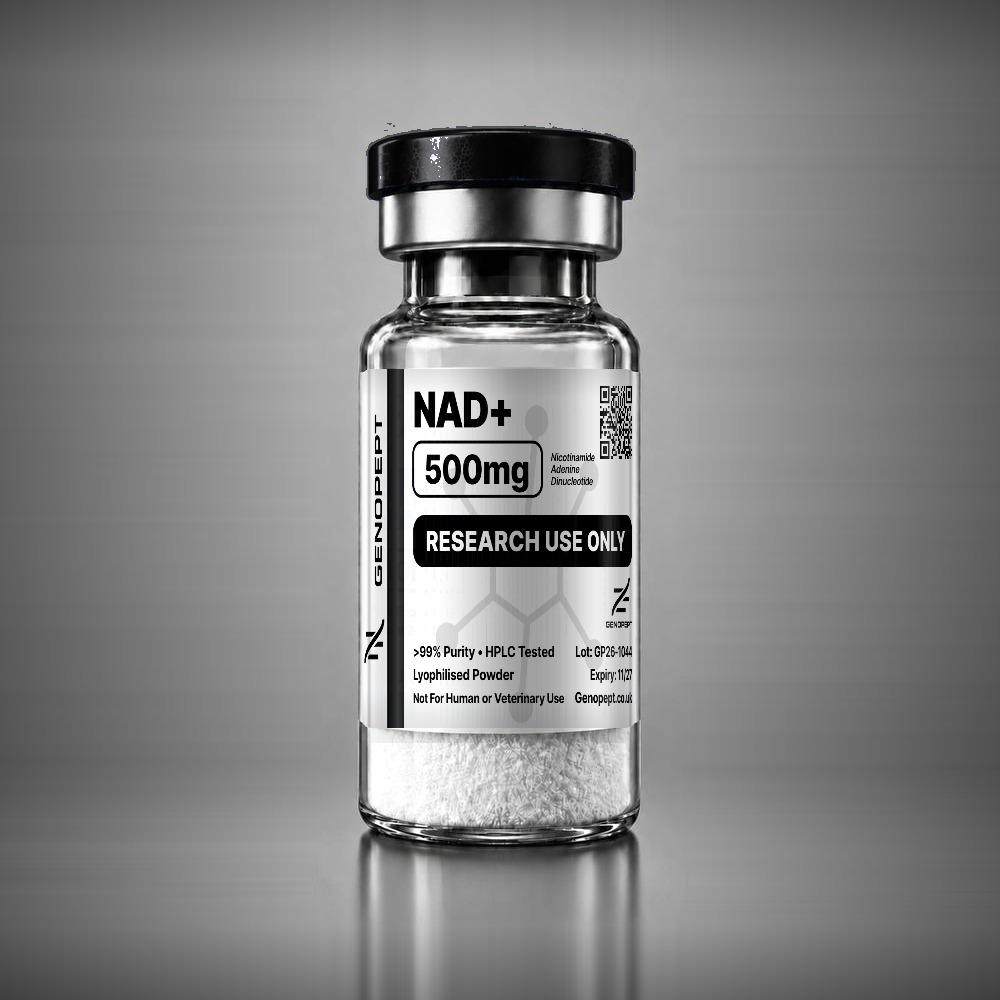
What is NAD+ (Nicotinamide Adenine Dinucleotide)?
NAD+ (nicotinamide adenine dinucleotide) is a dinucleotide coenzyme found in every living cell, made of an adenine nucleotide and a nicotinamide nucleotide joined by a pyrophosphate bridge. It is not a peptide. In its oxidised form (NAD+) it accepts electrons to become NADH, and this redox cycle drives glycolysis, the citric acid cycle and mitochondrial oxidative phosphorylation.
Beyond redox chemistry, NAD+ is consumed as a substrate by sirtuin deacetylases (SIRT1-7), poly(ADP-ribose) polymerases (PARPs) and the glycohydrolase CD38. Because tissue NAD+ levels are reported to decline with age in animal models and human cohort data, the coenzyme has become a focus of longevity, metabolic and neurodegeneration research.
GenoPept supplies research-grade NAD+ in the UK as a lyophilised powder in 100mg, 250mg, 500mg and 1000mg vials, verified at ≥99% purity by an independent laboratory and sold strictly for in-vitro laboratory research.
NAD+ (Nicotinamide Adenine Dinucleotide) research applications
NAD+ is used as a reagent, standard and experimental variable across biochemistry and ageing research. The areas below reflect published cell-culture, enzymatic and animal work, not claims about people.
Enzyme assays and redox biochemistry
NAD+ is the cofactor for hundreds of dehydrogenases, and research-grade NAD+ is used as a substrate in lactate dehydrogenase, alcohol dehydrogenase and glucose-6-phosphate dehydrogenase assays, with NADH absorbance at 340 nm as the readout.
Sirtuin and PARP signalling
Cell-culture studies vary NAD+ availability to investigate SIRT1 and SIRT3 activity, mitochondrial biogenesis via PGC-1α, and PARP-dependent DNA repair.
Ageing and NAD+ decline models
Rodent and invertebrate models are used to examine whether restoring NAD+ (via NAD+ itself or precursors) influences markers of mitochondrial function, muscle performance and healthspan.
Mitochondrial dysfunction and neurodegeneration
Preclinical models of neurodegeneration, hearing loss and axonal degeneration (involving SARM1 and NMNAT enzymes) use NAD+ to study axon survival and energy metabolism.
Metabolic disease models
NAD+ metabolism is investigated in models of obesity, fatty liver and insulin resistance, where NAMPT-dependent salvage pathways are altered.
Mechanism of action (preclinical)
NAD+ operates in two modes. As a redox coenzyme it accepts a hydride ion from substrates in catabolic reactions to form NADH, which then donates electrons to complex I of the mitochondrial electron transport chain, supporting ATP synthesis. The NAD+/NADH ratio is a key indicator of cellular redox state.
As a signalling substrate, NAD+ is cleaved by sirtuins to remove acetyl groups from histones and metabolic enzymes, by PARPs to build poly(ADP-ribose) chains at DNA damage sites, and by CD38 to generate cyclic ADP-ribose for calcium signalling. These consuming enzymes compete for the same pool, so NAD+ availability links energy status to gene regulation, DNA repair and inflammation in the models studied.
NAD+ (Nicotinamide Adenine Dinucleotide) product specifications
| Specification | Detail |
|---|---|
| Compound | NAD+ (Nicotinamide Adenine Dinucleotide) |
| Also known as | Nicotinamide adenine dinucleotide, beta-NAD, Coenzyme I, Diphosphopyridine nucleotide (DPN), NAD |
| Sequence / class | Dinucleotide coenzyme (adenine nucleotide linked to nicotinamide nucleotide through a pyrophosphate bridge); not a peptide |
| CAS number | 53-84-9 |
| Molecular formula | C21H27N7O14P2 |
| Molecular weight | 663.4 g/mol |
| Form | Lyophilised (freeze-dried) powder in a sealed sterile glass vial, black cap, lot and expiry on label |
| Available sizes | 100mg, 250mg, 500mg, 1000mg |
| Purity | ≥99% (HPLC) |
| Verification | Batch HPLC purity and LC-MS identity testing by an independent ISO/IEC 17025 laboratory (Puralytix), with Certificate of Analysis |
| Storage (unopened) | −20 °C long term; 2–8 °C short term; protect from light |
| Intended use | In-vitro laboratory research only. Not for human or veterinary use |
Available sizes
NAD+ is available from GenoPept in the following vial sizes:
- NAD+ 100mg vial
- NAD+ 250mg vial
- NAD+ 500mg vial
- NAD+ 1000mg vial
Laboratories that need larger quantities can order NAD+ in bulk boxes of 10 vials, which save 20–50% against single-vial pricing. Retail baskets also receive automatic discounts at £300, £500 and £1,000, and delivery is free on UK orders of £200 or more.
Reconstitution, handling and storage (laboratory)
Unopened NAD+ vials should be stored at −20 °C for long-term storage, or at 2–8 °C for short periods, and protected from light. Allow the vial to reach room temperature before opening to avoid condensation on the lyophilised cake.
To reconstitute for in-vitro work, add bacteriostatic water or another sterile diluent slowly down the inside wall of the vial, then swirl gently until the powder dissolves. Do not shake. NAD+ is water-soluble but degrades in alkaline or warm solutions, so prepare working solutions fresh in cold, neutral or slightly acidic buffer. Reconstituted solution should be kept at 2–8 °C and used within the period specified in the laboratory’s own protocol. See our guides on how to reconstitute research peptides and how to store research peptides for step-by-step handling notes.
Quality assurance and Certificate of Analysis
Every batch of NAD+ sold by GenoPept is tested by an independent third-party laboratory (Puralytix, ISO/IEC 17025 accredited) using HPLC for purity and LC-MS for identity confirmation. Results are published in a batch-specific Certificate of Analysis (COA), and each vial is labelled with its lot number and expiry date so the paperwork can be matched to the product on the bench.
Use the “View Certificate of Analysis” button on this page to open the current NAD+ COA, or browse the full COA library. Our article on what a Certificate of Analysis shows explains how to read the chromatogram and mass spectrum.
Related research compounds
- MOTS-c: a mitochondrial-derived peptide that acts on AMPK, a pathway closely coupled to NAD+ metabolism.
- SS-31 (Elamipretide): a cardiolipin-binding peptide studied in mitochondrial electron-transport research.
- Epitalon (Epithalon): a tetrapeptide investigated in telomerase and ageing models.
- Glutathione: the major cellular thiol antioxidant, often studied alongside NAD+ in redox research.
NAD+ (Nicotinamide Adenine Dinucleotide) frequently asked questions
What is NAD+ used for in research?
NAD+ is used as a coenzyme substrate in dehydrogenase enzyme assays and as an experimental variable in research on sirtuins, PARP-mediated DNA repair, mitochondrial function and ageing. Laboratories study it in cell-culture and animal models of metabolic disease and neurodegeneration. It is supplied in the UK strictly for in-vitro laboratory research.
How is NAD+ supplied and what purity is it?
GenoPept supplies NAD+ as a lyophilised powder in sealed sterile glass vials of 100mg, 250mg, 500mg and 1000mg. Each batch is analysed at ≥99% purity by HPLC and identity-confirmed by LC-MS at an independent ISO/IEC 17025 laboratory, with a batch Certificate of Analysis available from this page or the COA library.
How should NAD+ be stored?
Store unopened NAD+ vials at −20 °C for long-term storage, or at 2–8 °C for short periods, protected from light and moisture. NAD+ is unstable in alkaline or warm solution, so prepare working solutions fresh in cold neutral buffer, keep them at 2–8 °C and use within the period defined by your laboratory protocol.
Is NAD+ for human use?
No. NAD+ sold here is a research-grade reagent for in-vitro laboratory use only. It is not a medicine, not a food supplement and not for human or veterinary use, infusion, diagnosis or therapy. This page summarises published biochemistry and preclinical research and gives no usage guidance for people.
What is the difference between NAD+ and NADH, and between NAD+ and its precursors?
NAD+ is the oxidised form of the coenzyme and NADH is the reduced form; they interconvert as electrons move through metabolism. Precursors such as nicotinamide riboside and nicotinamide mononucleotide are smaller molecules that cells convert into NAD+ through salvage pathways. Research-grade NAD+ is the complete dinucleotide, used directly in enzyme assays and cell-culture experiments.
Research use only. NAD+ is supplied by GenoPept strictly for in-vitro laboratory research. It is not a medicine, is not for human or veterinary use, and is not intended for diagnostic or therapeutic purposes. Read our research use only policy and UK legal guide before ordering.
Research guides: NAD+ Research Guide · SS-31 (Elamipretide) Research Guide
Reviews
There are no reviews yet.