
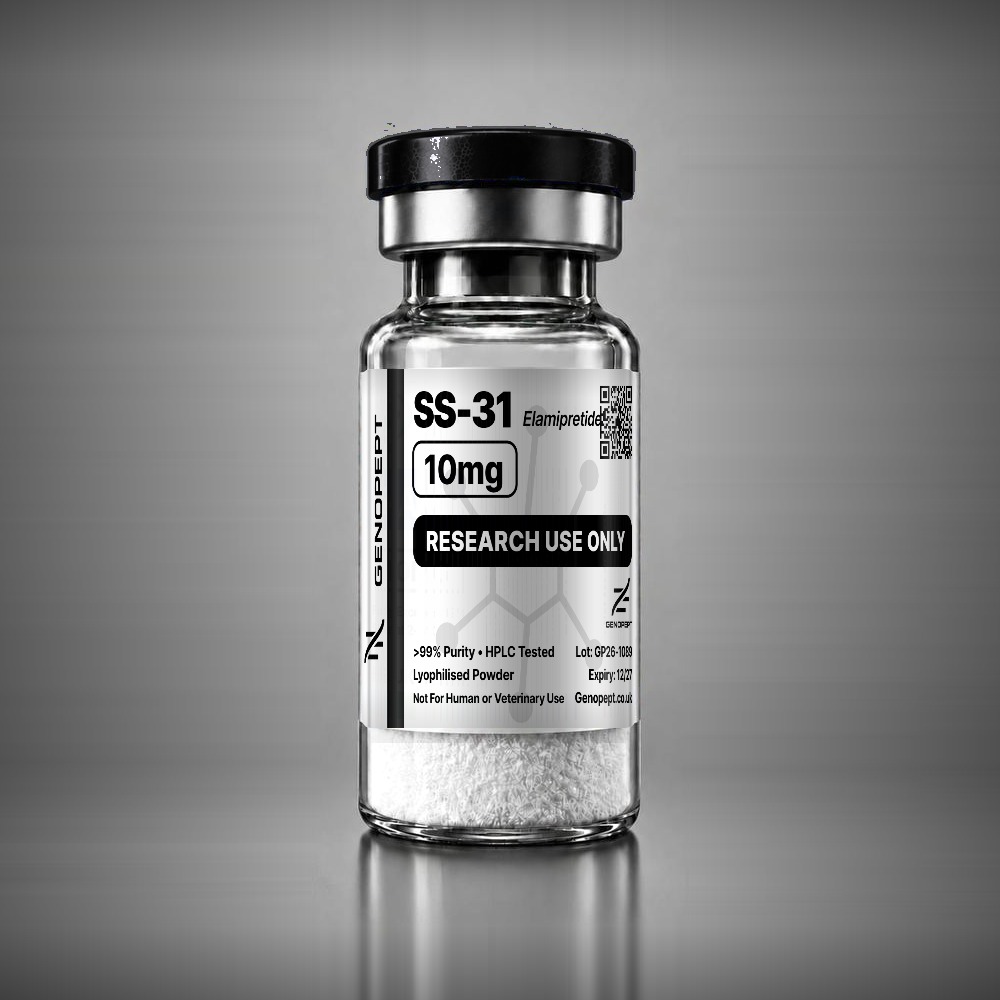
What is SS-31 (Elamipretide)?
SS-31 (elamipretide, MTP-131) is a synthetic tetrapeptide with the sequence D-Arg-Dmt-Lys-Phe-NH2, where Dmt is 2′,6′-dimethyltyrosine. It belongs to the Szeto-Schiller family of aromatic-cationic peptides, which alternate basic and aromatic residues so that they cross cell membranes and accumulate more than a thousand-fold in the inner mitochondrial membrane.
The peptide’s defining feature is selective binding to cardiolipin, the signature phospholipid of the inner mitochondrial membrane. Through this interaction SS-31 is reported to stabilise cristae structure, improve electron-transport efficiency and reduce reactive oxygen species in preclinical models. It has also been investigated in published clinical literature on the compound in primary mitochondrial myopathy, Barth syndrome and heart failure.
GenoPept supplies SS-31 in the UK as a lyophilised research peptide in 10mg and 50mg vials, each batch verified at ≥99% purity with a Certificate of Analysis, strictly for in-vitro laboratory research.
SS-31 (Elamipretide) research applications
SS-31 is one of the most cited mitochondria-targeted peptides. The research areas below summarise preclinical and cell-culture work and are not claims about effects in people.
Mitochondrial bioenergetics
Isolated mitochondria and cultured cells are used to study how SS-31 affects ATP production, membrane potential and oxygen consumption, particularly under conditions of cardiolipin peroxidation.
Ischaemia-reperfusion injury models
Cardiac, renal and cerebral ischaemia-reperfusion models in rodents have investigated SS-31 for its reported reduction of mitochondrial permeability transition and oxidative damage.
Ageing skeletal muscle
Aged-mouse studies examine whether SS-31 restores mitochondrial function and reduces redox stress in muscle fibres, a line of work relevant to sarcopenia research.
Heart failure and cardiomyopathy models
Preclinical models of pressure overload, mitochondrial cardiomyopathy and Barth syndrome use SS-31 to probe the link between cardiolipin integrity and cardiac energetics.
Neurodegeneration and retinal models
SS-31 is studied in models of Alzheimer’s-type pathology, Parkinson’s disease and retinal degeneration where mitochondrial dysfunction is an early event.
Mechanism of action (preclinical)
SS-31 partitions into the inner mitochondrial membrane and binds cardiolipin through electrostatic and hydrophobic interactions. Cardiolipin anchors cytochrome c and organises the respiratory supercomplexes; when it is peroxidised, cytochrome c switches from electron carrier to peroxidase and cristae architecture collapses. SS-31 is reported to protect cardiolipin from this oxidation and to preserve the cytochrome c electron-shuttle function.
The result in preclinical models is more efficient electron transport, lower electron leakage and reduced reactive oxygen species generation, without the peptide acting as a classical antioxidant scavenger. Downstream, this is associated with reduced opening of the mitochondrial permeability transition pore and less apoptotic signalling under stress.
SS-31 (Elamipretide) product specifications
| Specification | Detail |
|---|---|
| Compound | SS-31 (Elamipretide) |
| Also known as | Elamipretide, MTP-131, Szeto-Schiller peptide 31, SS-31 peptide, D-Arg-Dmt-Lys-Phe-NH2 |
| Sequence / class | Synthetic aromatic-cationic tetrapeptide: D-Arg-2′,6′-dimethyltyrosine-Lys-Phe-NH2 (Szeto-Schiller peptide) |
| CAS number | 736992-21-5 |
| Molecular formula | C32H49N9O5 |
| Molecular weight | 639.8 g/mol |
| Form | Lyophilised (freeze-dried) powder in a sealed sterile glass vial, black cap, lot and expiry on label |
| Available sizes | 10mg, 50mg |
| Purity | ≥99% (HPLC) |
| Verification | Batch HPLC purity and LC-MS identity testing by an independent ISO/IEC 17025 laboratory (Puralytix), with Certificate of Analysis |
| Storage (unopened) | −20 °C long term; 2–8 °C short term; protect from light |
| Intended use | In-vitro laboratory research only. Not for human or veterinary use |
Available sizes
SS-31 is available from GenoPept in the following vial sizes:
- SS-31 10mg vial
- SS-31 50mg vial
Laboratories that need larger quantities can order SS-31 in bulk boxes of 10 vials, which save 20–50% against single-vial pricing. Retail baskets also receive automatic discounts at £300, £500 and £1,000, and delivery is free on UK orders of £200 or more.
Reconstitution, handling and storage (laboratory)
Unopened SS-31 vials should be stored at −20 °C for long-term storage, or at 2–8 °C for short periods, and protected from light. Allow the vial to reach room temperature before opening to avoid condensation on the lyophilised cake.
To reconstitute for in-vitro work, add bacteriostatic water or another sterile diluent slowly down the inside wall of the vial, then swirl gently until the powder dissolves. Do not shake. As a small, stable tetrapeptide SS-31 dissolves readily and tolerates standard aqueous buffers. Reconstituted solution should be kept at 2–8 °C and used within the period specified in the laboratory’s own protocol. See our guides on how to reconstitute research peptides and how to store research peptides for step-by-step handling notes.
Quality assurance and Certificate of Analysis
Every batch of SS-31 sold by GenoPept is tested by an independent third-party laboratory (Puralytix, ISO/IEC 17025 accredited) using HPLC for purity and LC-MS for identity confirmation. Results are published in a batch-specific Certificate of Analysis (COA), and each vial is labelled with its lot number and expiry date so the paperwork can be matched to the product on the bench.
Use the “View Certificate of Analysis” button on this page to open the current SS-31 COA, or browse the full COA library. Our article on what a Certificate of Analysis shows explains how to read the chromatogram and mass spectrum.
Related research compounds
- MOTS-c: a mitochondrial-derived peptide studied for AMPK-linked metabolic signalling.
- Humanin: a cytoprotective mitochondrial-derived peptide investigated in ageing models.
- NAD+: the redox coenzyme central to the electron-transport chain that SS-31 research examines.
- FOXO4-DRI: a senolytic peptide for laboratories working on complementary ageing mechanisms.
SS-31 (Elamipretide) frequently asked questions
What is SS-31 used for in research?
SS-31 (elamipretide) is used in research on mitochondrial dysfunction. It binds cardiolipin in the inner mitochondrial membrane, so laboratories use it to study bioenergetics, reactive oxygen species, ischaemia-reperfusion injury, heart failure, ageing muscle and neurodegeneration in cell-culture and animal models. It is supplied in the UK strictly for in-vitro laboratory research.
How is SS-31 supplied and what purity is it?
GenoPept supplies SS-31 as a lyophilised powder in sealed sterile glass vials of 10mg and 50mg. Each batch is tested at ≥99% purity by HPLC and identity-confirmed by LC-MS at an independent ISO/IEC 17025 laboratory. The batch Certificate of Analysis is available from the button on this page or from the UK COA library.
How should SS-31 be stored?
Store unopened SS-31 vials at −20 °C for long-term storage, or 2–8 °C for short periods, protected from light. After reconstitution with bacteriostatic water or sterile diluent, keep the solution at 2–8 °C and use within the period stated in your laboratory protocol. As a small stable tetrapeptide it tolerates standard aqueous buffers well.
Is SS-31 for human use?
No. SS-31 sold here is for in-vitro laboratory research only. It is not a medicine and is not for human or veterinary use, diagnosis or therapy. Although elamipretide has been studied in clinical trials by its developer, the research-grade peptide sold here is not a licensed product and this page provides no dosing or usage guidance for people.
Is SS-31 an antioxidant?
Not in the classical sense. SS-31 does not primarily scavenge free radicals; it binds cardiolipin and protects the structure and function of the electron-transport chain so that fewer reactive oxygen species are produced in the first place. This distinguishes it from scavengers such as glutathione or vitamin E, and is why researchers describe it as a mitochondria-targeted rather than an antioxidant peptide.
Research use only. SS-31 is supplied by GenoPept strictly for in-vitro laboratory research. It is not a medicine, is not for human or veterinary use, and is not intended for diagnostic or therapeutic purposes. Read our research use only policy and UK legal guide before ordering.
Research guides: MOTS-c Research Guide · NAD+ Research Guide · SS-31 (Elamipretide) Research Guide
Reviews
There are no reviews yet.