
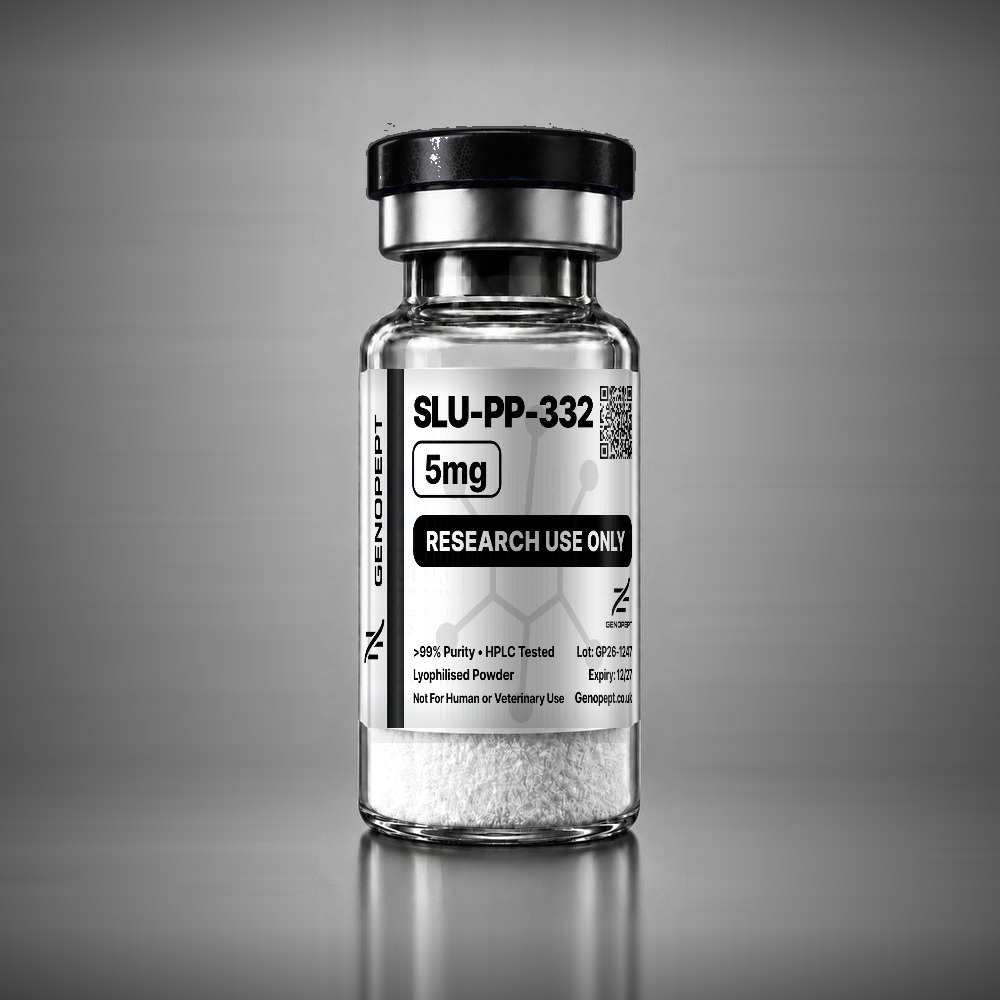
What is SLU-PP-332 5mg?
SLU-PP-332 is a synthetic small molecule (C18H14N2O2, 290.3 g/mol) that acts as a pan-agonist of the estrogen-related receptors, with its strongest activity at ERRα and additional activity at ERRβ and ERRγ. It is not a peptide. The compound was developed by researchers at Saint Louis University, which is the origin of its name.
Estrogen-related receptors are orphan nuclear receptors that, despite their name, do not bind oestrogen. Together with the coactivator PGC-1α they control the transcriptional programme for mitochondrial biogenesis and oxidative metabolism that skeletal muscle switches on after endurance exercise. SLU-PP-332 has been investigated in mice as a pharmacological way to trigger that programme, which is why published research describes it as an exercise mimetic.
GenoPept supplies SLU-PP-332 in the UK as a lyophilised research compound in a 5mg vial, verified at ≥99% purity by an independent laboratory and sold strictly for in-vitro laboratory research.
SLU-PP-332 5mg research applications
SLU-PP-332 is a relatively new tool compound, and the research below reflects published preclinical and cell-based work rather than any established use in people.
Exercise-mimetic and endurance models
Mouse studies reported that SLU-PP-332 increased the proportion of oxidative muscle fibres and running endurance in the absence of training, driven by ERRα-dependent gene expression.
Obesity and metabolic syndrome models
Diet-induced obese mice are used to investigate SLU-PP-332 for effects on energy expenditure, fat mass and glucose tolerance without changes in food intake.
ERR transcriptional biology
Cell-based reporter assays and transcriptomic studies use SLU-PP-332 to map ERR target genes and their interaction with PGC-1α in muscle, heart and liver cells.
Cardiac energetics
Because ERR signalling governs cardiac mitochondrial function, the compound is studied in models of heart failure and cardiac metabolic remodelling.
Neuroprotection and ageing
Emerging preclinical work explores ERR agonism in models of neurodegeneration and age-related mitochondrial decline.
Mechanism of action (preclinical)
SLU-PP-332 binds the ligand-binding domain of ERRα, ERRβ and ERRγ and stabilises the active conformation that recruits coactivators such as PGC-1α. The receptor-coactivator complex then drives transcription of genes for mitochondrial biogenesis, fatty-acid oxidation, oxidative phosphorylation and the slow-twitch muscle-fibre programme.
In mice this is reported to reproduce many transcriptional features of acute aerobic exercise and, with repeated dosing in the study design, to raise whole-body oxygen consumption and fatty-acid utilisation. The mechanism is receptor-dependent: effects were absent in ERRα-knockout models. All of this derives from preclinical research and the compound has not been evaluated in humans.
SLU-PP-332 5mg product specifications
| Specification | Detail |
|---|---|
| Compound | SLU-PP-332 5mg |
| Also known as | SLU-PP-332, ERR pan-agonist SLU-PP-332, Estrogen-related receptor agonist |
| Sequence / class | Small-molecule synthetic agonist of estrogen-related receptors ERR alpha, beta and gamma (not a peptide) |
| CAS number | 303760-60-3 |
| Molecular formula | C18H14N2O2 |
| Molecular weight | 290.3 g/mol |
| Form | Lyophilised (freeze-dried) powder in a sealed sterile glass vial, black cap, lot and expiry on label |
| Available sizes | 5mg |
| Purity | ≥99% (HPLC) |
| Verification | Batch HPLC purity and LC-MS identity testing by an independent ISO/IEC 17025 laboratory (Puralytix), with Certificate of Analysis |
| Storage (unopened) | −20 °C long term; 2–8 °C short term; protect from light |
| Intended use | In-vitro laboratory research only. Not for human or veterinary use |
Available sizes
SLU-PP-332 is available from GenoPept in the following vial sizes:
- SLU-PP-332 5mg vial
Laboratories that need larger quantities can order SLU-PP-332 in bulk boxes of 10 vials, which save 20–50% against single-vial pricing. Retail baskets also receive automatic discounts at £300, £500 and £1,000, and delivery is free on UK orders of £200 or more.
Reconstitution, handling and storage (laboratory)
Unopened SLU-PP-332 vials should be stored at −20 °C for long-term storage, or at 2–8 °C for short periods, and protected from light. Allow the vial to reach room temperature before opening to avoid condensation on the lyophilised cake.
To reconstitute for in-vitro work, add bacteriostatic water or another sterile diluent slowly down the inside wall of the vial, then swirl gently until the powder dissolves. Do not shake. SLU-PP-332 is a lipophilic small molecule; DMSO stock solutions diluted into aqueous buffer are typical in cell-culture protocols. Reconstituted solution should be kept at 2–8 °C and used within the period specified in the laboratory’s own protocol. See our guides on how to reconstitute research peptides and how to store research peptides for step-by-step handling notes.
Quality assurance and Certificate of Analysis
Every batch of SLU-PP-332 sold by GenoPept is tested by an independent third-party laboratory (Puralytix, ISO/IEC 17025 accredited) using HPLC for purity and LC-MS for identity confirmation. Results are published in a batch-specific Certificate of Analysis (COA), and each vial is labelled with its lot number and expiry date so the paperwork can be matched to the product on the bench.
Use the “View Certificate of Analysis” button on this page to open the current SLU-PP-332 COA, or browse the full COA library. Our article on what a Certificate of Analysis shows explains how to read the chromatogram and mass spectrum.
Related research compounds
- AICAR (Acadesine): the AMPK-activating exercise mimetic often studied in parallel with ERR agonists.
- MOTS-c: a mitochondrial-derived peptide investigated for exercise-like metabolic effects.
- 5-Amino-1MQ: an NNMT inhibitor used in adipocyte and energy-metabolism research.
- NAD+: the coenzyme whose metabolism sits downstream of the mitochondrial programme ERR controls.
SLU-PP-332 5mg frequently asked questions
What is SLU-PP-332 used for in research?
SLU-PP-332 is used as a pan-agonist of estrogen-related receptors (ERR alpha, beta and gamma) in exercise-physiology and metabolic research. Laboratories use it in cell-based reporter assays and mouse models to study mitochondrial biogenesis, oxidative muscle-fibre programmes, energy expenditure and obesity. It is supplied in the UK strictly for in-vitro laboratory research.
How is SLU-PP-332 supplied and what purity is it?
GenoPept supplies SLU-PP-332 as a lyophilised powder in a sealed sterile glass 5mg vial. Each batch is tested at ≥99% purity by HPLC and identity-confirmed by LC-MS at an independent ISO/IEC 17025 laboratory. The batch-specific Certificate of Analysis can be opened from the button on this page or in the UK COA library.
How should SLU-PP-332 be stored?
Store unopened SLU-PP-332 vials at −20 °C for long-term storage, or 2–8 °C for short periods, protected from light. For cell-culture work prepare a DMSO stock and dilute into buffer or medium as your protocol specifies. Keep working solutions at 2–8 °C and use within the period your laboratory defines.
Is SLU-PP-332 for human use?
No. SLU-PP-332 sold here is a research compound for in-vitro laboratory use only. It is not a medicine, has never been evaluated in humans, and is not for human or veterinary use, diagnosis or therapy. This page summarises published preclinical research and gives no dosing or usage guidance for people.
How does SLU-PP-332 differ from AICAR as an exercise mimetic?
Both are studied as exercise mimetics, but they act at different points. AICAR activates the energy sensor AMPK through its metabolite ZMP, an acute signalling event. SLU-PP-332 activates estrogen-related receptors, nuclear transcription factors that switch on the longer-term gene programme for mitochondrial biogenesis and oxidative fibres. Researchers often compare the two to separate acute kinase signalling from transcriptional adaptation.
Research use only. SLU-PP-332 is supplied by GenoPept strictly for in-vitro laboratory research. It is not a medicine, is not for human or veterinary use, and is not intended for diagnostic or therapeutic purposes. Read our research use only policy and UK legal guide before ordering.
Reviews
There are no reviews yet.