
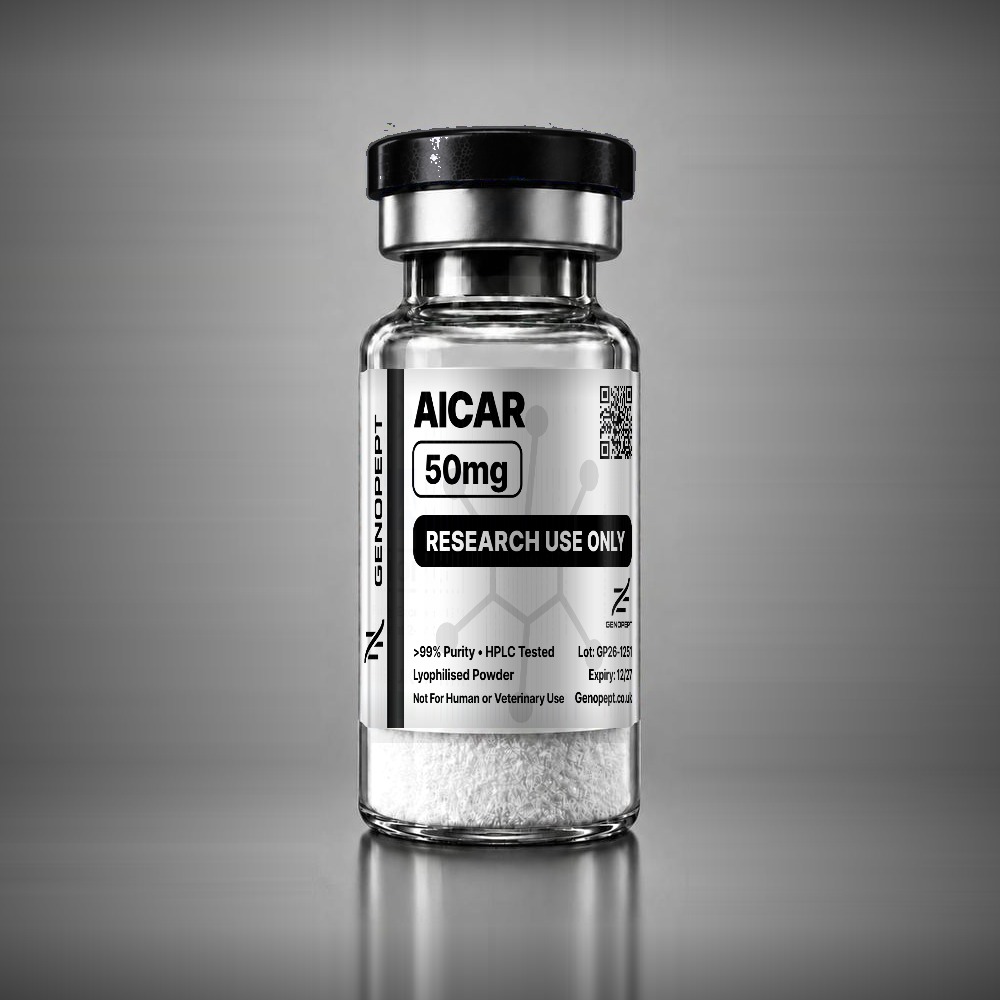
What is AICAR (Acadesine)?
AICAR (acadesine) is a synthetic, cell-permeable nucleoside analogue of adenosine, chemically 5-aminoimidazole-4-carboxamide-1-β-D-ribofuranoside, that acts as an activator of AMP-activated protein kinase (AMPK). It is not a peptide but a small molecule (C9H14N4O5, 258.2 g/mol) and is one of the most widely cited pharmacological tools for switching on AMPK signalling in cell-culture and animal models.
Inside cells AICAR is phosphorylated to ZMP, an AMP mimetic that binds the regulatory subunit of AMPK and drives the same energy-sensing response that follows exercise or nutrient restriction. AICAR has been described in published research as an exercise mimetic and appears in thousands of papers on glucose uptake, fatty-acid oxidation and mitochondrial biogenesis.
GenoPept supplies AICAR in the UK as a lyophilised research compound in 50mg and 100mg vials, verified at ≥99% purity by an independent laboratory. It is sold strictly for in-vitro laboratory research.
AICAR (Acadesine) research applications
AICAR is used across metabolic, muscle and cardiovascular research as a reference AMPK activator. The areas below reflect published preclinical and cell-culture work; none of it is a claim about use in people.
AMPK signalling and energy sensing
AICAR is the standard positive control for AMPK activation in cell-culture experiments. Researchers use it to test whether a downstream response (ACC phosphorylation, GLUT4 translocation, mTOR suppression) depends on AMPK, often alongside the AMPK inhibitor Compound C.
Skeletal muscle and exercise mimetic studies
Animal work has investigated AICAR for its ability to raise oxidative gene expression and running endurance in sedentary mice via AMPK and PGC-1α. This is the origin of the phrase “exercise in a pill”, which describes the research question rather than any outcome in humans.
Glucose metabolism and insulin signalling
Cell and rodent models use AICAR to study AMPK-dependent glucose uptake, hepatic gluconeogenesis and lipid handling in the context of insulin resistance and metabolic syndrome.
Cardiac ischaemia-reperfusion models
Acadesine was originally investigated in clinical literature as a cardioprotective agent during cardiac surgery. Preclinical models continue to explore adenosine-related and AMPK-related protection of heart tissue.
Cancer cell metabolism and autophagy
AICAR is studied in tumour cell lines for its effects on proliferation, mTORC1 signalling and autophagy, including AMPK-independent actions that researchers are still characterising.
Mechanism of action (preclinical)
AICAR enters cells through nucleoside transporters and is converted by adenosine kinase to ZMP (AICA ribotide). ZMP mimics AMP by binding the γ-subunit of AMPK, promoting phosphorylation of Thr172 on the catalytic α-subunit by upstream kinases such as LKB1. Activated AMPK then phosphorylates targets including acetyl-CoA carboxylase (ACC), raptor and TBC1D1, shifting cells from anabolic to catabolic programmes.
In the longer term AMPK activation increases PGC-1α activity and mitochondrial gene expression. AICAR also has AMPK-independent effects, including inhibition of certain enzymes and modulation of adenosine signalling, which researchers control for with genetic AMPK knockouts.
AICAR (Acadesine) product specifications
| Specification | Detail |
|---|---|
| Compound | AICAR (Acadesine) |
| Also known as | Acadesine, AICA riboside, 5-aminoimidazole-4-carboxamide ribonucleoside, AICAR |
| Sequence / class | Small-molecule nucleoside analogue (imidazole ribonucleoside); AMP-activated protein kinase (AMPK) activator |
| CAS number | 2627-69-2 |
| Molecular formula | C9H14N4O5 |
| Molecular weight | 258.2 g/mol |
| Form | Lyophilised (freeze-dried) powder in a sealed sterile glass vial, black cap, lot and expiry on label |
| Available sizes | 50mg, 100mg |
| Purity | ≥99% (HPLC) |
| Verification | Batch HPLC purity and LC-MS identity testing by an independent ISO/IEC 17025 laboratory (Puralytix), with Certificate of Analysis |
| Storage (unopened) | −20 °C long term; 2–8 °C short term; protect from light |
| Intended use | In-vitro laboratory research only. Not for human or veterinary use |
Available sizes
AICAR is available from GenoPept in the following vial sizes:
- AICAR 50mg vial
- AICAR 100mg vial
Laboratories that need larger quantities can order AICAR in bulk boxes of 10 vials, which save 20–50% against single-vial pricing. Retail baskets also receive automatic discounts at £300, £500 and £1,000, and delivery is free on UK orders of £200 or more.
Reconstitution, handling and storage (laboratory)
Unopened AICAR vials should be stored at −20 °C for long-term storage, or at 2–8 °C for short periods, and protected from light. Allow the vial to reach room temperature before opening to avoid condensation on the lyophilised cake.
To reconstitute for in-vitro work, add bacteriostatic water or another sterile diluent slowly down the inside wall of the vial, then swirl gently until the powder dissolves. Do not shake. AICAR is a small molecule and dissolves readily; water or buffer is suitable for most in-vitro applications. Reconstituted solution should be kept at 2–8 °C and used within the period specified in the laboratory’s own protocol. See our guides on how to reconstitute research peptides and how to store research peptides for step-by-step handling notes.
Quality assurance and Certificate of Analysis
Every batch of AICAR sold by GenoPept is tested by an independent third-party laboratory (Puralytix, ISO/IEC 17025 accredited) using HPLC for purity and LC-MS for identity confirmation. Results are published in a batch-specific Certificate of Analysis (COA), and each vial is labelled with its lot number and expiry date so the paperwork can be matched to the product on the bench.
Use the “View Certificate of Analysis” button on this page to open the current AICAR COA, or browse the full COA library. Our article on what a Certificate of Analysis shows explains how to read the chromatogram and mass spectrum.
Related research compounds
- MOTS-c: a mitochondrial-derived peptide that also converges on AMPK signalling in metabolic models.
- SLU-PP-332: an ERR agonist studied as a small-molecule exercise mimetic, often compared with AICAR.
- 5-Amino-1MQ: an NNMT inhibitor used in adipocyte and energy-metabolism research.
- NAD+: the coenzyme at the centre of the energy-sensing pathways AICAR activates.
AICAR (Acadesine) frequently asked questions
What is AICAR used for in research?
AICAR is used as a pharmacological activator of AMP-activated protein kinase (AMPK) in cell-culture and animal research. Laboratories use it to study glucose uptake, fatty-acid oxidation, mitochondrial biogenesis, autophagy and exercise-mimetic responses in skeletal muscle. It is a reference tool compound in metabolic research and is supplied strictly for in-vitro laboratory use.
How is AICAR supplied and what purity is it?
GenoPept supplies AICAR as a lyophilised powder in sealed sterile glass vials of 50mg and 100mg. Every batch is tested at ≥99% purity by HPLC, with identity confirmed by LC-MS at an independent ISO/IEC 17025 laboratory. The batch Certificate of Analysis is available from the button on this page or from the UK COA library.
How should AICAR be stored in the laboratory?
Store unopened AICAR vials at −20 °C for long-term storage, or at 2–8 °C for short periods, protected from light. After reconstitution in water or buffer, keep the solution at 2–8 °C and use it within the period set out in your laboratory’s protocol. Avoid repeated freeze-thaw cycles.
Is AICAR for human use?
No. AICAR sold here is a research compound for in-vitro laboratory research only. It is not a medicine, not a supplement and not for human or veterinary use, diagnosis or therapy. Nothing on this page is dosing or usage guidance for people, and buyers must be purchasing for legitimate research purposes in the UK.
Is AICAR a peptide, and how does it differ from MOTS-c?
AICAR is not a peptide; it is a small-molecule nucleoside analogue that activates AMPK directly through its metabolite ZMP. MOTS-c is a 16-amino-acid mitochondrial-derived peptide that is reported to raise AMPK activity indirectly through folate and methionine metabolism. Both are studied as exercise mimetics, but they enter the pathway at different points and are handled differently on the bench.
Research use only. AICAR is supplied by GenoPept strictly for in-vitro laboratory research. It is not a medicine, is not for human or veterinary use, and is not intended for diagnostic or therapeutic purposes. Read our research use only policy and UK legal guide before ordering.
Research guides: MOTS-c Research Guide
Reviews
There are no reviews yet.