
What is Glutathione (GSH)?
Glutathione (GSH) is an endogenous tripeptide, gamma-L-glutamyl-L-cysteinyl-glycine, present in almost all mammalian cells at millimolar concentrations, where it acts as the principal non-enzymatic antioxidant and thiol buffer. It is not a receptor ligand; its biological role rests on the reactive sulfhydryl group of its cysteine residue, which donates electrons to neutralise reactive oxygen species and conjugates to electrophilic compounds during detoxification.
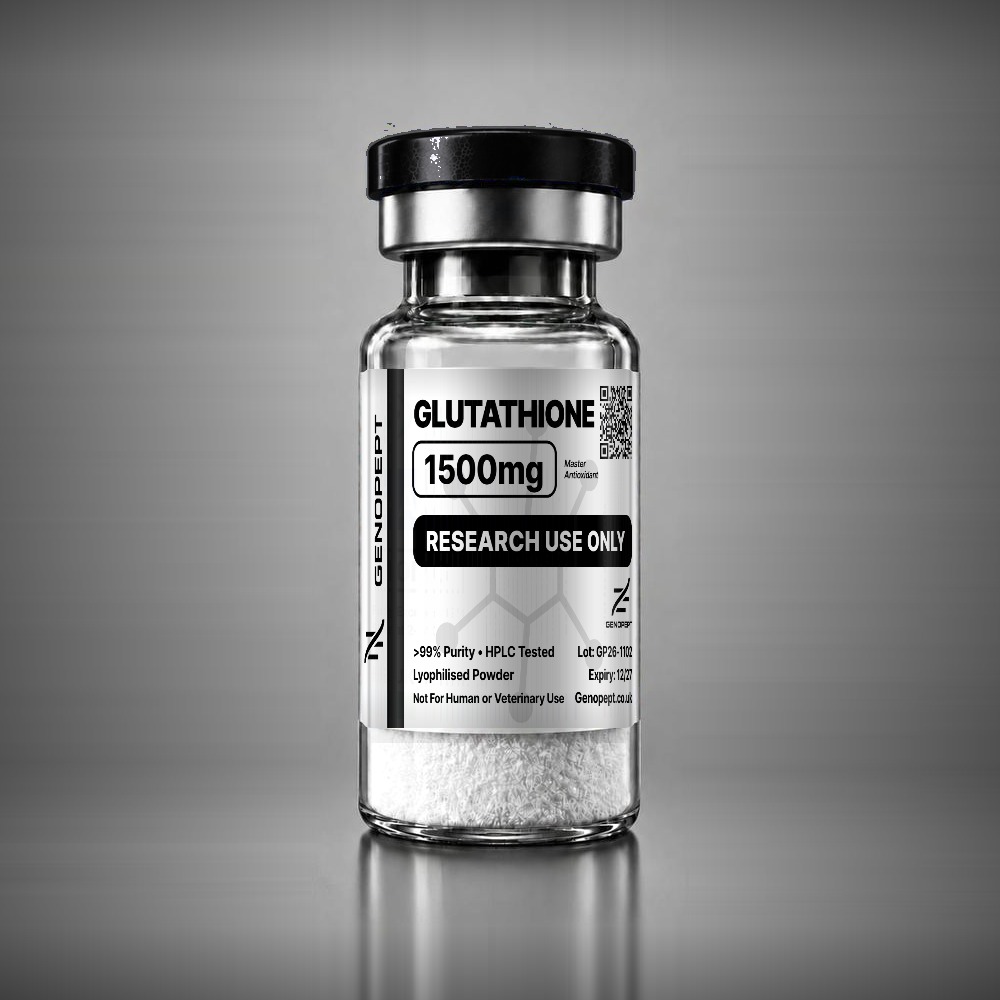
Reduced glutathione is supplied as high-purity lyophilised powder for UK laboratories in 600mg, 1200mg and 1500mg vials. The unusual gamma-peptide bond between glutamate and cysteine makes glutathione resistant to ordinary peptidases, which is why it persists in cells and why it is a standard reference compound in redox biology.
Glutathione (GSH) research applications
Oxidative stress and redox signalling
Glutathione is the reference compound for cell-culture studies of oxidative stress. Research measures the GSH to GSSG ratio as a marker of cellular redox state and uses exogenous glutathione to probe how depletion or supplementation alters stress responses.
Detoxification enzymology
Glutathione S-transferases, glutathione peroxidases and glutathione reductase all use GSH as substrate or product. Purified glutathione is required for enzyme kinetics, inhibitor screening and xenobiotic metabolism assays.
Mitochondrial and ageing models
Preclinical research investigates declining glutathione levels in ageing tissues and in mitochondrial dysfunction, often alongside compounds such as NAD+ and SS-31.
Skin pigmentation research
Glutathione has been studied in melanocyte cultures for its reported effect on tyrosinase activity and the balance between eumelanin and pheomelanin synthesis.
Neuroprotection models
Glutathione depletion is a feature of several animal models of neurodegeneration, and research explores GSH restoration as an experimental variable in those systems.
Mechanism of action (preclinical)
The cysteine thiol of glutathione is oxidised to form glutathione disulfide (GSSG) when it reduces hydrogen peroxide, lipid peroxides or other reactive species, a reaction catalysed by glutathione peroxidases. Glutathione reductase then regenerates GSH from GSSG using NADPH, closing the cycle that keeps the intracellular environment reducing.
Glutathione also conjugates to electrophiles through glutathione S-transferases, marking them for export and excretion, and forms mixed disulfides with protein cysteines (S-glutathionylation), a reversible post-translational modification that has been investigated as a redox signalling mechanism. Glutathione additionally regenerates other antioxidants, including ascorbate and alpha-tocopherol, in preclinical models.
Glutathione (GSH) product specifications
| Specification | Detail |
|---|---|
| Compound | Glutathione, reduced form |
| Also known as | GSH, L-glutathione, gamma-L-glutamyl-L-cysteinyl-glycine |
| Sequence / class | Endogenous tripeptide, gamma-Glu-Cys-Gly |
| CAS number | 70-18-8 |
| Molecular formula | C10H17N3O6S |
| Molecular weight | 307.32 g/mol |
| Form | Lyophilised powder in sealed sterile glass vial, black cap |
| Available sizes | 600mg, 1200mg, 1500mg |
| Purity | ≥99% (HPLC) |
| Verification | HPLC purity and LC-MS identity by Puralytix (ISO/IEC 17025), batch COA |
| Storage (unopened) | –20 °C long term; 2–8 °C short term; protect from light |
| Intended use | In-vitro laboratory research only |
Available sizes
- Glutathione 600mg vial
- Glutathione 1200mg vial
- Glutathione 1500mg vial
Boxes of 10 vials are available at 20 to 50% savings for laboratories through the bulk and wholesale page. All sizes ship from UK stock.
Reconstitution, handling and storage (laboratory)
Store unopened glutathione vials at –20 °C for long-term storage, or at 2 to 8 °C for short-term use, protected from light. Allow the vial to reach room temperature before opening to prevent condensation on the powder.
Reconstitute with bacteriostatic water or sterile diluent, adding solvent slowly down the vial wall and swirling gently; never shake. Because the thiol oxidises in solution, prepare fresh solutions where possible, keep them at 2 to 8 °C and use within the period stated in your protocol. Glutathione solutions are mildly acidic and can be buffered to the assay pH if required. Guidance is in the articles on reconstitution and storage.
Quality assurance and Certificate of Analysis
Every batch of Glutathione (GSH) supplied by GenoPept is tested by an independent UK third-party laboratory (Puralytix, ISO/IEC 17025 accredited). Testing covers purity by HPLC and identity confirmation by LC-MS. The batch Certificate of Analysis (COA) is available through the “View Certificate of Analysis” button on this page, and the full library is published at genopept.co.uk/coa-certificates.
Each vial is sealed, batch-identified with lot number and expiry date, and dispatched by tracked Royal Mail Special Delivery within the UK (free on orders of £200 or more). Read what a Certificate of Analysis shows to interpret the report.
Related research compounds
- NAD+: the cofactor that supplies NADPH for glutathione recycling, often studied alongside GSH.
- SS-31 (Elamipretide): a mitochondria-targeted peptide investigated in the same oxidative stress models.
- MOTS-c: a mitochondrial-derived peptide studied in metabolic and redox research.
- L-Carnitine: a fatty-acid transport cofactor commonly paired in mitochondrial metabolism studies.
Glutathione (GSH) frequently asked questions
What is glutathione used for in research?
Glutathione is used in research as the reference cellular antioxidant and thiol buffer. Laboratories use it to study oxidative stress, redox signalling, detoxification enzymes such as glutathione S-transferases, and the GSH/GSSG ratio as a marker of cell health. It is also investigated in models of mitochondrial function, ageing and xenobiotic metabolism in cell culture and animal studies.
How is GenoPept glutathione supplied and what is its purity?
GenoPept glutathione is supplied as lyophilised reduced glutathione powder in sealed sterile glass vials of 600mg, 1200mg and 1500mg. Every batch is tested by an independent ISO/IEC 17025 laboratory with HPLC purity of at least 99% and LC-MS identity confirmation. The batch Certificate of Analysis is linked from this page and in the COA library.
How should glutathione be stored in the laboratory?
Store unopened lyophilised glutathione vials at minus 20 °C for long-term storage, or at 2 to 8 °C for short periods, protected from light. Because the thiol group oxidises readily in solution, reconstitute only what a protocol needs, keep solutions at 2 to 8 °C and use them promptly. Minimise exposure to air and avoid repeated freeze-thaw cycles.
Is glutathione from GenoPept for human use?
No. Glutathione is sold strictly for in-vitro laboratory research. It is not a medicine or supplement, is not for human or veterinary use, and is not for diagnostic or therapeutic purposes. Purchasers confirm they are buying for research and agree to the research use only terms published on the GenoPept website.
What is the difference between reduced glutathione (GSH) and oxidised glutathione (GSSG)?
Reduced glutathione (GSH) is the active thiol form that donates electrons to neutralise reactive oxygen species; oxidised glutathione (GSSG) is the disulfide-linked dimer formed after GSH has done so. Cells recycle GSSG back to GSH using glutathione reductase and NADPH. The GSH to GSSG ratio is a widely used research readout of cellular redox status.
Research use only. This product is supplied for in-vitro laboratory research only. It is not for human or veterinary use, is not a medicine, and is not intended for diagnostic or therapeutic use. See the research use only policy for full terms.
Reviews
There are no reviews yet.