
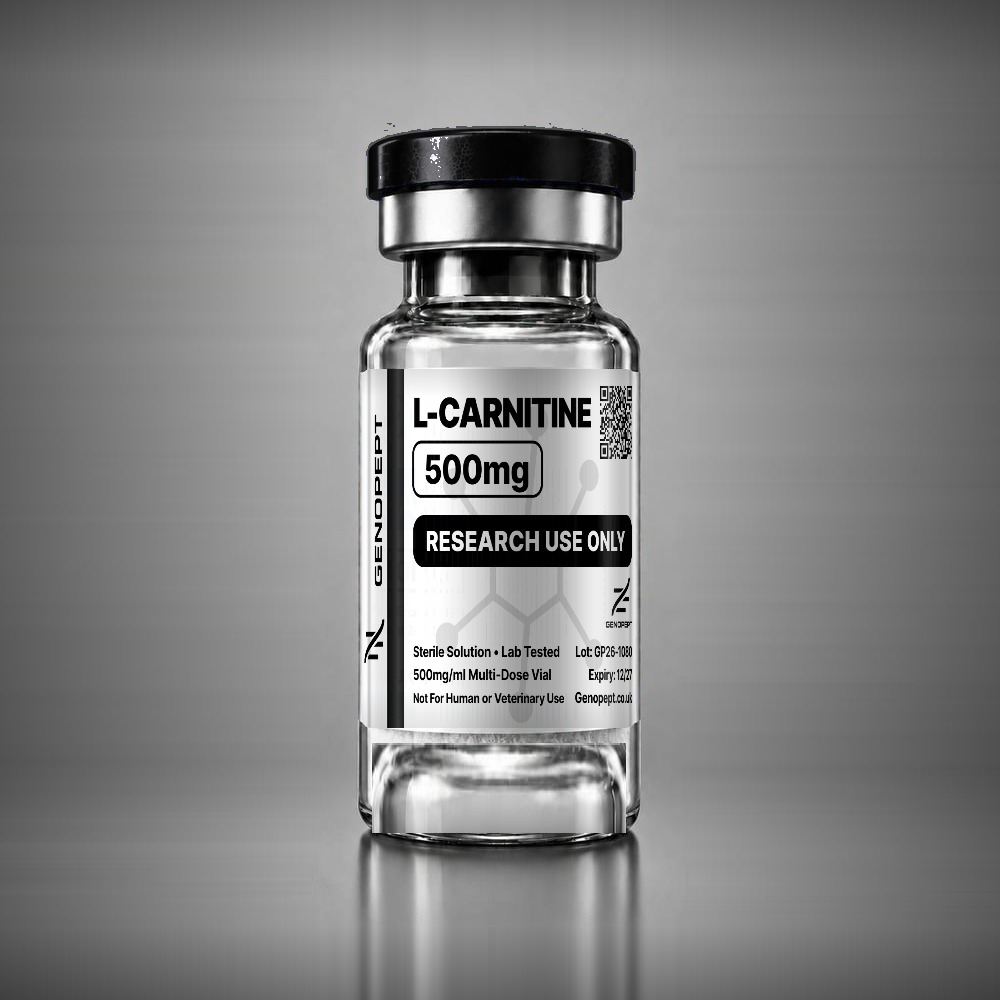
What is L-Carnitine?
L-Carnitine is an endogenous quaternary ammonium compound, (R)-3-hydroxy-4-(trimethylammonio)butanoate, synthesised in mammals from lysine and methionine and required for the transport of long-chain fatty acids across the inner mitochondrial membrane. It is not a peptide but a small polar molecule (CAS 541-15-1, C7H15NO3, 161.20 g/mol) that acts as the carrier in the carnitine shuttle.
L-carnitine is supplied to UK laboratories as a ready-to-use liquid research solution in sealed multi-dose vials, labelled by total L-carnitine content from 500mg to 5000mg. The solution format avoids the handling issues of the hygroscopic solid and lets researchers draw accurate volumes for cell-culture and animal-model work.
L-Carnitine research applications
Fatty-acid oxidation and energy metabolism
L-carnitine is the central research tool for studying mitochondrial beta-oxidation. Cell-culture and isolated-mitochondria studies use it to measure fatty-acid flux, oxygen consumption and the activity of carnitine palmitoyltransferase I and II.
Metabolic disease models
Preclinical research investigates L-carnitine in rodent models of obesity, insulin resistance and dyslipidaemia, where altered carnitine status and acylcarnitine profiles are studied as markers of metabolic flexibility.
Exercise and muscle physiology
Animal studies have examined L-carnitine in relation to muscle carnitine content, substrate utilisation during activity and recovery from exercise-induced stress.
Mitochondrial dysfunction and ageing
Because acylcarnitine accumulation is linked to mitochondrial overload, L-carnitine is studied in models of mitochondrial disease and age-related decline, frequently together with NAD+ and mitochondria-targeted peptides.
Analytical reference
High-purity L-carnitine serves as a calibration standard in LC-MS acylcarnitine profiling.
Mechanism of action (preclinical)
Long-chain fatty acyl-CoA molecules cannot cross the inner mitochondrial membrane directly. Carnitine palmitoyltransferase I (CPT1) on the outer membrane transfers the acyl group to L-carnitine to form acylcarnitine, which is exchanged for free carnitine by the carnitine-acylcarnitine translocase (CACT). CPT2 on the inner membrane then regenerates acyl-CoA in the matrix for beta-oxidation.
L-carnitine also buffers the mitochondrial acyl-CoA to CoA ratio by accepting excess acyl groups, which preclinical research links to maintenance of pyruvate dehydrogenase activity and glucose oxidation. Cellular uptake occurs mainly through the organic cation transporter OCTN2 (SLC22A5), and OCTN2 deficiency models are a recognised system for studying primary carnitine deficiency.
L-Carnitine product specifications
| Specification | Detail |
|---|---|
| Compound | L-Carnitine (levocarnitine) |
| Also known as | (R)-carnitine, L-carnitine free base, 3-hydroxy-4-(trimethylammonio)butanoate |
| Sequence / class | Endogenous quaternary ammonium compound; fatty-acid transport cofactor (not a peptide) |
| CAS number | 541-15-1 |
| Molecular formula | C7H15NO3 |
| Molecular weight | 161.20 g/mol |
| Form | Liquid research solution in sealed multi-dose glass vial |
| Available sizes | 500mg, 600mg, 1000mg, 5000mg (total L-carnitine per vial) |
| Purity | ≥99% (HPLC) for the active compound |
| Verification | HPLC purity and LC-MS identity by Puralytix (ISO/IEC 17025), batch COA |
| Storage (unopened) | 2–8 °C, protect from light, do not freeze |
| Intended use | In-vitro laboratory research only |
Available sizes
- L-Carnitine 500mg research solution vial
- L-Carnitine 600mg research solution vial
- L-Carnitine 1000mg research solution vial
- L-Carnitine 5000mg research solution vial
Boxes of 10 vials are available with 20 to 50% savings through the bulk and wholesale page for UK laboratories running larger studies.
Reconstitution, handling and storage (laboratory)
L-carnitine is supplied as a liquid research solution and does not require reconstitution. Store unopened vials at 2 to 8 °C, protected from light, and do not freeze. Allow the vial to reach room temperature before drawing to reduce condensation and volume error.
Swab the stopper before each draw and use a fresh sterile needle to preserve the multi-dose seal. Record the first-puncture date on the label and keep the vial refrigerated between uses. Further dilutions in assay buffer should be prepared fresh. General guidance on handling research compounds is in the GenoPept article on how to store research peptides.
Quality assurance and Certificate of Analysis
Every batch of L-Carnitine supplied by GenoPept is tested by an independent UK third-party laboratory (Puralytix, ISO/IEC 17025 accredited). Testing covers purity by HPLC and identity confirmation by LC-MS. The batch Certificate of Analysis (COA) is available through the “View Certificate of Analysis” button on this page, and the full library is published at genopept.co.uk/coa-certificates.
Each vial is sealed, batch-identified with lot number and expiry date, and dispatched by tracked Royal Mail Special Delivery within the UK (free on orders of £200 or more). Read what a Certificate of Analysis shows to interpret the report.
Related research compounds
- Lipo-C Fat Metabolism Complex 10ml: a lipotropic research solution studied in the same fat-metabolism models.
- NAD+: the redox cofactor for beta-oxidation, commonly co-investigated with carnitine.
- MOTS-c: a mitochondrial-derived peptide studied in metabolic regulation.
- AOD-9604: a growth hormone fragment investigated in lipid metabolism research.
L-Carnitine frequently asked questions
What is L-carnitine used for in research?
L-carnitine is used in research to study fatty-acid transport into mitochondria, beta-oxidation and energy metabolism. Laboratories investigate it in cell-culture and animal models of metabolic disease, exercise physiology, mitochondrial dysfunction and ageing, and use it as a substrate in carnitine palmitoyltransferase assays. It is supplied as a liquid research solution for those applications.
How is L-carnitine supplied and what purity does it have?
GenoPept L-carnitine is supplied as a ready-made liquid research solution in sealed multi-dose glass vials, labelled by total L-carnitine content: 500mg, 600mg, 1000mg and 5000mg. Every batch is tested by an independent ISO/IEC 17025 laboratory, with HPLC purity of at least 99% for the active compound and LC-MS identity confirmation on the batch Certificate of Analysis.
How should the L-carnitine solution be stored?
Store unopened vials of L-carnitine solution at 2 to 8 °C, protected from light, and do not freeze. After the first puncture keep the vial refrigerated, swab the stopper before each draw, and use within the period set by your laboratory protocol. L-carnitine is hygroscopic as a solid, which is one reason the solution format is convenient for repeated sampling.
Is L-carnitine from GenoPept for human use?
No. The L-carnitine research solution sold by GenoPept is for in-vitro laboratory research only. It is not a medicine, supplement or food ingredient, is not for human or veterinary use, and is not intended for diagnostic or therapeutic use. Buyers must accept the research use only terms before ordering from the UK site.
What is the difference between L-carnitine and acetyl-L-carnitine?
L-carnitine is the parent quaternary ammonium compound that shuttles long-chain fatty acids into mitochondria. Acetyl-L-carnitine is its acetylated ester, which carries an acetyl group and is studied more often in neurological models because it crosses membranes differently and can donate acetyl units. Both are interconverted in cells by carnitine acetyltransferase, but they are distinct research compounds.
Research use only. This product is supplied for in-vitro laboratory research only. It is not for human or veterinary use, is not a medicine, and is not intended for diagnostic or therapeutic use. See the research use only policy for full terms.
Reviews
There are no reviews yet.