
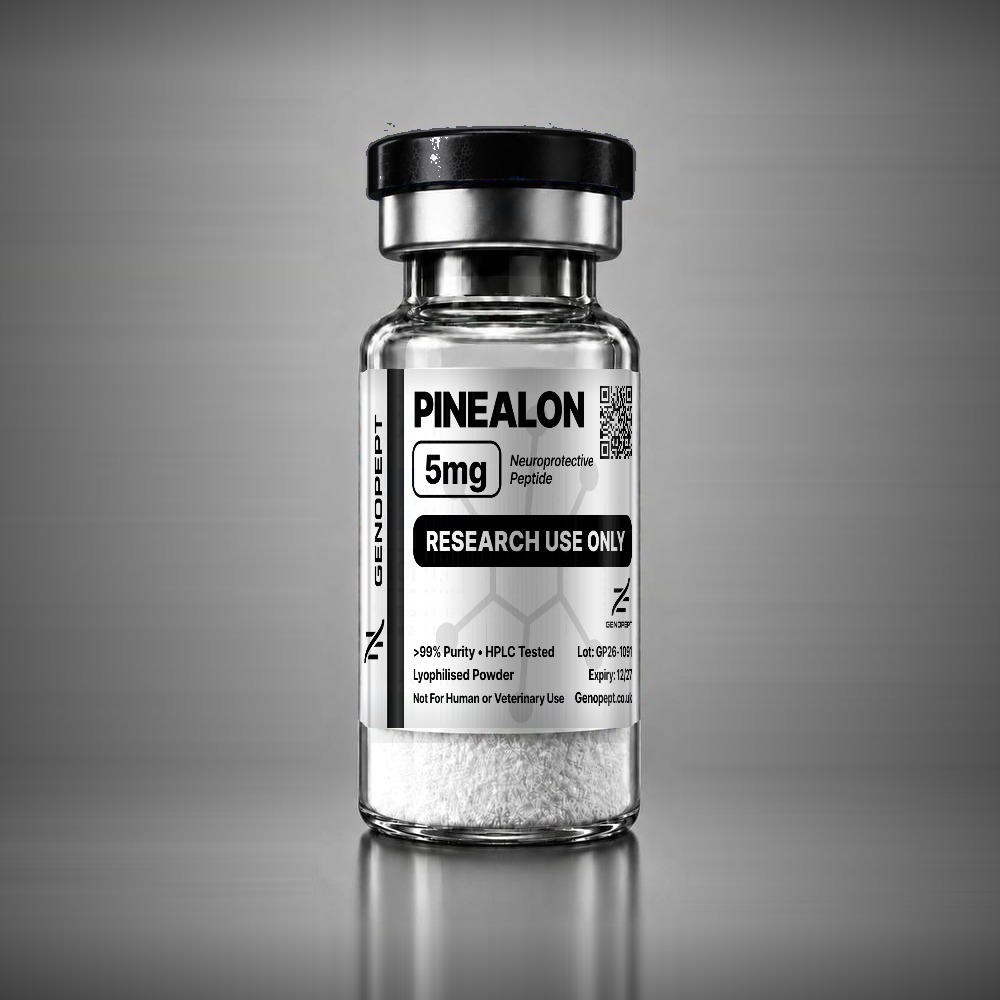
What is Pinealon?
Pinealon is a synthetic tripeptide (three amino acids) with the sequence Glu-Asp-Arg, also known as the EDR peptide. It belongs to the family of short peptide bioregulators developed in Russia and associated with the work of Khavinson. Pinealon is studied as a neuroprotective research peptide aimed at the nervous system. GenoPept supplies Pinealon in the UK as a lyophilised powder for laboratory research.
As a peptide bioregulator, Pinealon is investigated for reported effects on gene expression and cellular protection in neural tissue models. Its very short length is characteristic of the Khavinson bioregulator class, which is proposed to interact directly with DNA and regulatory pathways in preclinical work.
Pinealon research applications
Preclinical research relevant to Pinealon covers several model-based areas, listed here for scientific context only.
- Neuroprotection: studied in models of oxidative and hypoxic stress on neural cells.
- Cognitive ageing: investigated in aged-animal models of learning.
- Gene regulation: research explores reported effects on expression of protective genes.
- Antioxidant activity: examined for reported reduction of oxidative markers in cell culture.
Mechanism of action (preclinical)
In the peptide bioregulator hypothesis, short peptides such as Pinealon are proposed to enter cells and interact with DNA and histone regions to modulate expression of genes involved in cellular defence and repair. Preclinical studies report that Pinealon reduces markers of oxidative stress and supports neuronal survival under experimental hypoxia. These mechanisms are described in the Khavinson bioregulator literature and reflect laboratory observations rather than effects in people. See the GenoPept guide to peptide bioregulators for background.
Pinealon product specifications
| Compound | Pinealon |
|---|---|
| Also known as | EDR peptide, Glu-Asp-Arg |
| Sequence / class | Synthetic tripeptide bioregulator (Glu-Asp-Arg) |
| CAS number | 175175-23-2 |
| Molecular formula | C15H26N6O8 |
| Molecular weight | 418.4 g/mol |
| Form | Lyophilised powder |
| Available sizes | 5 mg, 10 mg, 20 mg |
| Purity | Batch-specific; see applicable report |
| Verification | Batch-specific; see applicable report |
| Storage (unopened) | –20 °C long term, protected from light |
| Intended use | In-vitro laboratory research only |
Available sizes
- Pinealon 5mg vial
- Pinealon 10mg vial
- Pinealon 20mg vial
Pinealon is offered in the vial sizes listed above for UK research laboratories. Wholesale boxes of 10 vials are available through GenoPept for teams running larger studies, with tiered savings on bulk orders. See the bulk and wholesale page for details.
Reconstitution, handling and storage (laboratory)
Pinealon is supplied as a lyophilised (freeze-dried) powder in a sealed sterile glass vial with a black cap. For laboratory reconstitution, add bacteriostatic water or a suitable sterile diluent slowly down the inner vial wall, then swirl gently until dissolved. Never shake the vial, as agitation can shear the peptide.
Store unopened vials at –20 °C for long-term stability, or at 2–8 °C for short periods, protected from light. After reconstitution, keep the solution at 2–8 °C and use it within the window stated in the laboratory protocol. See the GenoPept guides on how to reconstitute research peptides and how to store research peptides.
Quality assurance and Certificate of Analysis
Purity and identity results are batch-specific. Consult the applicable supplied report for its results and methods; confirm the batch covers current stock and verify the laboratory’s accreditation scope directly.
The matching Certificate of Analysis (COA) is available from the “View Certificate of Analysis” button on this page, and the full library is published at the GenoPept COA certificates page. Learn more about what a Certificate of Analysis shows and the UK legal status of research peptides.
Related research compounds
- Epitalon — a pineal tetrapeptide bioregulator studied in longevity research.
- DSIP — a neuropeptide studied in sleep and stress-response research.
- Semax — a nootropic ACTH(4-10) research peptide.
- Selank — a tuftsin-derived anxiolytic research peptide.
Pinealon frequently asked questions
What is Pinealon used for in research?
Pinealon is used in laboratory research to study neuroprotection, cognitive ageing, gene regulation and antioxidant activity in neural cell and animal models. As a Khavinson-class peptide bioregulator it is examined for reported effects on protective gene expression. It is supplied strictly for in-vitro research and not for human use, diagnosis or therapy.
How is Pinealon supplied and what is its purity?
Purity and identity results are batch-specific. Consult the applicable supplied report for its results and methods; confirm the batch covers current stock and verify the laboratory’s accreditation scope directly.
How should Pinealon be stored?
Store unopened Pinealon vials at –20 °C for long-term stability, or at 2–8 °C for short periods, protected from light. After reconstitution with bacteriostatic water or sterile diluent, keep the solution at 2–8 °C and use it within the window stated in the laboratory protocol to maintain peptide integrity.
Is Pinealon for human use?
No. Pinealon from GenoPept is a research chemical supplied for in-vitro laboratory research only. It is not a medicine, not for human or veterinary use, and not intended for diagnostic or therapeutic purposes. All handling should be performed by qualified personnel in a controlled laboratory setting in line with UK research guidance.
What is a peptide bioregulator like Pinealon?
Pinealon is a short synthetic tripeptide (Glu-Asp-Arg) from the Khavinson family of peptide bioregulators developed in Russia. In this research framework, very short peptides are proposed to interact with DNA and regulatory regions to modulate protective gene expression in tissue models. Pinealon is studied specifically in the context of the nervous system.
Research use only. This product is supplied for in-vitro laboratory research only. It is not for human or veterinary use, is not a medicine, and is not intended for diagnostic or therapeutic use. Handling should be carried out only by qualified personnel in an appropriate laboratory setting.
Research guides: Epitalon (Epithalon) Research Guide
Reviews
There are no reviews yet.