
What is P21?
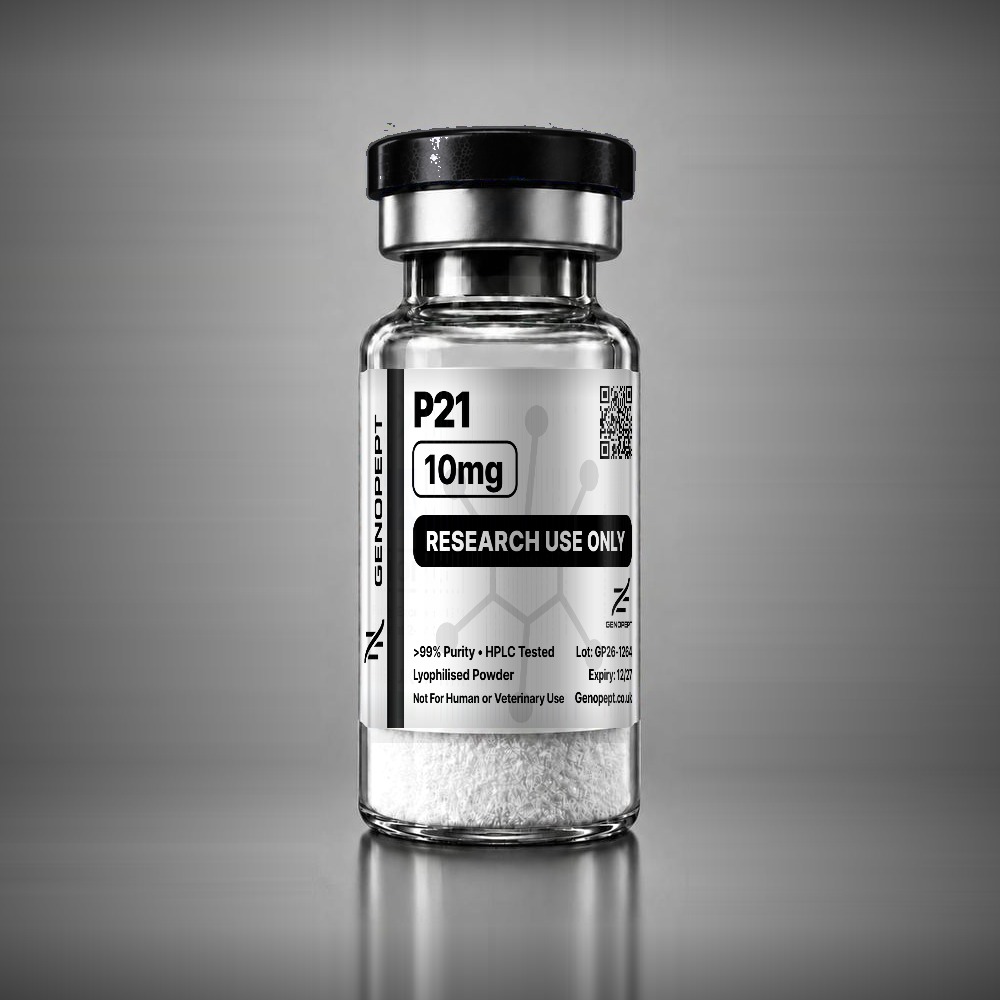
P21 (also written P021) is a synthetic peptidergic compound derived from the biologically active region of ciliary neurotrophic factor (CNTF). It is based on a short core sequence corresponding to CNTF residues 148 to 151 (Ac-DGGLAG-NH2), modified with an adamantane group on a C-terminal glycine to increase lipophilicity and stability. GenoPept supplies P21 in the UK as a lyophilised powder in a 10 mg vial for laboratory research.
P21 is studied as a neurotrophic small-peptide mimetic. The adamantane modification is reported to improve resistance to enzymatic breakdown and to support passage across experimental membranes, which is why P21 is used as a research tool in neurogenesis and synaptic plasticity studies.
P21 research applications
Preclinical research on P21 covers several model-based areas, listed here for scientific context only.
- Neurogenesis: studied for reported promotion of neural progenitor formation in animal models.
- Synaptic plasticity: investigated for reported effects on synaptic markers and learning in mice.
- Neurotrophic signalling: research explores reported increases in BDNF expression.
- Neurodegeneration models: examined in transgenic models of Alzheimer-type pathology.
Mechanism of action (preclinical)
In preclinical literature, P21 is reported to act through two complementary pathways. It is described as a competitive inhibitor of leukaemia inhibitory factor (LIF) signalling, which in model systems constrains the formation of neural progenitor cells, and as an enhancer of brain-derived neurotrophic factor (BDNF) expression, which supports neurogenesis and synaptic plasticity. Together these effects are reported to promote neural repair markers in animal models. These are laboratory findings only; P21 has not been tested in humans.
P21 product specifications
| Compound | P21 (P021) |
|---|---|
| Also known as | P021, CNTF-derived peptidergic compound, Ac-DGGLAG-NH2 |
| Sequence / class | CNTF(148-151)-derived peptide with adamantylated glycine (Ac-DGGLAG-NH2) |
| Molecular formula | C30H54N6O5 |
| Molecular weight | 578.3 g/mol |
| Form | Lyophilised powder |
| Available sizes | 10 mg |
| Purity | ≥99% (HPLC) |
| Verification | HPLC purity + LC-MS identity, third-party (ISO/IEC 17025) |
| Storage (unopened) | –20 °C long term, protected from light |
| Intended use | In-vitro laboratory research only |
Available sizes
- P21 10mg vial
P21 is offered in the vial sizes listed above for UK research laboratories. Wholesale boxes of 10 vials are available through GenoPept for teams running larger studies, with tiered savings on bulk orders. See the bulk and wholesale page for details.
Reconstitution, handling and storage (laboratory)
P21 is supplied as a lyophilised (freeze-dried) powder in a sealed sterile glass vial with a black cap. For laboratory reconstitution, add bacteriostatic water or a suitable sterile diluent slowly down the inner vial wall, then swirl gently until dissolved. Never shake the vial, as agitation can shear the peptide.
Store unopened vials at –20 °C for long-term stability, or at 2–8 °C for short periods, protected from light. After reconstitution, keep the solution at 2–8 °C and use it within the window stated in the laboratory protocol. See the GenoPept guides on how to reconstitute research peptides and how to store research peptides.
Quality assurance and Certificate of Analysis
Every batch of P21 supplied by GenoPept is verified to at least 99% purity. Identity and purity are confirmed by an independent third-party laboratory (Puralytix, accredited to ISO/IEC 17025) using HPLC for purity and LC-MS for identity. Each vial is batch-identified with a lot number and expiry date on the label.
The matching Certificate of Analysis (COA) is available from the “View Certificate of Analysis” button on this page, and the full library is published at the GenoPept COA certificates page. Learn more about what a Certificate of Analysis shows and the UK legal status of research peptides.
Related research compounds
- PE-22-28 — a spadin-derived peptide studied in neurogenesis research.
- Semax — a nootropic ACTH(4-10) research peptide.
- DSIP — a neuropeptide studied in sleep and stress-response research.
- Pinealon — a neuroprotective tripeptide bioregulator.
P21 frequently asked questions
What is P21 used for in research?
P21, also called P021, is used in laboratory research to study neurogenesis, synaptic plasticity and neurotrophic signalling in cell and animal models, including transgenic models of Alzheimer-type pathology. As a CNTF-derived peptide it is examined for reported effects on BDNF and LIF pathways. It is supplied strictly for research, not for human use.
How is P21 supplied and what is its purity?
GenoPept supplies P21 as a lyophilised powder in a sealed sterile glass vial with a black cap, in a 10 mg size. Every batch is verified to at least 99% purity by an independent ISO/IEC 17025 laboratory using HPLC and LC-MS, and each order includes a batch Certificate of Analysis accessible from the product page.
How should P21 be stored?
Store the unopened P21 vial at –20 °C for long-term stability, or at 2–8 °C for short periods, protected from light. After reconstitution with bacteriostatic water or sterile diluent, keep the solution at 2–8 °C and use it within the window given in the laboratory protocol to preserve peptide integrity.
Is P21 for human use?
No. P21 from GenoPept is a research chemical supplied for in-vitro laboratory research only. It is not a medicine, not for human or veterinary use, and not intended for diagnostic or therapeutic purposes. P21 has not been tested in humans. All handling should be carried out by qualified personnel in a controlled laboratory setting in line with UK research guidance.
How is P21 related to CNTF?
P21 is derived from the biologically active region of ciliary neurotrophic factor (CNTF), based on residues 148 to 151, with an adamantane group added to a C-terminal glycine to improve stability and membrane passage. This design lets researchers study CNTF-like neurotrophic signalling using a small, more stable peptide in preclinical models.
Research use only. This product is supplied for in-vitro laboratory research only. It is not for human or veterinary use, is not a medicine, and is not intended for diagnostic or therapeutic use. Handling should be carried out only by qualified personnel in an appropriate laboratory setting.
Reviews
There are no reviews yet.