
What is Humanin?
Humanin is a 24-amino-acid peptide encoded by a short open reading frame within the 16S ribosomal RNA gene (MT-RNR2) of mitochondrial DNA. Its sequence is MAPRGFSCLLLLTSEIDLPVKRRA. It was the first mitochondrial-derived peptide (MDP) to be identified, discovered in 2001 during a screen for factors that protected neuronal cells from stress.
Humanin is secreted from cells and is detectable in plasma, cerebrospinal fluid and various tissues, with levels reported to decline with age in animal and human studies. It belongs to a growing family of MDPs that includes MOTS-c and the small humanin-like peptides (SHLPs), all of which are studied for roles in cellular stress responses and metabolism.
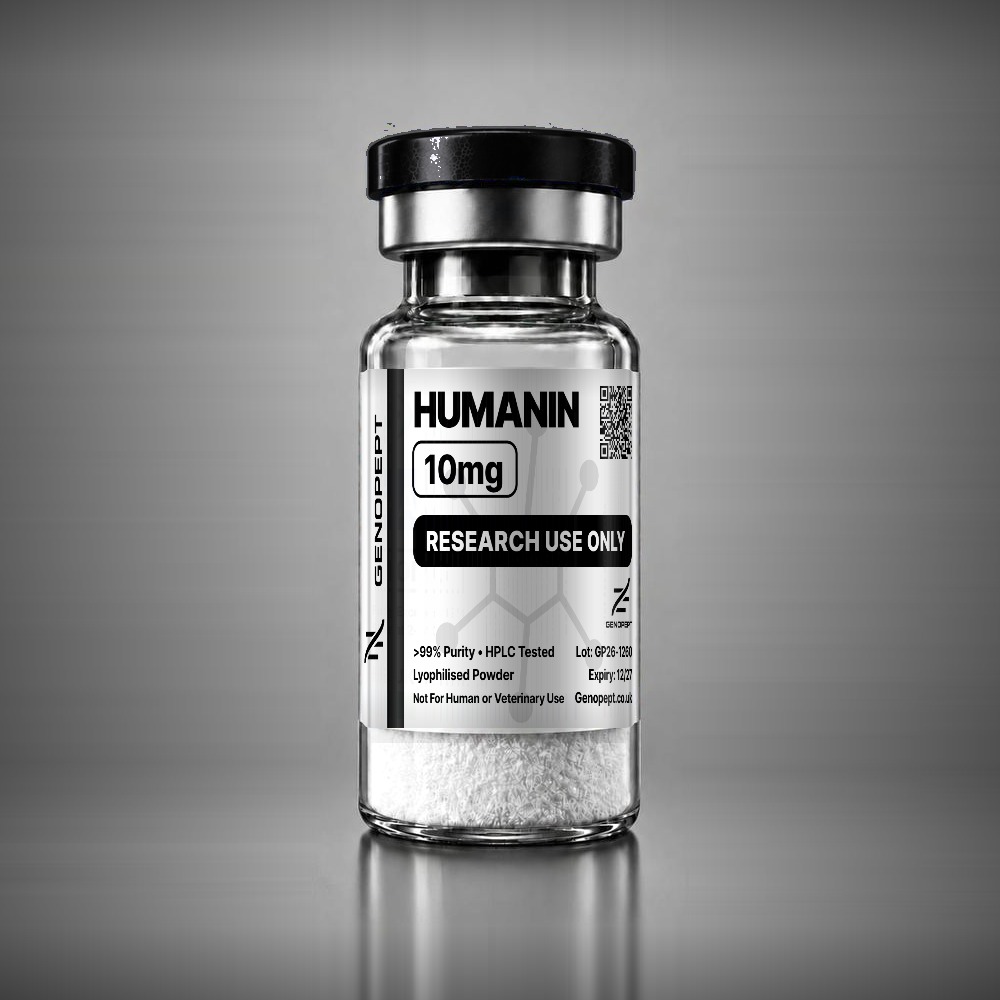
GenoPept supplies Humanin to UK laboratories as a 10mg lyophilised vial, third-party verified at ≥99% purity with a batch Certificate of Analysis.
Humanin research applications
Humanin is investigated across a wide range of preclinical and cell-based research areas:
- Neuroprotection – Humanin has been studied in neuronal cell cultures and animal models of neurodegeneration for its reported ability to suppress apoptosis induced by cellular stressors.
- Metabolic regulation – research explores Humanin in models of insulin sensitivity, glucose handling and diet-induced metabolic dysfunction.
- Cardiovascular models – the peptide has been investigated in models of ischaemia-reperfusion injury, atherosclerosis and endothelial stress.
- Ageing and longevity biology – Humanin levels correlate with lifespan in some animal studies, and it is used to probe mitochondrial signalling in ageing research.
- Oxidative stress and apoptosis assays – it is a standard tool for studying BAX-mediated apoptosis and mitochondrial membrane integrity in vitro.
- Analogue development – native Humanin is the reference for potent variants such as HNG (S14G-Humanin) used in mechanistic studies.
Mechanism of action (preclinical)
Humanin acts through both intracellular and extracellular mechanisms. Inside the cell it binds the pro-apoptotic protein BAX, preventing its translocation to the mitochondrial membrane and the release of cytochrome c, and it also interacts with IGFBP-3. Extracellularly, Humanin binds a trimeric receptor composed of CNTFR, WSX-1 and gp130 that activates JAK2/STAT3 signalling, and it can also signal through formyl peptide receptor-like 1 (FPRL1).
These pathways converge on enhanced cellular stress resistance, reduced apoptosis and improved mitochondrial function in preclinical models. Humanin has also been reported to influence AMPK and insulin signalling in metabolic tissues.
Humanin product specifications
Each vial is supplied to the specification below. Rows are limited to values that can be verified from published sources.
| Specification | Detail |
|---|---|
| Compound | Humanin (mitochondrial-derived peptide) |
| Also known as | HN, Humanin peptide, MT-RNR2-derived peptide, Mitochondrial-derived peptide (MDP) |
| Sequence / class | 24-amino-acid mitochondrial-derived peptide (Met-Ala-Pro-Arg-Gly-Phe-Ser-Cys-Leu-Leu-Leu-Leu-Thr-Ser-Glu-Ile-Asp-Leu-Pro-Val-Lys-Arg-Arg-Ala) |
| CAS number | 330936-69-1 |
| Molecular formula | C119H204N34O32S2 |
| Molecular weight | 2687.2 g/mol |
| Form | Lyophilised powder in a sealed, sterile glass vial (black cap), batch-labelled with lot and expiry |
| Available sizes | 10mg |
| Purity | ≥99% (HPLC) |
| Verification | HPLC purity and LC-MS identity by an independent ISO/IEC 17025 laboratory; batch COA supplied |
| Storage (unopened) | –20 °C long term; 2–8 °C short term; protect from light |
| Intended use | In-vitro laboratory research only. Not for human or veterinary use. |
Available sizes
- Humanin 10mg vial, lyophilised powder
Bulk and wholesale boxes of 10 vials of Humanin save 20–50% for laboratories running larger studies; see the bulk and wholesale page. Free UK delivery applies to orders of £200 or more.
Reconstitution, handling and storage (laboratory)
Humanin is shipped as a lyophilised powder and should be stored unopened at –20 °C for long-term laboratory storage, or at 2–8 °C for short periods, protected from light. Allow the sealed vial to reach room temperature before opening to avoid condensation on the powder.
To reconstitute, add bacteriostatic water or another sterile diluent slowly down the inside wall of the vial, then swirl gently until dissolved. Never shake, as shear stress can denature the peptide. Humanin contains a single cysteine and a hydrophobic leucine-rich core, so dissolve gently and avoid oxidising conditions. After reconstitution keep the solution at 2–8 °C and use it within the period defined in your laboratory protocol.
Full step-by-step guidance is available in our articles on how to reconstitute research peptides and how to store research peptides. Handle with gloves and standard laboratory precautions.
Quality assurance and Certificate of Analysis
Every batch of Humanin is tested by an independent third-party laboratory (Puralytix, ISO/IEC 17025 accredited). Purity is confirmed by HPLC at ≥99% and identity is confirmed by LC-MS, so the material in the vial matches the label.
A batch-specific Certificate of Analysis is available through the “View Certificate of Analysis” button on this page, and the complete library is published in the COA library. Our guide to what a Certificate of Analysis shows explains how to read the chromatogram and mass spectrum. Vials are batch-identified with lot number and expiry, and orders are dispatched discreetly by tracked Royal Mail Special Delivery within the UK.
Related research compounds
- MOTS-c – a second mitochondrial-derived peptide studied alongside Humanin in metabolic research
- SS-31 (Elamipretide) – a mitochondria-targeted peptide for complementary mitochondrial function studies
- Epitalon (Epithalon) – a tetrapeptide studied in ageing and telomerase research
- NAD+ – a mitochondrial cofactor used in cellular energy and ageing models
Humanin frequently asked questions
What is Humanin used for in research?
Humanin is used in laboratory studies of mitochondrial signalling, cellular stress resistance and ageing. Researchers apply it in neuronal apoptosis assays, models of insulin sensitivity and metabolic dysfunction, cardiovascular ischaemia models, oxidative stress studies and as a reference for analogues such as HNG. Supplied for in-vitro laboratory research only.
How is Humanin supplied and what is its purity?
GenoPept supplies Humanin as 10mg of lyophilised powder in a sealed, sterile glass vial with a black cap and batch label. Each lot is tested by an independent ISO/IEC 17025 laboratory, with ≥99% purity by HPLC and identity confirmed by LC-MS. The batch Certificate of Analysis is available on the product page and in the COA library.
How should Humanin be stored?
Store unopened Humanin vials at –20 °C for long-term storage or at 2–8 °C for short periods, protected from light. After reconstitution with bacteriostatic water, keep the solution at 2–8 °C, avoid freeze–thaw cycles and use it within the period defined in your laboratory protocol.
Is Humanin for human use?
No. Humanin is supplied exclusively for in-vitro laboratory research. It is not a medicine, is not approved for human or veterinary use and is not for diagnostic or therapeutic purposes. UK customers must accept the research use only policy before an order is accepted.
What is the difference between Humanin and MOTS-c?
Both are mitochondrial-derived peptides, but Humanin is a 24-amino-acid peptide encoded in the 16S rRNA gene and studied mainly for cytoprotective and anti-apoptotic signalling via BAX, IGFBP-3 and the CNTFR/gp130 receptor. MOTS-c is a 16-amino-acid peptide from the 12S rRNA gene that is studied chiefly as an AMPK-linked regulator of metabolism and exercise adaptation.
Research use only. This product is supplied strictly for in-vitro laboratory research. It is not for human or veterinary use, not a medicine, and not for diagnostic or therapeutic use. Read the GenoPept research use only policy before ordering.
Research guides: MOTS-c Research Guide · SS-31 (Elamipretide) Research Guide
Reviews
There are no reviews yet.