
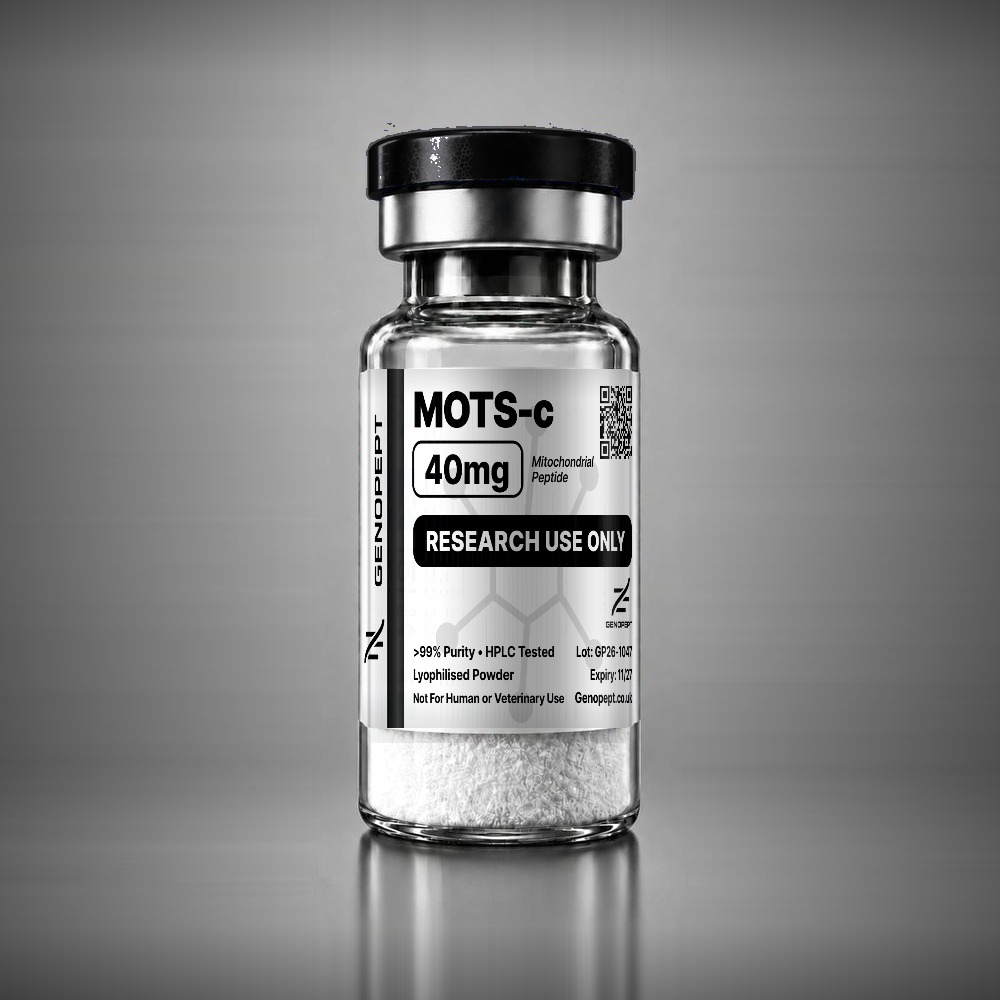
What is MOTS-c?
MOTS-c is a 16-amino-acid mitochondrial-derived peptide (MRWQEMGYIFYPRKLR) encoded by a short open reading frame within the mitochondrial 12S ribosomal RNA gene (MT-RNR1). It belongs to the small family of mitochondrial-derived peptides that also includes humanin, and it was first described in published research in 2015 as a signalling molecule that links mitochondrial status to whole-body metabolism.
MOTS-c is studied because it acts as a retrograde signal: produced in mitochondria, it moves into the cytoplasm and, under metabolic stress, into the nucleus where it modulates gene expression. Preclinical work has investigated it as an exercise mimetic, a regulator of insulin sensitivity and a factor in age-related metabolic decline.
GenoPept supplies MOTS-c in the UK as a lyophilised research peptide in 10mg, 20mg and 40mg vials, each batch verified at ≥99% purity with an independent Certificate of Analysis, strictly for in-vitro laboratory research.
MOTS-c research applications
MOTS-c research spans metabolism, exercise physiology and ageing. The areas below reflect published cell-culture and animal work and are not claims about effects in people.
Exercise physiology and mitochondrial signalling
Studies in mice reported that MOTS-c levels rise with exercise and that administration in these models was associated with improved endurance, which is why it is studied as an exercise-mimetic peptide.
Glucose metabolism and insulin sensitivity
Rodent models of high-fat feeding and age-related insulin resistance are used to investigate MOTS-c effects on skeletal-muscle glucose uptake and systemic metabolic markers.
Ageing and metabolic homeostasis
Circulating MOTS-c declines with age in animal and human cohort data, and researchers explore whether restoring it influences metabolic resilience in aged models.
Nuclear stress response
Under metabolic stress MOTS-c translocates to the nucleus and regulates antioxidant response element (ARE) genes through interactions with NRF2, a mechanism studied in cell culture.
Bone, cardiovascular and inflammatory models
Emerging preclinical literature investigates MOTS-c in osteoporosis, vascular calcification and inflammatory signalling models.
Mechanism of action (preclinical)
MOTS-c is reported to inhibit the folate cycle at the level of 5-methyltetrahydrofolate, which lowers de-novo purine synthesis and raises intracellular AICAR (ZMP). ZMP accumulation activates AMP-activated protein kinase (AMPK), the master energy sensor that increases glucose uptake and fatty-acid oxidation in skeletal muscle.
Separately, metabolic stress promotes MOTS-c translocation to the nucleus, where it associates with NRF2 and other transcription factors to regulate stress-response and antioxidant genes. More recent work also describes binding to casein kinase 2. These mechanisms are drawn from cell and animal research and remain under active investigation.
MOTS-c product specifications
| Specification | Detail |
|---|---|
| Compound | MOTS-c |
| Also known as | Mitochondrial open reading frame of the 12S rRNA type-c, MOTS-c peptide, Mitochondrial-derived peptide (MDP) |
| Sequence / class | 16-amino-acid mitochondrial-derived peptide (Met-Arg-Trp-Gln-Glu-Met-Gly-Tyr-Ile-Phe-Tyr-Pro-Arg-Lys-Leu-Arg) |
| CAS number | 1627580-64-6 |
| Molecular formula | C101H152N28O22S2 |
| Molecular weight | 2174.6 g/mol |
| Form | Lyophilised (freeze-dried) powder in a sealed sterile glass vial, black cap, lot and expiry on label |
| Available sizes | 10mg, 20mg, 40mg |
| Purity | ≥99% (HPLC) |
| Verification | Batch HPLC purity and LC-MS identity testing by an independent ISO/IEC 17025 laboratory (Puralytix), with Certificate of Analysis |
| Storage (unopened) | −20 °C long term; 2–8 °C short term; protect from light |
| Intended use | In-vitro laboratory research only. Not for human or veterinary use |
Available sizes
MOTS-c is available from GenoPept in the following vial sizes:
- MOTS-c 10mg vial
- MOTS-c 20mg vial
- MOTS-c 40mg vial
Laboratories that need larger quantities can order MOTS-c in bulk boxes of 10 vials, which save 20–50% against single-vial pricing. Retail baskets also receive automatic discounts at £300, £500 and £1,000, and delivery is free on UK orders of £200 or more.
Reconstitution, handling and storage (laboratory)
Unopened MOTS-c vials should be stored at −20 °C for long-term storage, or at 2–8 °C for short periods, and protected from light. Allow the vial to reach room temperature before opening to avoid condensation on the lyophilised cake.
To reconstitute for in-vitro work, add bacteriostatic water or another sterile diluent slowly down the inside wall of the vial, then swirl gently until the powder dissolves. Do not shake. MOTS-c contains methionine residues that can oxidise, so minimise exposure of reconstituted solutions to air and light. Reconstituted solution should be kept at 2–8 °C and used within the period specified in the laboratory’s own protocol. See our guides on how to reconstitute research peptides and how to store research peptides for step-by-step handling notes.
Quality assurance and Certificate of Analysis
Every batch of MOTS-c sold by GenoPept is tested by an independent third-party laboratory (Puralytix, ISO/IEC 17025 accredited) using HPLC for purity and LC-MS for identity confirmation. Results are published in a batch-specific Certificate of Analysis (COA), and each vial is labelled with its lot number and expiry date so the paperwork can be matched to the product on the bench.
Use the “View Certificate of Analysis” button on this page to open the current MOTS-c COA, or browse the full COA library. Our article on what a Certificate of Analysis shows explains how to read the chromatogram and mass spectrum.
Related research compounds
- Humanin: the other well-characterised mitochondrial-derived peptide, studied alongside MOTS-c in ageing research.
- SS-31 (Elamipretide): a cardiolipin-binding tetrapeptide investigated in mitochondrial dysfunction models.
- AICAR (Acadesine): the direct AMPK activator whose metabolite ZMP is elevated by MOTS-c.
- NAD+: the mitochondrial coenzyme at the heart of cellular energy metabolism.
MOTS-c frequently asked questions
What is MOTS-c used for in research?
MOTS-c is used in metabolic and ageing research as a mitochondrial-derived signalling peptide. Laboratories investigate it in cell-culture and rodent models of exercise, insulin resistance, obesity and age-related metabolic decline, focusing on AMPK activation and nuclear stress responses. It is supplied in the UK strictly for in-vitro laboratory research.
How is MOTS-c supplied and what purity is it?
GenoPept supplies MOTS-c as a lyophilised powder in sealed sterile glass vials of 10mg, 20mg and 40mg. Every batch is tested at ≥99% purity by HPLC with LC-MS identity confirmation at an independent ISO/IEC 17025 laboratory. The batch Certificate of Analysis is available from this page or the COA library.
How should MOTS-c be stored?
Store unopened MOTS-c vials at −20 °C for long-term storage, or 2–8 °C for short periods, protected from light. After reconstitution with bacteriostatic water or sterile diluent, keep the solution at 2–8 °C, limit exposure to air because of its methionine residues, and use within the period defined by your laboratory protocol.
Is MOTS-c for human use?
No. MOTS-c sold here is for in-vitro laboratory research only. It is not a medicine, not a supplement and not for human or veterinary use, diagnosis or therapy. This page summarises published preclinical research and contains no dosing or usage guidance for people.
How does MOTS-c differ from humanin?
Both are mitochondrial-derived peptides, but they come from different genes and act differently. MOTS-c is a 16-amino-acid peptide from the 12S rRNA gene that is studied for AMPK-linked metabolic regulation. Humanin is a 24-amino-acid peptide from the 16S rRNA gene studied mainly for cytoprotective and anti-apoptotic signalling. Researchers often investigate both together in ageing models.
Research use only. MOTS-c is supplied by GenoPept strictly for in-vitro laboratory research. It is not a medicine, is not for human or veterinary use, and is not intended for diagnostic or therapeutic purposes. Read our research use only policy and UK legal guide before ordering.
Research guides: MOTS-c Research Guide · NAD+ Research Guide · SS-31 (Elamipretide) Research Guide



Reviews
There are no reviews yet.