
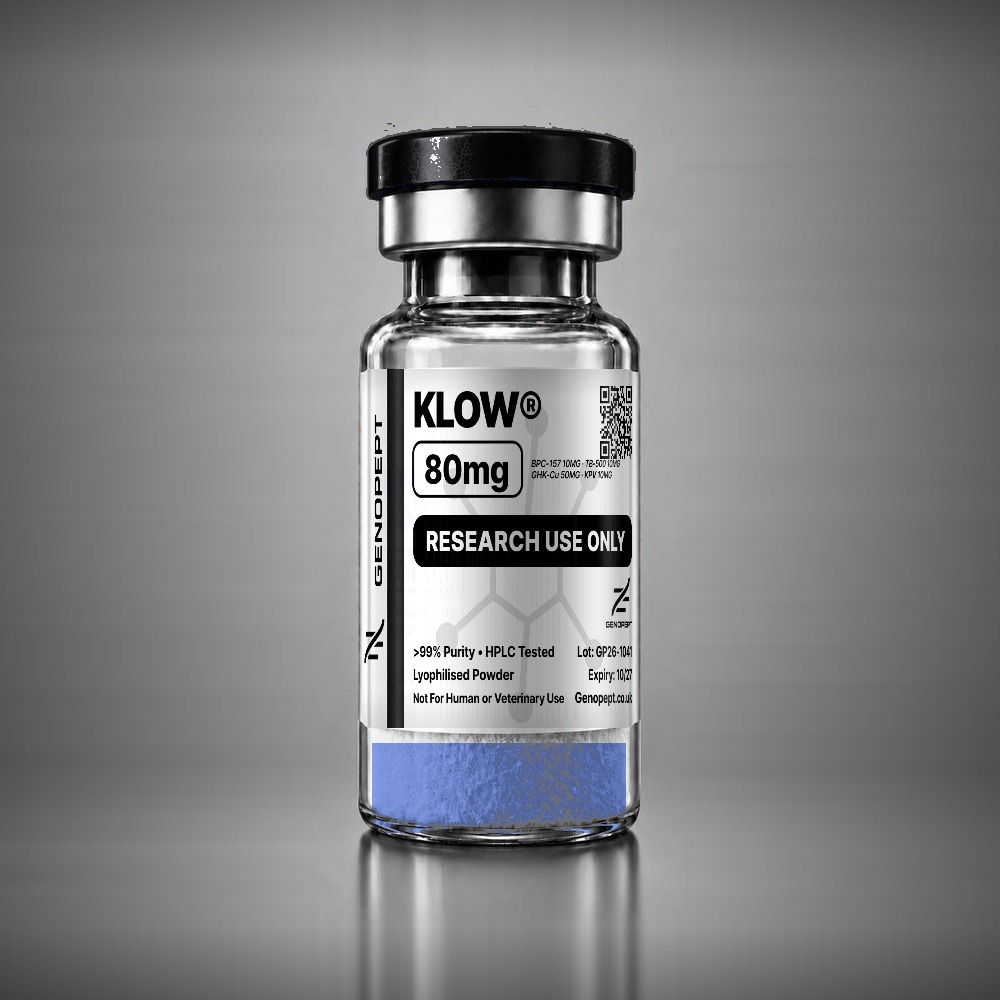
What is KLOW Blend?
KLOW Blend is a four-peptide research blend containing BPC-157, TB-500, GHK-Cu and KPV in a single 80mg lyophilised vial. BPC-157 is a synthetic 15-amino-acid gastric-derived peptide; TB-500 is a synthetic N-acetylated seven-residue fragment of thymosin beta-4; GHK-Cu is the copper(II) complex of the tripeptide glycyl-histidyl-lysine; and KPV is the tripeptide lysine-proline-valine, residues 11–13 of alpha-MSH.
The blend extends the three-component GLOW formulation by adding KPV, which is studied in preclinical models for inhibition of NF-κB-driven inflammation. A single vial therefore covers repair signalling, cell migration, copper-dependent matrix remodelling and inflammatory pathway modulation.
The vial contains 80mg of peptide in total; the per-component quantities are given on the batch Certificate of Analysis rather than on this page. GenoPept supplies KLOW Blend as a lyophilised powder for in-vitro laboratory research in the UK.
KLOW Blend research applications
KLOW Blend research draws on the preclinical literature for each of its four components and on multi-peptide studies in repair and inflammation models. The main areas are summarised below and none are approved uses.
Wound models with an inflammatory component
Animal and ex-vivo wound models examine whether adding KPV, which has been reported to reduce IL-6, IL-8 and TNF-α output in cell cultures, changes the repair end points associated with BPC-157, TB-500 and GHK-Cu.
Gut injury and colitis research
BPC-157 and KPV are both extensively studied in rodent colitis and gastric injury models; KLOW Blend allows laboratories to add the migration and matrix components in the same experiment.
Skin, matrix and collagen research
GHK-Cu contributes the collagen, elastin and glycosaminoglycan synthesis pathways studied in fibroblast cultures, while KPV is investigated in keratinocytes for oxidative stress and MAPK signalling.
Multi-pathway mechanism studies
The four components act on distinct targets, so KLOW Blend supports factorial designs in which individual peptides are omitted to isolate their contribution.
Mechanism of action (preclinical)
Each component of KLOW Blend has a separate preclinical mechanism. BPC-157 modulates the nitric oxide system and growth-factor signalling (FAK-paxillin, VEGFR2). TB-500 reproduces the actin-binding LKKTET motif of thymosin beta-4 and regulates cytoskeletal dynamics and cell motility.
GHK-Cu delivers copper(II) to enzymes such as lysyl oxidase and superoxide dismutase and has been reported to modulate a broad set of genes involved in matrix remodelling and inflammation. KPV inhibits NF-κB activation in cell models, reportedly by reducing IκB degradation and p65 nuclear translocation, and is taken up by intestinal epithelial cells via the PepT1 transporter. Whether these mechanisms interact in a combined system is the subject of ongoing research; all findings described are preclinical.
KLOW Blend product specifications
Component values are drawn from public chemical databases; LC-MS identity testing confirms all four peptides in every batch. Per-component quantities appear on the batch COA.
| Specification | Detail |
|---|---|
| Compound | KLOW Blend: BPC-157 + TB-500 + GHK-Cu + KPV in a single 80mg vial |
| Also known as | BPC-157 + TB-500 + GHK-Cu + KPV blend, KLOW peptide blend, GLOW + KPV blend, Klow 80 |
| Sequence / class | Blend of four synthetic peptides: BPC-157, 15 amino acids (CAS 137525-51-0, 1419.5 g/mol); TB-500, Ac-LKKTETQ (CAS 885340-08-9, 889.0 g/mol); GHK-Cu, Gly-His-Lys-Cu (CAS 89030-95-5, 401.9 g/mol); KPV, Lys-Pro-Val (CAS 67727-97-3, 342.4 g/mol) |
| Form | Lyophilised powder, sealed sterile glass vial, black cap, lot and expiry on label |
| Available sizes | 80mg |
| Purity | Batch-specific; see applicable report |
| Verification | Batch-specific; see applicable report |
| Storage (unopened) | –20 °C long term; 2–8 °C short term; protect from light |
| Intended use | In-vitro laboratory research only; not for human or veterinary use |
Available sizes
KLOW Blend is currently supplied in one combined vial size:
- 80mg vial – BPC-157 + TB-500 + GHK-Cu + KPV, 80mg total peptide; component breakdown on the COA
Bulk boxes of 10 vials save 20–50% against single-vial pricing; see the bulk and wholesale page for details. Orders of £200 or more qualify for free tracked UK delivery.
Reconstitution, handling and storage (laboratory)
Unopened vials should be stored at –20 °C for long-term storage, or at 2–8 °C for short periods, always protected from light. Keep vials sealed until the day they are needed.
To reconstitute, allow the vial to reach room temperature, then add bacteriostatic water or another sterile diluent slowly down the inside wall of the vial. Swirl gently until the powder dissolves; never shake, because shear can damage peptide chains. KLOW Blend reconstitutes to a blue-tinted solution because of the copper peptide; use the component quantities on the COA to calculate the concentration of each peptide in your stock.
Once in solution, keep the vial at 2–8 °C and use it within the period stated in your laboratory protocol. See our guides on how to reconstitute research peptides and how to store research peptides.
Quality assurance and Certificate of Analysis
Purity and identity results are batch-specific. Consult the applicable supplied report for its results and methods; confirm the batch covers current stock and verify the laboratory’s accreditation scope directly.
Use the “View Certificate of Analysis” button on this page to open the COA for the current batch, or browse the complete library at genopept.co.uk/coa-certificates. Our guide on what a Certificate of Analysis shows explains how to read the chromatogram and mass spectrum. Vials carry lot number and expiry so results trace to the exact material supplied.
Related research compounds
- GLOW Blend (BPC-157 + TB-500 + GHK-Cu) – the three-peptide blend without KPV, for study arms that exclude the anti-inflammatory component.
- KPV – the single-peptide vial for KPV-only control arms.
- Wolverine Blend (BPC-157 + TB-500) – the two-peptide repair blend without copper or KPV.
- GHK-Cu Copper Peptide – the single-peptide copper tripeptide vial for matrix-remodelling arms.
KLOW Blend frequently asked questions
What is KLOW Blend used for in research?
KLOW Blend is used in preclinical research that combines tissue-repair, matrix-remodelling and anti-inflammatory peptides in one system, typically in wound, colitis, fibroblast and keratinocyte models. Researchers examine whether the NF-κB-inhibiting tripeptide KPV changes the repair end points associated with BPC-157, TB-500 and GHK-Cu. GenoPept supplies KLOW Blend solely for in-vitro laboratory research; all findings are from animal and cell models.
How is KLOW Blend supplied and what purity is it?
Purity and identity results are batch-specific. Consult the applicable supplied report for its results and methods; confirm the batch covers current stock and verify the laboratory’s accreditation scope directly.
How should KLOW Blend be stored?
Store unopened KLOW Blend vials at –20 °C for long-term storage or at 2–8 °C for short-term use, protected from light. After reconstitution with bacteriostatic water, keep the blue-tinted solution at 2–8 °C and use it within the period stated in your laboratory protocol. Avoid repeated freeze-thaw cycles and metal containers that could compete for the copper ion.
Is KLOW Blend for human use?
No. KLOW Blend from GenoPept is for in-vitro laboratory research only. It is not a medicine or a cosmetic product, is not approved for human or veterinary use in the UK or elsewhere, and is not for diagnostic or therapeutic purposes. We do not provide dosing or administration guidance, and purchasers must confirm the blend is for legitimate research.
What does KPV add to the KLOW Blend?
KPV is the C-terminal tripeptide of alpha-MSH (Lys-Pro-Val) and is studied in cell and rodent models for inhibition of NF-κB signalling and reduced inflammatory cytokine output, without the pigmentation activity of the parent hormone. Adding it to the GLOW combination gives researchers an inflammation-modulating component alongside the repair, migration and copper-dependent remodelling pathways of BPC-157, TB-500 and GHK-Cu.
Research use only. This product is supplied strictly for in-vitro laboratory research in the UK. It is not for human or veterinary use, is not a medicine, and is not for diagnostic or therapeutic use. Nothing on this page is medical advice. See our research use only policy and UK legal guide.
Research guides: BPC-157 vs TB-500 · GHK-Cu (Copper Peptide) Research Guide · Peptide Blends Explained · TB-500 (Thymosin Beta-4) Research Guide · Immune and Antimicrobial Peptides Research Guide
Reviews
There are no reviews yet.