
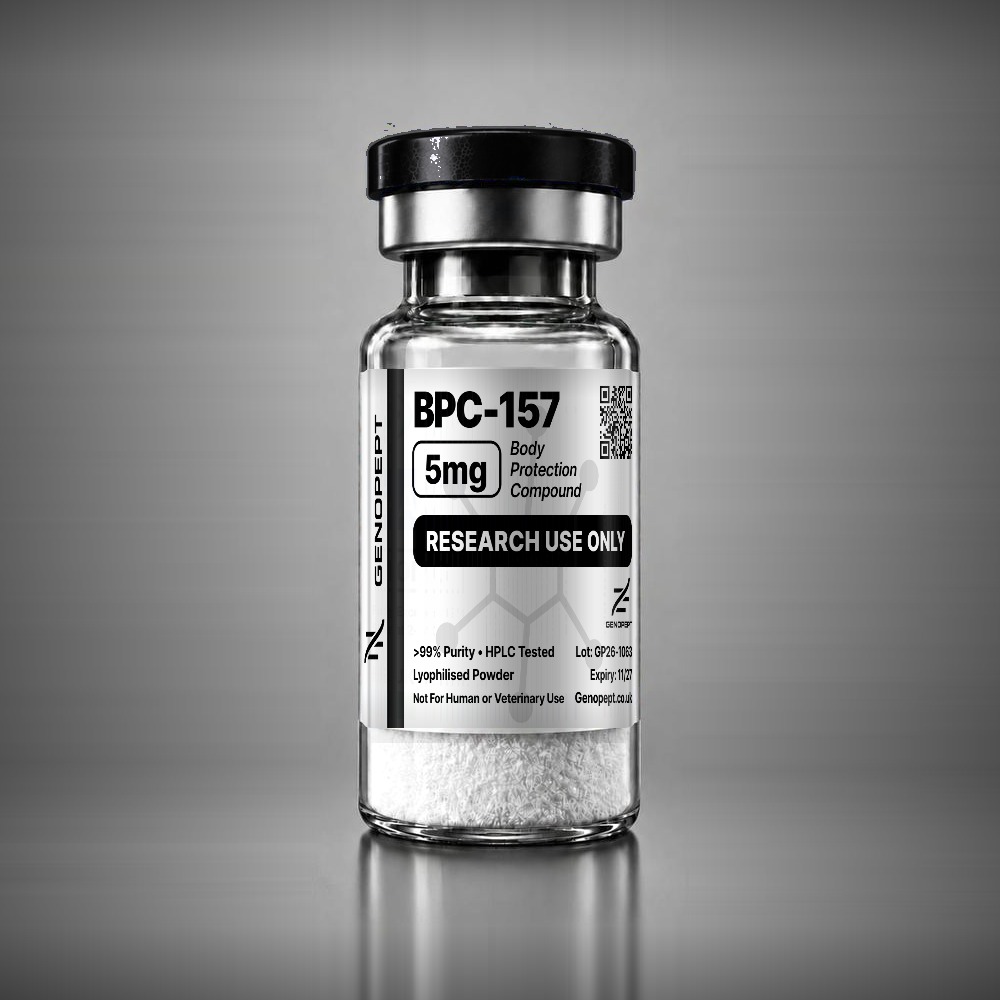
What is BPC-157?
BPC-157 is a synthetic pentadecapeptide (15 amino acids, sequence Gly-Glu-Pro-Pro-Pro-Gly-Lys-Pro-Ala-Asp-Asp-Ala-Gly-Leu-Val) derived from a partial sequence of a protective protein identified in human gastric juice. The name stands for Body Protection Compound-157, and it is one of the most requested repair and recovery research peptides in the UK.
Unlike many signalling peptides, BPC-157 has no single classical receptor. Published preclinical work associates it with nitric oxide (NO) system modulation, growth-factor receptor signalling (including VEGFR2 and the FAK-paxillin pathway) and angiogenesis. It is stable in acidic conditions, which is one reason the compound has attracted so much interest in gut-focused animal studies.
GenoPept supplies BPC-157 as a lyophilised powder in 2mg, 5mg, 10mg and 20mg vials for in-vitro laboratory research. Researchers looking to buy BPC-157 in the UK can view the batch Certificate of Analysis before ordering.
BPC-157 research applications
Published research on BPC-157 is almost entirely preclinical, using rodent, cell-culture and ex-vivo tissue models. The main areas of investigation are listed below; none of these are approved uses, and the compound is supplied only for laboratory study.
Tendon, ligament and muscle injury models
BPC-157 has been investigated in rat models of Achilles tendon transection, medial collateral ligament injury and crush injury of skeletal muscle, where researchers report changes in fibroblast migration and outgrowth from tendon explants.
Gastrointestinal models
The compound originates from gastric juice, and a large body of animal work examines it in models of gastric ulceration, colitis, fistulas and NSAID-induced gut lesions. Its gut-related studies are the reason it is sometimes called a cytoprotective peptide.
Vascular and angiogenesis research
Studies in rodents explore BPC-157 in models of vessel occlusion and ischaemia-reperfusion, with reported effects on collateral vessel formation and endothelial signalling.
Nervous system models
Preclinical research has also looked at BPC-157 in models of nerve crush, traumatic brain injury and dopaminergic disturbance, examining behavioural and histological end points.
Comparative peptide studies
Because BPC-157 and TB-500 are frequently co-investigated, many laboratories study them side by side; our BPC-157 vs TB-500 research comparison summarises the published differences.
Mechanism of action (preclinical)
The mechanism of BPC-157 remains under investigation, and the literature describes several converging pathways rather than one receptor. In cell-culture work the peptide has been reported to increase phosphorylation of focal adhesion kinase (FAK) and paxillin, promoting fibroblast migration and adhesion, which is thought to underlie its effects in tendon explant models.
Interaction with the nitric oxide system is a recurring theme: in animal models BPC-157 has been reported to counter both NO synthase inhibition and NO over-production, suggesting a modulatory rather than one-directional effect. Reported up-regulation of VEGFR2 and early growth response gene-1 (EGR-1) links the peptide to angiogenesis and tissue remodelling. These findings are preclinical and are described here for research context only.
BPC-157 product specifications
The values below are drawn from public chemical databases and are confirmed for each batch by LC-MS identity testing.
| Specification | Detail |
|---|---|
| Compound | BPC-157 (Body Protection Compound-157), synthetic pentadecapeptide |
| Also known as | Body Protection Compound-157, Bepecin, PL 14736, BPC 157, Pentadecapeptide BPC 157 |
| Sequence / class | 15-amino-acid synthetic peptide (Gly-Glu-Pro-Pro-Pro-Gly-Lys-Pro-Ala-Asp-Asp-Ala-Gly-Leu-Val) |
| CAS number | 137525-51-0 |
| Molecular formula | C62H98N16O22 |
| Molecular weight | 1419.5 g/mol |
| Form | Lyophilised powder, sealed sterile glass vial, black cap, lot and expiry on label |
| Available sizes | 2mg, 5mg, 10mg, 20mg |
| Purity | Batch-specific; see applicable report |
| Verification | Batch-specific; see applicable report |
| Storage (unopened) | –20 °C long term; 2–8 °C short term; protect from light |
| Intended use | In-vitro laboratory research only; not for human or veterinary use |
Available sizes
BPC-157 is offered in four vial sizes so laboratories can match the quantity to their study design:
- 2mg vial – suited to pilot and cell-culture work
- 5mg vial
- 10mg vial
- 20mg vial – for larger or multi-arm animal studies
Bulk boxes of 10 vials save 20–50% against single-vial pricing; see the bulk and wholesale page for details. Orders of £200 or more qualify for free tracked UK delivery.
Reconstitution, handling and storage (laboratory)
Unopened vials should be stored at –20 °C for long-term storage, or at 2–8 °C for short periods, always protected from light. Keep vials sealed until the day they are needed.
To reconstitute, allow the vial to reach room temperature, then add bacteriostatic water or another sterile diluent slowly down the inside wall of the vial. Swirl gently until the powder dissolves; never shake, because shear can damage peptide chains. A 5mg BPC-157 vial reconstituted with 2 ml of diluent gives a 2.5 mg/ml stock; scale the volume to suit the concentration your assay requires.
Once in solution, keep the vial at 2–8 °C and use it within the period stated in your laboratory protocol. See our guides on how to reconstitute research peptides and how to store research peptides.
Quality assurance and Certificate of Analysis
Purity and identity results are batch-specific. Consult the applicable supplied report for its results and methods; confirm the batch covers current stock and verify the laboratory’s accreditation scope directly.
Use the “View Certificate of Analysis” button on this page to open the COA for the current batch, or browse the complete library at genopept.co.uk/coa-certificates. Our guide on what a Certificate of Analysis shows explains how to read the chromatogram and mass spectrum. Vials carry lot number and expiry so results trace to the exact material supplied.
Related research compounds
- TB-500 (Thymosin Beta-4 Fragment) – the peptide most often co-investigated with BPC-157 in repair models.
- Wolverine Blend (BPC-157 + TB-500) – both compounds pre-combined in a single vial for comparative work.
- GHK-Cu Copper Peptide – a copper tripeptide studied for collagen and remodelling pathways.
- KPV – an alpha-MSH-derived tripeptide studied in inflammation models, often paired with BPC-157 in gut research.
BPC-157 frequently asked questions
What is BPC-157 used for in research?
BPC-157 is used in preclinical research on tissue repair, particularly rodent models of tendon, ligament, muscle, gut and vascular injury. Laboratories also study its interaction with the nitric oxide system and growth-factor signalling pathways such as VEGFR2 and FAK-paxillin. All published work is in animal or cell models, and GenoPept supplies the peptide solely for that type of in-vitro laboratory investigation.
How is BPC-157 supplied and what purity is it?
Purity and identity results are batch-specific. Consult the applicable supplied report for its results and methods; confirm the batch covers current stock and verify the laboratory’s accreditation scope directly.
How should BPC-157 be stored?
Store unopened lyophilised BPC-157 vials at –20 °C for long-term storage, or at 2–8 °C if they will be used within a short period, and keep them protected from light. After reconstitution with bacteriostatic water, hold the solution at 2–8 °C and use it within the period defined in your laboratory protocol. Avoid repeated freeze-thaw cycles.
Is BPC-157 for human use?
No. BPC-157 from GenoPept is for in-vitro laboratory research only. It is not a medicine, is not approved by any regulator for human or veterinary use, and is not intended for diagnostic or therapeutic purposes. We do not provide dosing information, and purchasers must confirm they are buying for legitimate research applications.
What is the difference between BPC-157 and TB-500?
BPC-157 is a 15-amino-acid peptide derived from a gastric protein and is studied mainly for growth-factor and nitric oxide pathways, whereas TB-500 is a fragment of thymosin beta-4 that binds actin and is studied for cell migration. The two are frequently co-investigated; our BPC-157 vs TB-500 comparison article covers the published differences in detail.
Research use only. This product is supplied strictly for in-vitro laboratory research in the UK. It is not for human or veterinary use, is not a medicine, and is not for diagnostic or therapeutic use. Nothing on this page is medical advice. See our research use only policy and UK legal guide.
Research guides: Bacteriostatic Water for Research Peptides · BPC-157 Research Guide · BPC-157 vs TB-500 · How to Choose a Research Peptide Supplier in the UK · How to Reconstitute Research Peptides
Reviews
There are no reviews yet.