
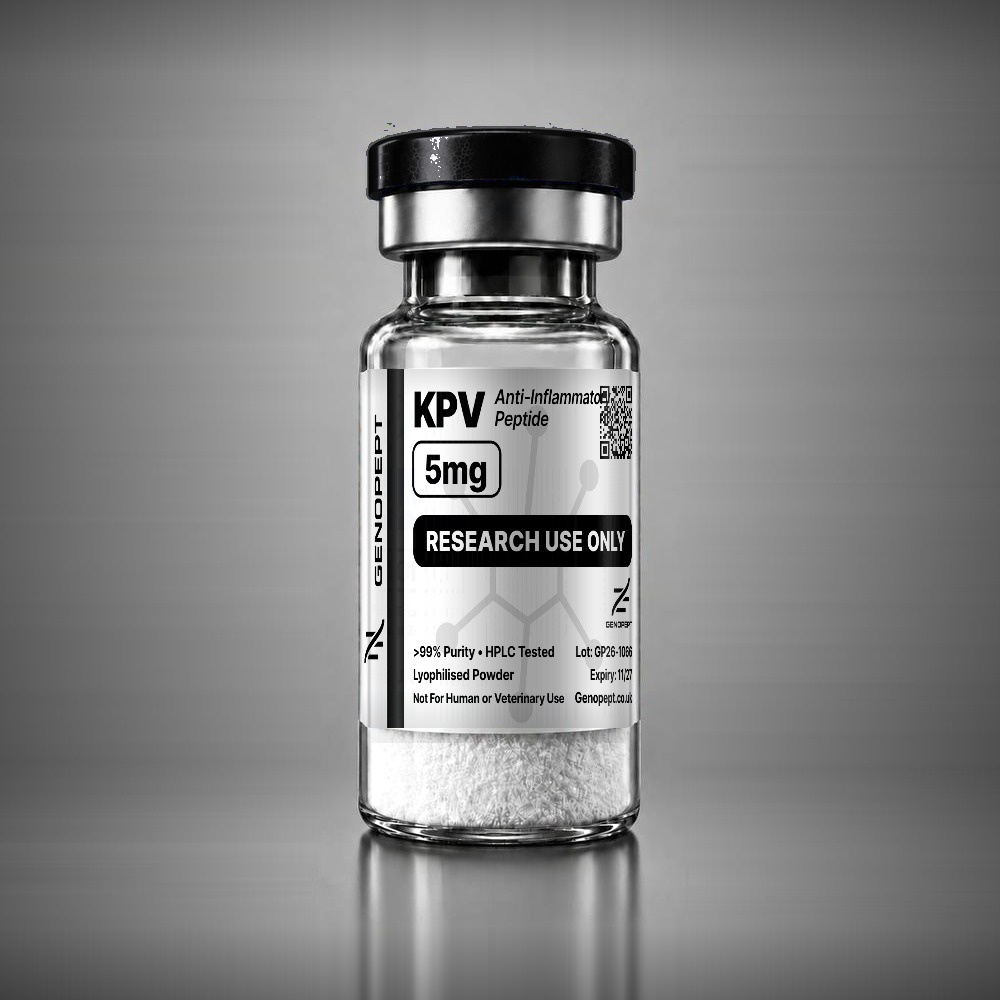
What is KPV?
KPV is a synthetic tripeptide with the sequence lysine-proline-valine (Lys-Pro-Val), identical to the C-terminal residues 11–13 of alpha-melanocyte-stimulating hormone (α-MSH), a 13-amino-acid melanocortin. Research on KPV explores whether this minimal fragment retains the anti-inflammatory signalling of the parent hormone without its pigmentation-related activity at melanocortin-1 receptors.
With a molecular weight of about 342 g/mol, KPV is one of the smallest peptides in the GenoPept catalogue. Its small size allows uptake through the intestinal peptide transporter PepT1 in cell and animal models, a feature that has made KPV a popular tool in gut inflammation research.
GenoPept supplies KPV as a lyophilised powder in 5mg and 10mg vials for in-vitro laboratory research. Researchers wanting to buy KPV in the UK can check the batch Certificate of Analysis before ordering.
KPV research applications
KPV research is preclinical, drawing on cell-culture, mouse and rat models. The main directions are summarised below and none represent approved uses.
Intestinal inflammation models
KPV has been investigated in dextran sulphate sodium (DSS) and TNBS colitis models in mice, where researchers report reduced inflammatory cytokine expression and tissue damage scores. Uptake via PepT1 in colonic epithelial cells is a recurring theme.
Skin and keratinocyte research
Cell studies examine KPV in keratinocytes challenged with inflammatory stimuli, measuring oxidative stress markers and MAPK and NF-κB pathway activity. This work informs its use in cosmetic-science and dermal research.
Immune cell signalling
KPV is studied in macrophage and T-cell cultures for effects on IL-6, IL-8 and TNF-α production, and for its interaction with NF-κB nuclear translocation.
Antimicrobial studies
Some published work reports that KPV and related α-MSH fragments have antimicrobial activity against Staphylococcus aureus and Candida albicans in vitro.
Combination research
Because KPV targets inflammation while BPC-157 and TB-500 are studied for repair, KPV appears in multi-peptide research such as the KLOW Blend.
Mechanism of action (preclinical)
The best characterised action of KPV in cell models is inhibition of NF-κB activation. KPV has been reported to reduce IκB degradation and nuclear translocation of the p65 subunit, lowering transcription of pro-inflammatory cytokines. Interestingly, several studies suggest this occurs independently of classical melanocortin receptor binding, which distinguishes KPV from full-length α-MSH.
In intestinal epithelial cells the tripeptide is transported by PepT1, allowing direct intracellular effects. Additional preclinical findings include modulation of MAPK signalling and reduced reactive oxygen species in keratinocytes. All of these observations come from laboratory models and are described here for research context only.
KPV product specifications
The values below are drawn from public chemical databases and are confirmed for each batch by LC-MS identity testing.
| Specification | Detail |
|---|---|
| Compound | KPV (Lys-Pro-Val), synthetic tripeptide, α-MSH fragment 11–13 |
| Also known as | Lys-Pro-Val, α-MSH (11–13), alpha-MSH 11-13, ACTH (11–13), Lysyl-prolyl-valine |
| Sequence / class | 3-amino-acid synthetic peptide (Lys-Pro-Val), C-terminal fragment of alpha-MSH |
| CAS number | 67727-97-3 |
| Molecular formula | C16H30N4O4 |
| Molecular weight | 342.4 g/mol |
| Form | Lyophilised powder, sealed sterile glass vial, black cap, lot and expiry on label |
| Available sizes | 5mg, 10mg |
| Purity | Batch-specific; see applicable report |
| Verification | Batch-specific; see applicable report |
| Storage (unopened) | –20 °C long term; 2–8 °C short term; protect from light |
| Intended use | In-vitro laboratory research only; not for human or veterinary use |
Available sizes
KPV is available in two vial sizes:
- 5mg vial – suited to cell-culture and pilot studies
- 10mg vial – for larger or repeated assays
Bulk boxes of 10 vials save 20–50% against single-vial pricing; see the bulk and wholesale page for details. Orders of £200 or more qualify for free tracked UK delivery.
Reconstitution, handling and storage (laboratory)
Unopened vials should be stored at –20 °C for long-term storage, or at 2–8 °C for short periods, always protected from light. Keep vials sealed until the day they are needed.
To reconstitute, allow the vial to reach room temperature, then add bacteriostatic water or another sterile diluent slowly down the inside wall of the vial. Swirl gently until the powder dissolves; never shake, because shear can damage peptide chains. Because KPV has a low molecular weight, a 5mg vial in 1 ml of diluent gives a molar concentration of roughly 14.6 mM; dilute further to the working range required by your assay.
Once in solution, keep the vial at 2–8 °C and use it within the period stated in your laboratory protocol. See our guides on how to reconstitute research peptides and how to store research peptides.
Quality assurance and Certificate of Analysis
Purity and identity results are batch-specific. Consult the applicable supplied report for its results and methods; confirm the batch covers current stock and verify the laboratory’s accreditation scope directly.
Use the “View Certificate of Analysis” button on this page to open the COA for the current batch, or browse the complete library at genopept.co.uk/coa-certificates. Our guide on what a Certificate of Analysis shows explains how to read the chromatogram and mass spectrum. Vials carry lot number and expiry so results trace to the exact material supplied.
Related research compounds
- KLOW Blend (BPC-157 + TB-500 + GHK-Cu + KPV) – the four-peptide research blend that includes KPV.
- BPC-157 (Body Protection Compound) – frequently studied alongside KPV in gut injury models.
- LL-37 Antimicrobial Peptide – a human cathelicidin studied for innate immunity and antimicrobial action.
- Thymosin Alpha-1 (Tα1) – an immune-modulating peptide for comparative immunology work.
KPV frequently asked questions
What is KPV used for in research?
KPV is used in preclinical inflammation research. Laboratories study it in mouse colitis models, keratinocyte and macrophage cultures, and assays of NF-κB and MAPK signalling, as well as in vitro antimicrobial screens. Its uptake by the PepT1 transporter makes it a useful tool for gut epithelial studies. GenoPept supplies KPV only for this type of in-vitro laboratory work.
How is KPV supplied and what purity is it?
Purity and identity results are batch-specific. Consult the applicable supplied report for its results and methods; confirm the batch covers current stock and verify the laboratory’s accreditation scope directly.
How should KPV be stored?
Store unopened KPV vials at –20 °C for long-term storage, or at 2–8 °C for short-term use, and protect them from light. After reconstitution with bacteriostatic water, keep the solution at 2–8 °C and use it within the period stated in your laboratory protocol. As a small tripeptide, KPV is comparatively stable, but repeated freeze-thaw should still be avoided.
Is KPV for human use?
No. KPV from GenoPept is supplied for in-vitro laboratory research only. It is not a medicine, is not approved for human or veterinary use, and is not for diagnostic or therapeutic purposes. We do not provide dosing or administration guidance, and customers must confirm that the material is being purchased for legitimate research.
How does KPV differ from alpha-MSH?
Alpha-MSH is the full 13-amino-acid melanocortin hormone that binds melanocortin receptors and drives pigmentation, whereas KPV is only its last three residues (Lys-Pro-Val). Published research reports that KPV retains NF-κB-inhibiting, anti-inflammatory activity in cell models but lacks the pigmentation-related receptor activity of the parent hormone, which is why it is studied as a minimal fragment.
Research use only. This product is supplied strictly for in-vitro laboratory research in the UK. It is not for human or veterinary use, is not a medicine, and is not for diagnostic or therapeutic use. Nothing on this page is medical advice. See our research use only policy and UK legal guide.
Research guides: Immune and Antimicrobial Peptides Research Guide
Reviews
There are no reviews yet.