
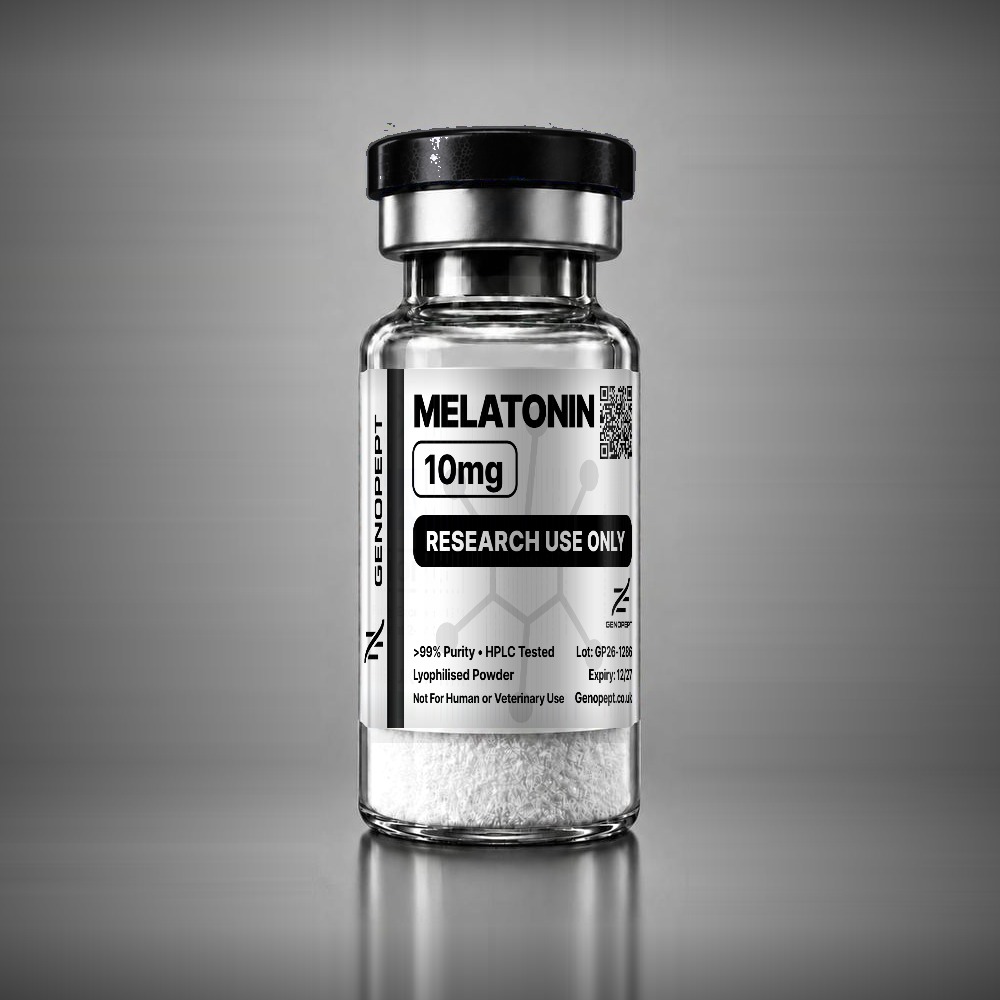
What is Melatonin 10mg?
Melatonin is a small-molecule indoleamine, chemically N-acetyl-5-methoxytryptamine, synthesised from the amino acid tryptophan through 5-hydroxytryptophan, serotonin and N-acetylserotonin. In vertebrates it is produced principally by the pineal gland in a light-dependent rhythm, and it is also made locally in skin, retina, gut and mitochondria. GenoPept supplies melatonin UK laboratories as a 10mg lyophilised research compound.
Although it is not a peptide, melatonin is stocked in our cosmetic and skin research category because it is heavily studied in keratinocyte, fibroblast and melanocyte cell models as an antioxidant and circadian signalling molecule. It acts as a full agonist at the melatonin receptors MT1 and MT2 with picomolar and nanomolar affinity respectively, and it also scavenges free radicals directly.
Melatonin 10mg research applications
Melatonin is used as a research reagent in chronobiology, antioxidant and mitochondrial research, dermatological cell science and neurobiology. The applications below summarise in-vitro and preclinical work and are not claims about effects in people.
Circadian rhythm and receptor signalling
Melatonin is the reference agonist for MT1 and MT2 receptors in cell-based assays and animal models of circadian entrainment, allowing researchers to study clock-gene expression, receptor desensitisation and the pharmacology of synthetic melatonin receptor ligands.
Antioxidant and free-radical research
Cell-culture studies investigate melatonin as a direct scavenger of hydroxyl and peroxyl radicals and as an inducer of antioxidant enzymes such as superoxide dismutase and glutathione peroxidase, with its metabolites also showing radical-scavenging activity.
Skin cell biology and photobiology
In keratinocyte, fibroblast and melanocyte cultures, melatonin is used to study protection against ultraviolet-induced oxidative damage, DNA-repair pathways and the local cutaneous melatoninergic system.
Mitochondrial function
Research explores melatonin’s accumulation in mitochondria and its influence on membrane potential, electron transport efficiency and apoptosis signalling in cell models of oxidative stress.
Neurobiology and neuroprotection models
Animal and cell models use melatonin to study neuronal responses to oxidative and excitotoxic injury, sleep-related neurochemistry and interactions with other neuromodulators.
Mechanism of action (preclinical)
Melatonin binds MT1 and MT2 receptors, both Gi/o-coupled G protein-coupled receptors, inhibiting adenylyl cyclase and lowering intracellular cAMP; MT2 activation also reduces cGMP formation. In the suprachiasmatic nucleus of animal models these receptors mediate circadian phase-shifting and modulation of neuronal firing, while in peripheral tissues they regulate local clock-gene expression.
Receptor-independent mechanisms are equally important in preclinical research. Melatonin is lipophilic, crosses cell membranes and accumulates in mitochondria, where it directly scavenges reactive oxygen and nitrogen species and upregulates antioxidant enzymes. Its oxidation products, including cyclic 3-hydroxymelatonin and N1-acetyl-N2-formyl-5-methoxykynuramine, retain antioxidant activity, creating a cascade of radical scavenging.
Melatonin 10mg product specifications
| Specification | Detail |
|---|---|
| Compound | Melatonin (N-acetyl-5-methoxytryptamine), indoleamine |
| Also known as | N-acetyl-5-methoxytryptamine, 5-Methoxy-N-acetyltryptamine, MLT |
| Sequence / class | Small-molecule indoleamine hormone derived from tryptophan via serotonin; not a peptide |
| CAS number | 73-31-4 |
| Molecular formula | C13H16N2O2 |
| Molecular weight | 232.3 g/mol |
| Form | Lyophilised (freeze-dried) powder in a sealed, sterile glass vial with black cap; lot number and expiry on the label |
| Available sizes | 10mg |
| Purity | Batch-specific; see applicable report |
| Verification | Batch-specific; see applicable report |
| Storage (unopened) | –20 °C long term; 2–8 °C short term; protect from light |
| Intended use | In-vitro laboratory research only. Not for human or veterinary use, not a medicine, not for diagnostic or therapeutic use |
Available sizes
Melatonin is currently supplied in a single research vial size suitable for cell-culture and small animal-model studies:
- 10mg vial
Laboratories running larger studies can order it in bulk boxes of 10 vials at 20–50% below single-vial pricing through our bulk and wholesale page, with UK-only retail delivery.
Reconstitution, handling and storage (laboratory)
This compound is supplied as a lyophilised powder and should be stored unopened at –20 °C for long-term holding, or at 2–8 °C for short periods, always protected from light. Melatonin is light-sensitive and has limited water solubility, so protect it from light and, where a protocol allows, dissolve it first in a small volume of ethanol or DMSO before diluting into aqueous buffer.
To reconstitute for in-vitro work, add bacteriostatic water or another sterile diluent slowly down the inside wall of the vial, then swirl gently until the powder dissolves. Never shake the vial, because shear can damage the molecule. After reconstitution keep the solution at 2–8 °C and use it within the period stated in the laboratory protocol. UK laboratories can also read our guides on how to reconstitute research peptides and how to store research peptides.
Quality assurance and Certificate of Analysis
Purity and identity results are batch-specific. Consult the applicable supplied report for its results and methods; confirm the batch covers current stock and verify the laboratory’s accreditation scope directly.
For melatonin the LC-MS identity test confirms the expected mass of N-acetyl-5-methoxytryptamine and HPLC quantifies purity against related indole impurities. Our article on what a Certificate of Analysis shows explains how to read the purity chromatogram and mass spectrum. Orders are dispatched from the UK by tracked Royal Mail Special Delivery (£10, free on orders of £200 or more), with automatic cart discounts of 5% from £300, 10% from £500 and 15% from £1,000. We accept card, Apple Pay, Google Pay and cryptocurrency payments.
Related research compounds
- DSIP (Delta Sleep-Inducing Peptide) – a neuropeptide studied alongside melatonin in sleep and circadian research.
- Epitalon (Epithalon) Telomerase Activator – a pineal-derived tetrapeptide investigated for its relationship to melatonin synthesis.
- Glutathione – a complementary antioxidant for oxidative-stress cell models.
- Pinealon Neuroprotective Peptide – a short peptide bioregulator studied in neuroprotection models.
Melatonin 10mg frequently asked questions
What is melatonin used for in research?
Melatonin is used as the reference MT1 and MT2 receptor agonist in circadian and chronobiology research, as a direct antioxidant in oxidative-stress and mitochondrial cell models, and in keratinocyte, fibroblast and melanocyte cultures to study protection against ultraviolet-induced damage. It is also used in neuroprotection and sleep-neurochemistry animal models. All applications are in-vitro or preclinical.
How is melatonin supplied and what purity is it?
Purity and identity results are batch-specific. Consult the applicable supplied report for its results and methods; confirm the batch covers current stock and verify the laboratory’s accreditation scope directly.
How should melatonin be stored?
Store unopened melatonin vials at –20 °C for long-term holding, or at 2–8 °C for short periods, protected from light because melatonin degrades under illumination. After dissolution in a suitable solvent for the assay, keep the solution at 2–8 °C in the dark and use it within the period defined by your laboratory protocol.
Is melatonin for human use?
No. Melatonin from GenoPept is sold strictly for in-vitro laboratory research. It is not for human or veterinary use, it is not a medicine or supplement, and it is not for diagnostic or therapeutic purposes. We do not provide dosing or usage guidance, and nothing on this page should be interpreted as advice.
Is melatonin a peptide?
No. Melatonin is a small-molecule indoleamine (N-acetyl-5-methoxytryptamine) with a molecular weight of about 232 g/mol, not a chain of amino acids. It is derived from a single amino acid, tryptophan, via serotonin. GenoPept lists it among cosmetic and skin research compounds because it is widely studied in the same cell models as peptides such as GHK-Cu and palmitoyl pentapeptide-4.
Research use only. Melatonin is supplied strictly for in-vitro laboratory research. It is not for human or veterinary use, it is not a medicine, and it is not for diagnostic or therapeutic use. Nothing on this page is medical advice. Read our research use only policy and guide to research peptides and UK law before ordering.
Reviews
There are no reviews yet.