
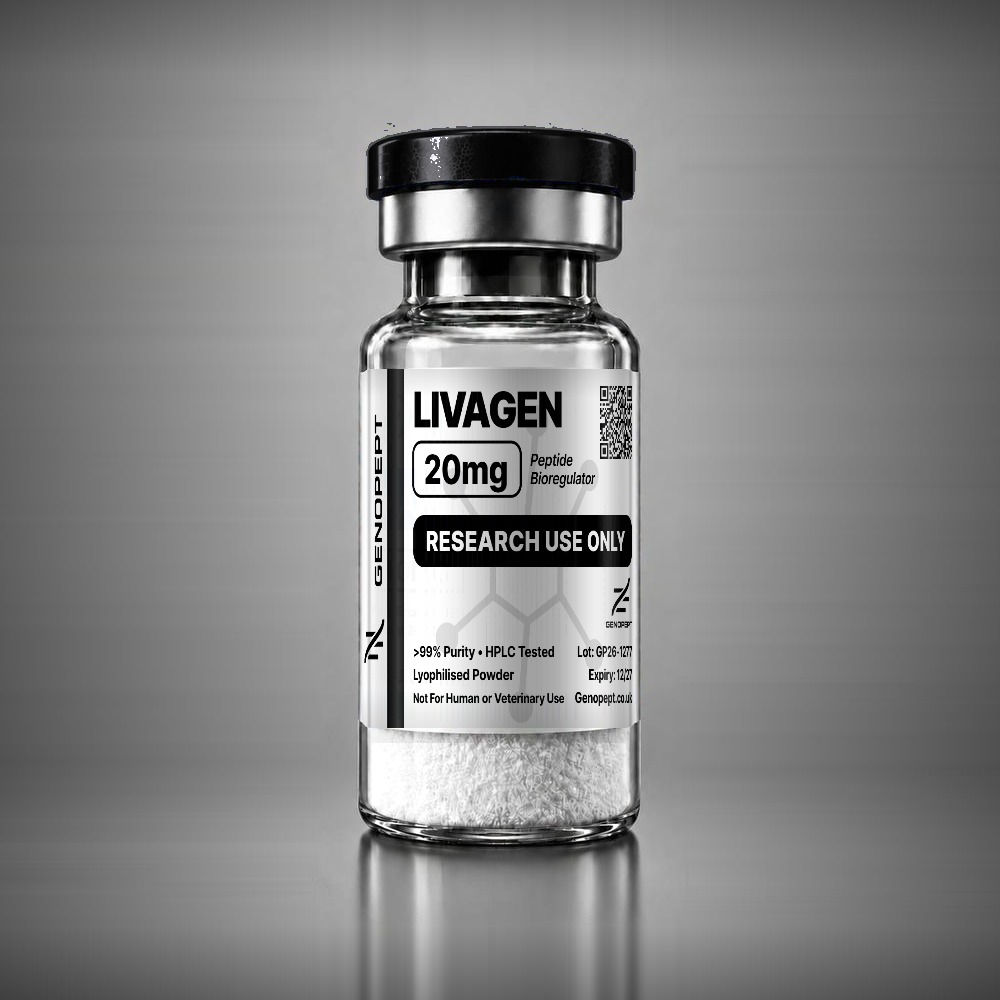
What is Livagen?
Livagen is a synthetic tetrapeptide bioregulator with the sequence Lys-Glu-Asp-Ala (KEDA), designed as a defined analogue of short peptides isolated from liver tissue. It belongs to the Khavinson series and is associated in preclinical research with hepatocytes and with liver-related metabolic and gene-expression endpoints.
Livagen is also one of the peptides used in chromatin-activation studies on lymphocytes from aged donors, which is why it appears in both hepatology and gerontology literature. GenoPept supplies Livagen UK-wide as a 20mg lyophilised research vial. Our guide to peptide bioregulators explains how Livagen fits within the Khavinson series.
Livagen research applications
Research on this peptide is confined to preclinical settings, chiefly cell culture and rodent models, with a focus on liver and hepatocytes. The areas below summarise where the published literature has investigated the KEDA sequence.
Hepatocyte culture
Livagen has been investigated in primary hepatocyte and hepatoma cell lines, with reported endpoints including proliferation, expression of liver-specific enzymes and markers of cellular stress.
Chromatin activation assays
Published work has used the KEDA tetrapeptide in assays of heterochromatin decondensation and ribosomal gene activity in cultured lymphocytes from elderly donors, a standard bioregulator experimental model.
Liver ageing and metabolic models
Research explores whether Livagen alters age-related changes in hepatic tissue in aged rodents, including lipid-handling gene expression and antioxidant enzyme activity.
Comparison with Ovagen
Livagen and Ovagen are both liver-associated Khavinson peptides; side-by-side studies compare their effects on hepatocyte gene expression to understand the contribution of the lysine residue.
Mechanism of action (preclinical)
The mechanism proposed for Livagen follows the general Khavinson model: penetration into the cell and nucleus, followed by interaction with DNA and histone proteins to alter transcription of tissue-relevant genes. In lymphocyte studies, Livagen is reported to promote decondensation of heterochromatin and activation of ribosomal genes, an effect interpreted as restoration of transcriptional activity in aged cells. In hepatocyte models, research has reported changes in expression of enzymes tied to liver metabolism. A defined receptor has not been identified.
Livagen product specifications
| Specification | Detail |
|---|---|
| Compound | Livagen |
| Also known as | Livagen peptide, KEDA peptide, Lys-Glu-Asp-Ala, liver bioregulator |
| Sequence / class | 4-amino-acid synthetic tetrapeptide (Lys-Glu-Asp-Ala, KEDA) |
| Molecular formula | C18H31N5O9 |
| Molecular weight | 461.5 g/mol (calculated from sequence) |
| Form | Lyophilised powder, sealed sterile glass vial, black cap |
| Available sizes | 20mg vial |
| Purity | ≥99% (HPLC) |
| Verification | HPLC purity and LC-MS identity by independent ISO/IEC 17025 laboratory (Puralytix), batch COA |
| Storage (unopened) | –20 °C long term; 2–8 °C short term, protect from light |
| Intended use | In-vitro laboratory research only |
Available sizes
- 20mg vial (lyophilised powder)
We currently offer this peptide in one format for UK research customers. Boxes of 10 vials are available at bulk pricing, saving 20–50% compared with single vials; details are on the bulk and wholesale page.
Reconstitution, handling and storage (laboratory)
Because Livagen is an ultra-short tetrapeptide, it dissolves readily but is sensitive to mechanical stress. Reconstitute with bacteriostatic water or a sterile diluent matched to your experiment, directing the solvent down the vial wall and swirling gently. Do not shake or vortex. Our step-by-step guide to reconstituting research peptides covers volumes and technique.
Store sealed vials at –20 °C for long-term stability; 2–8 °C is acceptable for short-term holding, always protected from light. Reconstituted solutions should be refrigerated at 2–8 °C and used within the timeframe your protocol defines; avoid freeze-thaw cycling. Further detail is in our article on storing research peptides. Standard laboratory PPE and waste-disposal practice apply.
Quality assurance and Certificate of Analysis
We do not release a Livagen batch without third-party analytical data. Puralytix, an independent ISO/IEC 17025 laboratory, runs HPLC for purity (minimum 99%) and LC-MS for identity, checking the observed mass against the calculated mass of Lys-Glu-Asp-Ala. Use the View Certificate of Analysis button above or browse the full COA library; our guide to reading a Certificate of Analysis explains each section.
Related research compounds
- Ovagen 20mg – the other liver-associated tripeptide (Glu-Asp-Leu) most often compared with Livagen
- Pancragen 20mg – the pancreatic tetrapeptide, a natural partner in digestive-system panels
- Vilon 20mg – the thymic dipeptide used as a control in chromatin-activation assays
- Glutathione Master Antioxidant – a tripeptide antioxidant widely used in hepatocyte oxidative-stress research
Livagen frequently asked questions
What is Livagen used for in research?
Livagen is used in laboratory research on hepatocytes, liver tissue ageing and chromatin activation in cultured cells. Investigators apply the Lys-Glu-Asp-Ala tetrapeptide to hepatocyte and lymphocyte cultures and to aged animal models to study gene expression and metabolic enzyme activity. GenoPept supplies it strictly for in-vitro research.
What are the purity and format of Livagen from GenoPept?
Livagen is supplied as a 20mg lyophilised powder in a sealed, sterile glass vial with a black cap and lot-numbered label. Each batch is verified at 99% or higher purity by HPLC and confirmed by LC-MS at an independent ISO/IEC 17025 laboratory, with the Certificate of Analysis available on the product page.
How do I store Livagen?
Store unopened Livagen vials at minus 20 degrees Celsius long term, or at 2 to 8 degrees Celsius for short periods protected from light. Reconstituted solutions should be refrigerated at 2 to 8 degrees Celsius and used within the timeframe defined in your laboratory protocol.
Is Livagen for human use?
No. Livagen is for in-vitro laboratory research only and is not a medicine. It is not for human or veterinary use and not for diagnostic or therapeutic purposes. GenoPept does not supply dosing information and sells only to researchers conducting legitimate work in the UK.
Livagen versus Ovagen: what is the difference?
Livagen (Lys-Glu-Asp-Ala) is a four-residue peptide with a basic lysine at the N-terminus, while Ovagen (Glu-Asp-Leu) is a three-residue acidic peptide. Both are associated with liver tissue, but Livagen is additionally used in chromatin-activation studies, whereas Ovagen is more often used in digestive-tract and hepatocyte proliferation models.
Research use only. This Livagen product is supplied for in-vitro laboratory research and is not a medicine. It is not for human or veterinary use, nor for diagnostic or therapeutic purposes. Read our research use only statement and research peptides and UK law before ordering.
Reviews
There are no reviews yet.