
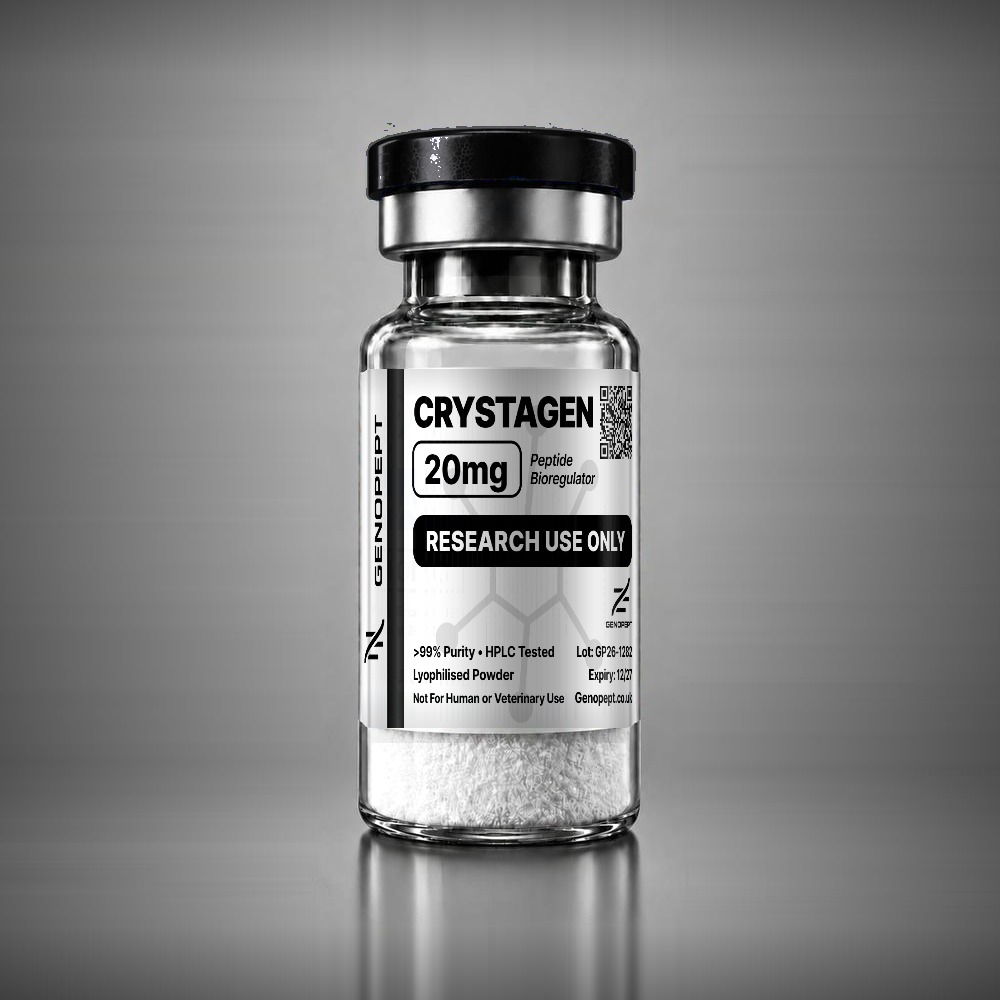
What is Crystagen?
Crystagen is a synthetic tripeptide bioregulator with the sequence Glu-Asp-Pro (EDP), developed as a defined analogue of short peptides isolated from immune tissue. Within the Khavinson family it is grouped with Vilon and Thymalin as an immune-associated bioregulator and is studied in models of thymus, spleen and lymphocyte function.
Crystagen contains a proline residue that constrains the peptide backbone, distinguishing it from the flexible Lys-Glu dipeptide of Vilon. GenoPept supplies Crystagen UK laboratories as a 20mg lyophilised vial for in-vitro immunology research. For background on the whole family, read our guide to Khavinson peptide bioregulators.
Crystagen research applications
Research on this peptide is confined to preclinical settings, chiefly cell culture and rodent models, with a focus on immune system, thymus and lymphoid tissue. The areas below summarise where the published literature has investigated the EDP sequence.
Lymphocyte and thymocyte culture
Crystagen has been investigated in cultures of peripheral lymphocytes and thymic cells, where reported readouts include proliferation, expression of activation markers and cytokine transcription.
Immunosenescence models
Research explores whether the EDP tripeptide alters age-related changes in immune cell populations in aged rodents, including thymic involution markers and lymphocyte subset ratios.
Chromatin and gene-activation assays
Crystagen is used in experiments measuring chromatin decondensation and transcriptional activity in lymphocytes, a common assay format in bioregulator research.
Comparison with other immune peptides
Because Crystagen, Vilon and Thymalin are all associated with immune tissue but differ in size and origin, they are frequently studied together to separate sequence-specific from class-wide effects.
Mechanism of action (preclinical)
The mechanism proposed for Crystagen is the nuclear, gene-regulatory model applied to all ultra-short Khavinson peptides. The Glu-Asp-Pro sequence is proposed to enter immune cells and interact with DNA and histone proteins, changing chromatin accessibility at genes involved in lymphocyte proliferation and cytokine expression. Published in-vitro work reports increased transcriptional activity and changes in interleukin-related signalling in cultured lymphocytes. These observations are preclinical; no cell-surface receptor has been identified for Crystagen.
Crystagen product specifications
| Specification | Detail |
|---|---|
| Compound | Crystagen |
| Also known as | Crystagen peptide, EDP peptide, Glu-Asp-Pro, immune bioregulator |
| Sequence / class | 3-amino-acid synthetic tripeptide (Glu-Asp-Pro, EDP) |
| Molecular formula | C14H21N3O8 |
| Molecular weight | 359.3 g/mol (calculated from sequence) |
| Form | Lyophilised powder, sealed sterile glass vial, black cap |
| Available sizes | 20mg vial |
| Purity | ≥99% (HPLC) |
| Verification | HPLC purity and LC-MS identity by independent ISO/IEC 17025 laboratory (Puralytix), batch COA |
| Storage (unopened) | –20 °C long term; 2–8 °C short term, protect from light |
| Intended use | In-vitro laboratory research only |
Available sizes
- 20mg vial (lyophilised powder)
This bioregulator is stocked in the UK in a single vial size. Laboratories running larger studies can order bulk boxes of 10 vials at 20–50% off through our bulk and wholesale page.
Reconstitution, handling and storage (laboratory)
Crystagen is supplied as a lyophilised powder and should be reconstituted only under laboratory conditions. Use bacteriostatic water or a sterile diluent appropriate to your assay. Add the solvent slowly down the inside wall of the vial, swirl gently until the powder dissolves and never shake, as agitation can degrade short peptides. Detailed steps are in our guide to reconstituting research peptides.
Unopened vials should be stored at –20 °C for long-term use, or at 2–8 °C for short periods, protected from light. After reconstitution, keep the solution at 2–8 °C and use it within the period stated in your laboratory protocol. See how to store research peptides for a full summary. Wear gloves and eye protection, work in a clean environment and dispose of residues according to local laboratory rules.
Quality assurance and Certificate of Analysis
Every batch of Crystagen we supply is tested by Puralytix, an independent ISO/IEC 17025 laboratory, using HPLC to confirm purity of at least 99% and LC-MS to confirm identity against the expected mass of the Glu-Asp-Pro sequence. The batch Certificate of Analysis is available through the View Certificate of Analysis button on this page and in our COA library. Our explainer on what a Certificate of Analysis shows describes how to read the chromatogram and mass spectrum.
Related research compounds
- Vilon 20mg – the thymic dipeptide (Lys-Glu) most closely associated with Crystagen in immune research
- Thymalin 10mg – a polypeptide thymic fraction used as a broader immune comparator
- Pancragen 20mg – the pancreatic tetrapeptide, a non-immune control in tissue-selectivity work
- Thymosin Alpha-1 (Tα1) Immune Modulator – a well-characterised immune-modulating peptide studied in lymphocyte models
Crystagen frequently asked questions
What is Crystagen used for in research?
Crystagen is used in laboratory research on immune cells and lymphoid tissue. Investigators apply the Glu-Asp-Pro tripeptide to cultured lymphocytes and thymic cells, and to aged animal models, to study proliferation, activation markers, cytokine expression and chromatin activity. GenoPept supplies it for in-vitro research use only.
What is the purity and format of GenoPept Crystagen?
Crystagen is supplied as 20mg of lyophilised powder in a sealed, sterile glass vial with a black cap. Purity is at least 99% by HPLC and identity is confirmed by LC-MS, both performed by an independent ISO/IEC 17025 laboratory. Each lot has a Certificate of Analysis accessible from the product page.
How is Crystagen stored?
Store unopened Crystagen vials at minus 20 degrees Celsius for long-term storage, or at 2 to 8 degrees Celsius short term, protected from light. Reconstituted solutions should be refrigerated at 2 to 8 degrees Celsius and used within the period defined in your laboratory protocol.
Is Crystagen for human use?
No. Crystagen from GenoPept is strictly for in-vitro laboratory research. It is not a medicine, not for human or veterinary use and not for diagnostic or therapeutic use. No dosing or administration guidance is provided and the product is sold only for legitimate research in the UK.
How does Crystagen compare with Vilon?
Crystagen (Glu-Asp-Pro) is a tripeptide with a rigid proline residue, while Vilon (Lys-Glu) is a two-residue peptide. Both are associated with immune tissue in Khavinson research, but Vilon has a larger published record, whereas Crystagen is more often used in newer immunosenescence and chromatin-activation studies. They are commonly run in parallel.
Research use only. Crystagen is sold for in-vitro laboratory research only. It is not for human or veterinary use, not a medicine, and not for diagnostic or therapeutic use. See our research use only policy and UK legal guidance on research peptides.
Reviews
There are no reviews yet.