
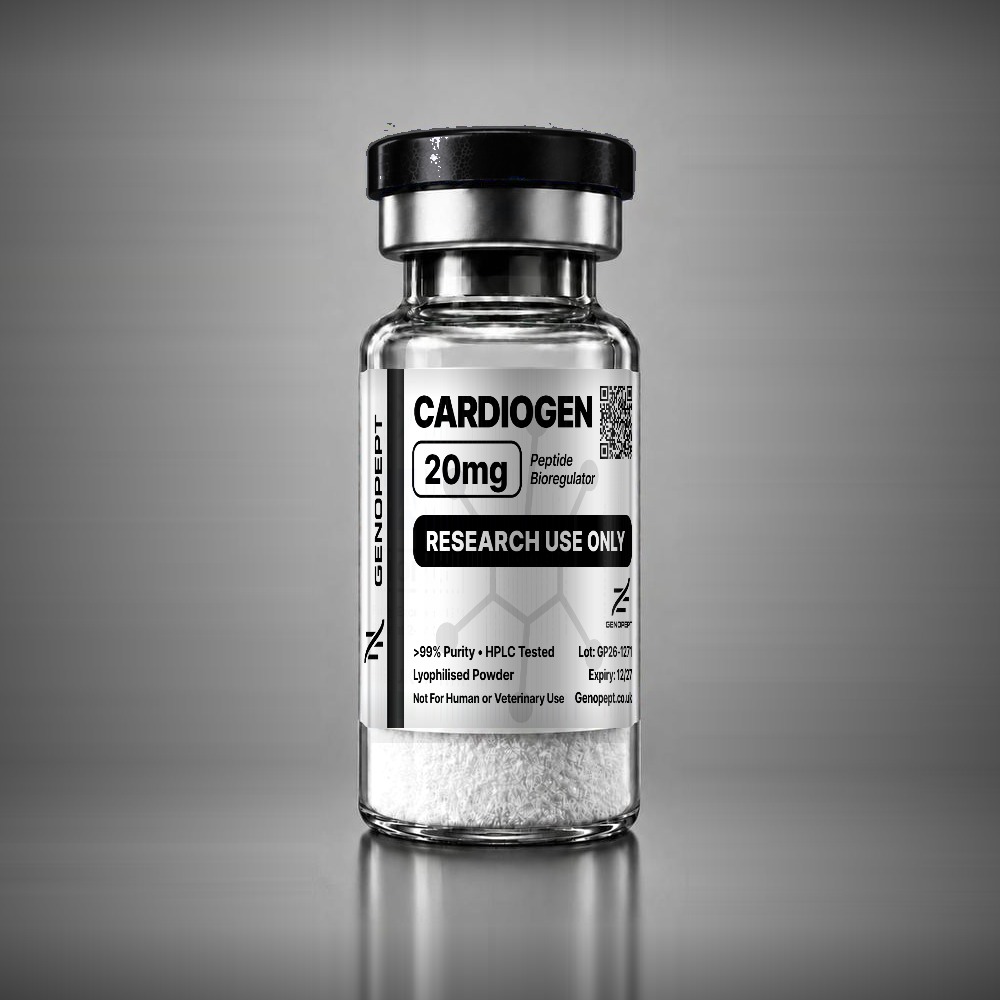
What is Cardiogen?
Cardiogen is a synthetic tetrapeptide bioregulator with the sequence Ala-Glu-Asp-Arg (AEDR), created as a defined analogue of short peptides originally isolated from heart tissue. It is part of the Khavinson bioregulator family and is associated in preclinical literature with cardiomyocytes, cardiac fibroblasts and the myocardial extracellular matrix.
The arginine at the C-terminus gives Cardiogen a different charge profile from its acidic relatives such as Cartalax and Epitalon, which is one reason it features in structure-activity comparisons. GenoPept supplies Cardiogen UK researchers as a 20mg lyophilised vial for in-vitro cardiovascular cell biology. Our guide to peptide bioregulators explains how Cardiogen fits within the Khavinson series.
Cardiogen research applications
Research on this peptide is confined to preclinical settings, chiefly cell culture and rodent models, with a focus on cardiac muscle and heart tissue. The areas below summarise where the published literature has investigated the AEDR sequence.
Cardiomyocyte and cardiac fibroblast culture
Cardiogen has been investigated in cultures of neonatal and adult cardiac cells, with reported endpoints including proliferation, expression of contractile and structural proteins, and markers of cellular senescence.
Myocardial ageing models
Research explores whether the AEDR peptide alters age-associated changes in myocardial tissue in aged rodents, including fibrosis-related gene expression and antioxidant enzyme activity.
Ischaemia and reperfusion models
Preclinical studies have examined Cardiogen in isolated heart and cell-culture models of oxygen deprivation, focusing on apoptosis markers and mitochondrial function. These findings are early-stage and model-dependent.
Peptide panel comparisons
Cardiogen is used with Vesugen and Cartalax in panels that test how tissue-derived short peptides differ in their effects on cells of cardiovascular versus connective-tissue origin.
Tumour-cell studies
Some published work reports that Cardiogen influences proliferation and apoptosis signalling in certain cultured tumour cell lines; this is an exploratory area and not a therapeutic claim.
Mechanism of action (preclinical)
Cardiogen is proposed to act through the epigenetic mechanism common to Khavinson peptides: cellular uptake, nuclear localisation and interaction with DNA or histones to modulate transcription of tissue-relevant genes. In cardiac cell cultures, research has reported increased expression of proteins associated with cell renewal and reduced expression of markers linked to apoptosis and senescence. The positively charged arginine residue is thought to influence nucleic-acid binding compared with fully acidic sequences, though a specific molecular target has not been defined.
Cardiogen product specifications
| Specification | Detail |
|---|---|
| Compound | Cardiogen |
| Also known as | Cardiogen peptide, AEDR peptide, Ala-Glu-Asp-Arg, cardiac bioregulator |
| Sequence / class | 4-amino-acid synthetic tetrapeptide (Ala-Glu-Asp-Arg, AEDR) |
| Molecular formula | C18H31N7O9 |
| Molecular weight | 489.5 g/mol (calculated from sequence) |
| Form | Lyophilised powder, sealed sterile glass vial, black cap |
| Available sizes | 20mg vial |
| Purity | ≥99% (HPLC) |
| Verification | HPLC purity and LC-MS identity by independent ISO/IEC 17025 laboratory (Puralytix), batch COA |
| Storage (unopened) | –20 °C long term; 2–8 °C short term, protect from light |
| Intended use | In-vitro laboratory research only |
Available sizes
- 20mg vial (lyophilised powder)
We currently offer this peptide in one format for UK research customers. Boxes of 10 vials are available at bulk pricing, saving 20–50% compared with single vials; details are on the bulk and wholesale page.
Reconstitution, handling and storage (laboratory)
Because Cardiogen is an ultra-short tetrapeptide, it dissolves readily but is sensitive to mechanical stress. Reconstitute with bacteriostatic water or a sterile diluent matched to your experiment, directing the solvent down the vial wall and swirling gently. Do not shake or vortex. Our step-by-step guide to reconstituting research peptides covers volumes and technique.
Store sealed vials at –20 °C for long-term stability; 2–8 °C is acceptable for short-term holding, always protected from light. Reconstituted solutions should be refrigerated at 2–8 °C and used within the timeframe your protocol defines; avoid freeze-thaw cycling. Further detail is in our article on storing research peptides. Standard laboratory PPE and waste-disposal practice apply.
Quality assurance and Certificate of Analysis
We do not release a Cardiogen batch without third-party analytical data. Puralytix, an independent ISO/IEC 17025 laboratory, runs HPLC for purity (minimum 99%) and LC-MS for identity, checking the observed mass against the calculated mass of Ala-Glu-Asp-Arg. Use the View Certificate of Analysis button above or browse the full COA library; our guide to reading a Certificate of Analysis explains each section.
Related research compounds
- Vesugen 20mg – the vascular tripeptide (Lys-Glu-Asp) that complements Cardiogen in cardiovascular studies
- Cartalax 20mg – the cartilage tripeptide used as a connective-tissue comparator
- Crystagen 20mg – the immune tripeptide for adding an immunological readout
- SS-31 (Elamipretide) Mitochondrial Peptide – a mitochondria-targeted peptide studied in cardiac energetics models
Cardiogen frequently asked questions
What is Cardiogen researched for?
Cardiogen is researched in laboratory models of heart tissue, including cultured cardiomyocytes, cardiac fibroblasts and isolated rodent hearts. Investigators examine cell proliferation, structural protein expression, apoptosis markers and age-related myocardial change. GenoPept supplies the AEDR tetrapeptide strictly for in-vitro research and not as a treatment.
How is Cardiogen supplied and tested?
GenoPept Cardiogen is a 20mg lyophilised powder in a sealed, sterile, black-capped glass vial with lot and expiry on the label. Every batch is tested independently by an ISO/IEC 17025 laboratory using HPLC for purity (99% minimum) and LC-MS for identity. The Certificate of Analysis is linked from the product page.
What storage does Cardiogen require?
Store unopened Cardiogen at minus 20 degrees Celsius for long-term stability, or at 2 to 8 degrees Celsius for short periods protected from light. After reconstitution with bacteriostatic water, hold at 2 to 8 degrees Celsius and use within the interval stated in your laboratory protocol. Avoid repeated freezing of reconstituted material.
Is Cardiogen approved for human use?
No. Cardiogen is for in-vitro laboratory research only. It is not a medicine, has no approval for human or veterinary use and is not for diagnostic or therapeutic purposes. GenoPept does not supply dosing information and sells only to researchers and organisations in the UK for legitimate laboratory work.
What is the difference between Cardiogen and Vesugen?
Cardiogen (Ala-Glu-Asp-Arg) is a tetrapeptide associated with cardiac muscle, whereas Vesugen (Lys-Glu-Asp) is a tripeptide associated with the vascular wall and endothelium. Researchers studying cardiovascular tissue often use both, applying Cardiogen to myocardial cell models and Vesugen to endothelial or smooth-muscle cultures.
Research use only. This Cardiogen product is supplied for in-vitro laboratory research and is not a medicine. It is not for human or veterinary use, nor for diagnostic or therapeutic purposes. Read our research use only statement and research peptides and UK law before ordering.
Reviews
There are no reviews yet.