
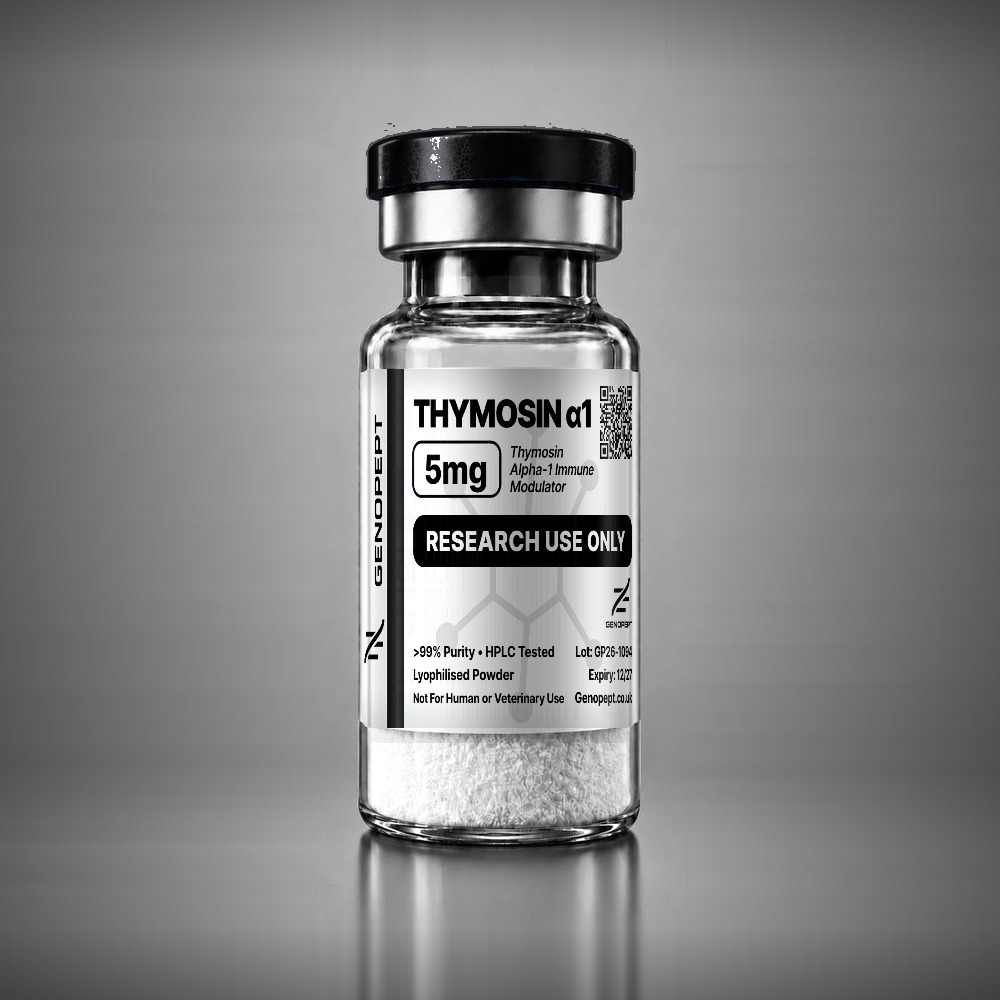
What is Thymosin Alpha-1 (Tα1)?
Thymosin Alpha-1 (Tα1, INN thymalfasin) is a 28-amino-acid peptide with an acetylated N-terminus, originally isolated from calf thymus fraction 5 and now produced synthetically. It is derived from the N-terminal region of prothymosin alpha and is strongly acidic, with a molecular weight of about 3108 g/mol and CAS number 62304-98-7.
Thymosin Alpha-1 is one of the most extensively studied thymic peptides. In cell and animal research it has been investigated for promoting T-cell maturation, enhancing dendritic-cell antigen presentation and signalling through Toll-like receptors, and the peptide studied in licensed medicines in some countries is used in published clinical literature on hepatitis B, sepsis and as a vaccine adjuvant. The research-grade peptide sold here is not a licensed product.
Purity and identity results are batch-specific. Consult the applicable supplied report for its results and methods; confirm the batch covers current stock and verify the laboratory’s accreditation scope directly.
Thymosin Alpha-1 (Tα1) research applications
Thymosin Alpha-1 research spans immunology, infection models, oncology and ageing. The areas below reflect published cell-culture, animal and clinical-literature work on the compound and do not describe use of this product in people.
T-cell development and immune restoration
Thymocyte and peripheral T-cell cultures are used to study how Tα1 influences maturation markers, CD4+ helper function and interleukin-2 production, and animal models of immunosuppression examine immune recovery.
Toll-like receptor signalling and dendritic cells
Tα1 is reported to act through TLR2 and TLR9 on dendritic cells, driving MyD88-dependent maturation and cytokine release, a mechanism investigated in innate-immunity research.
Infection and sepsis models
Preclinical models of viral, fungal and bacterial infection and of sepsis-induced immune paralysis use Thymosin Alpha-1 to study pathogen clearance and immune balance.
Oncology and vaccine adjuvant research
The peptide is studied as an adjuvant alongside vaccines and as an immunomodulator in tumour models, including work on regulatory T-cell and dendritic-cell responses.
Immunosenescence
Aged-animal models investigate whether Tα1 influences age-related decline in thymic output and T-cell repertoire.
Mechanism of action (preclinical)
Thymosin Alpha-1 does not act through a single dedicated receptor. It is reported to engage Toll-like receptors, particularly TLR2 and TLR9, on dendritic cells and macrophages, activating MyD88 and NF-κB signalling and promoting release of interleukin-12, interferon-alpha and other cytokines that steer T-helper 1 responses.
Downstream, Tα1 is associated with increased expression of MHC class I, enhanced natural-killer and cytotoxic T-cell activity, and induction of indoleamine 2,3-dioxygenase in dendritic cells, which helps balance effector and regulatory responses. It has also been reported to reduce oxidative stress and modulate glutathione levels in cell models. These mechanisms derive from preclinical and clinical-literature research on the compound.
Thymosin Alpha-1 (Tα1) product specifications
| Specification | Detail |
|---|---|
| Compound | Thymosin Alpha-1 (Tα1) |
| Also known as | Thymalfasin, Tα1, Ta1, Thymosin alpha 1, Thymosin α1 |
| Sequence / class | 28-amino-acid N-acetylated thymic peptide (Ac-Ser-Asp-Ala-Ala-Val-Asp-Thr-Ser-Ser-Glu-Ile-Thr-Thr-Lys-Asp-Leu-Lys-Glu-Lys-Lys-Glu-Val-Val-Glu-Glu-Ala-Glu-Asn-OH) |
| CAS number | 62304-98-7 |
| Molecular formula | C129H215N33O55 |
| Molecular weight | 3108.3 g/mol |
| Form | Lyophilised (freeze-dried) powder in a sealed sterile glass vial, black cap, lot and expiry on label |
| Available sizes | 2mg, 5mg, 10mg |
| Purity | Batch-specific; see applicable report |
| Verification | Batch-specific; see applicable report |
| Storage (unopened) | −20 °C long term; 2–8 °C short term; protect from light |
| Intended use | In-vitro laboratory research only. Not for human or veterinary use |
Available sizes
Thymosin Alpha-1 is available from GenoPept in the following vial sizes:
- Thymosin Alpha-1 2mg vial
- Thymosin Alpha-1 5mg vial
- Thymosin Alpha-1 10mg vial
Laboratories that need larger quantities can order Thymosin Alpha-1 in bulk boxes of 10 vials, which save 20–50% against single-vial pricing. Retail orders also receive automatic discounts at £300, £500 and £1,000, and delivery is free on UK orders of £200 or more.
Reconstitution, handling and storage (laboratory)
Unopened Thymosin Alpha-1 vials should be stored at −20 °C for long-term storage, or at 2–8 °C for short periods, and protected from light. Allow the vial to reach room temperature before opening to avoid condensation on the lyophilised cake.
To reconstitute for in-vitro work, add bacteriostatic water or another sterile diluent slowly down the inside wall of the vial, then swirl gently until the powder dissolves. Do not shake. Thymosin Alpha-1 is strongly acidic and highly water-soluble, and standard sterile diluents are suitable. Reconstituted solution should be kept at 2–8 °C and used within the period specified in the laboratory’s own protocol. See our guides on how to reconstitute research peptides and how to store research peptides for step-by-step handling notes.
Quality assurance and Certificate of Analysis
Purity and identity results are batch-specific. Consult the applicable supplied report for its results and methods; confirm the batch covers current stock and verify the laboratory’s accreditation scope directly.
Use the “View Certificate of Analysis” button on this page to open the current Thymosin Alpha-1 COA, or browse the full COA library. Our article on what a Certificate of Analysis shows explains how to read the chromatogram and mass spectrum.
Related research compounds
- Thymalin: the thymic polypeptide complex from which single thymic peptides were characterised.
- LL-37: a cathelicidin antimicrobial peptide for innate-immunity research.
- KPV: an alpha-MSH tripeptide studied in inflammation and mucosal immunity models.
- BPC-157: a gastric pentadecapeptide studied in tissue-repair and inflammation research.
Thymosin Alpha-1 (Tα1) frequently asked questions
What is Thymosin Alpha-1 used for in research?
Thymosin Alpha-1 is used in immunology research as a thymic immunomodulatory peptide. Laboratories study it in T-cell and dendritic-cell cultures, Toll-like receptor signalling assays, animal models of infection, sepsis and immunosuppression, vaccine-adjuvant research and immunosenescence models. It is supplied in the UK strictly for in-vitro laboratory research.
How is Thymosin Alpha-1 supplied and what purity is it?
Purity and identity results are batch-specific. Consult the applicable supplied report for its results and methods; confirm the batch covers current stock and verify the laboratory’s accreditation scope directly.
How should Thymosin Alpha-1 be stored?
Store unopened Thymosin Alpha-1 vials at −20 °C for long-term storage, or 2–8 °C for short periods, protected from light. After reconstitution with bacteriostatic water or sterile diluent, keep the solution at 2–8 °C and use within the period stated in your laboratory protocol, avoiding repeated freeze-thaw cycles.
Is Thymosin Alpha-1 for human use?
No. Thymosin Alpha-1 sold here is for in-vitro laboratory research only. It is not a medicine in the UK and is not for human or veterinary use, diagnosis or therapy. Although thymalfasin is licensed in some countries, this research-grade peptide is not a licensed product and this page provides no dosing or usage guidance for people.
How does Thymosin Alpha-1 differ from thymosin beta-4 and TB-500?
Despite the shared name they are unrelated peptides. Thymosin Alpha-1 is a 28-amino-acid acidic peptide from prothymosin alpha, studied for immune modulation through Toll-like receptors. Thymosin beta-4 is a 43-amino-acid actin-binding protein studied in tissue repair, and TB-500 is its synthetic fragment. Laboratories choose between them according to whether the question is immunological or regenerative.
Research use only. Thymosin Alpha-1 is supplied by GenoPept strictly for in-vitro laboratory research. It is not a medicine, is not for human or veterinary use, and is not intended for diagnostic or therapeutic purposes. Read our research use only policy and UK legal guide before ordering.
Research guides: Immune and Antimicrobial Peptides Research Guide
Reviews
There are no reviews yet.