
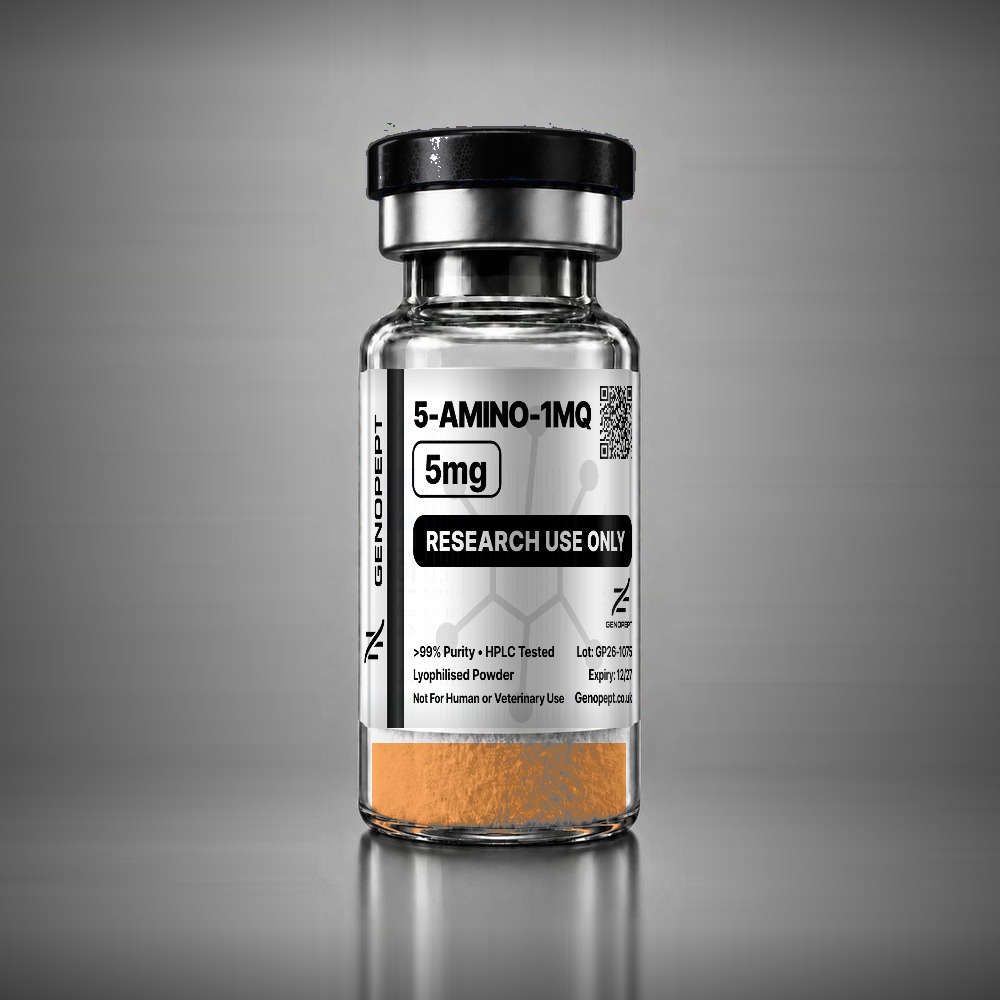
What is 5-Amino-1MQ?
5-Amino-1MQ (5-amino-1-methylquinolinium) is a small, positively charged quinolinium compound that selectively inhibits nicotinamide N-methyltransferase (NNMT). It is not a peptide. NNMT is a cytosolic enzyme, abundant in liver and adipose tissue, that transfers a methyl group from S-adenosylmethionine (SAM) to nicotinamide, producing 1-methylnicotinamide and removing nicotinamide from the NAD+ salvage pathway.
5-Amino-1MQ was identified in published medicinal-chemistry research as a membrane-permeable NNMT inhibitor with good selectivity over related methyltransferases. Preclinical work in diet-induced obese mice reported reduced adipose mass and changes in adipocyte metabolism, which made it a widely discussed tool compound in metabolic research.
GenoPept supplies 5-Amino-1MQ in the UK as a lyophilised research compound in 5mg, 10mg, 20mg and 50mg vials, verified at ≥99% purity by an independent laboratory and sold strictly for in-vitro laboratory research.
5-Amino-1MQ research applications
5-Amino-1MQ research centres on NNMT biology in metabolism, cancer and ageing. The areas below reflect published cell-culture and animal work and do not describe use in people.
Adipocyte metabolism and obesity models
3T3-L1 adipocytes and diet-induced obese mice are used to study how NNMT inhibition changes lipogenesis, energy expenditure and adipocyte size.
NAD+ salvage and SAM availability
By preventing nicotinamide methylation, 5-Amino-1MQ is reported to raise intracellular NAD+ and S-adenosylmethionine in cell models, connecting it to sirtuin activity and methylation capacity research.
Cancer cell biology
NNMT is overexpressed in several tumour types, and 5-Amino-1MQ is used to investigate NNMT-dependent metabolic reprogramming, epigenetic changes and drug resistance in cancer cell lines.
Skeletal muscle and ageing
Aged-mouse models have investigated NNMT inhibition for effects on muscle stem-cell activation and regeneration after injury.
Hepatic metabolism
Because NNMT is highly expressed in liver, the compound is studied in models of fatty liver and hepatic glucose and lipid handling.
Mechanism of action (preclinical)
5-Amino-1MQ binds the nicotinamide-binding pocket of NNMT and blocks methyl transfer from SAM to nicotinamide. This lowers 1-methylnicotinamide production and preserves both substrates: nicotinamide is retained for NAD+ synthesis via NAMPT, and SAM remains available for other methylation reactions.
In adipocyte and animal models the resulting rise in NAD+ and SAM is associated with increased sirtuin-dependent signalling, altered histone methylation and a shift toward oxidative metabolism, with reduced lipid accumulation reported in cultured fat cells. These are preclinical observations and the downstream pathways are still being mapped.
5-Amino-1MQ product specifications
| Specification | Detail |
|---|---|
| Compound | 5-Amino-1MQ |
| Also known as | 5-amino-1-methylquinolinium, NNMT inhibitor 5-amino-1MQ, NNMTi, 5-Amino-1MQ |
| Sequence / class | Small-molecule quinolinium salt; selective nicotinamide N-methyltransferase (NNMT) inhibitor (not a peptide) |
| CAS number | 42464-96-0 |
| Molecular formula | C10H11N2+ (quinolinium cation; supplied as a salt) |
| Form | Lyophilised (freeze-dried) powder in a sealed sterile glass vial, black cap, lot and expiry on label |
| Available sizes | 5mg, 10mg, 20mg, 50mg |
| Purity | ≥99% (HPLC) |
| Verification | Batch HPLC purity and LC-MS identity testing by an independent ISO/IEC 17025 laboratory (Puralytix), with Certificate of Analysis |
| Storage (unopened) | −20 °C long term; 2–8 °C short term; protect from light |
| Intended use | In-vitro laboratory research only. Not for human or veterinary use |
Available sizes
5-Amino-1MQ is available from GenoPept in the following vial sizes:
- 5-Amino-1MQ 5mg vial
- 5-Amino-1MQ 10mg vial
- 5-Amino-1MQ 20mg vial
- 5-Amino-1MQ 50mg vial
Laboratories that need larger quantities can order 5-Amino-1MQ in bulk boxes of 10 vials, which save 20–50% against single-vial pricing. Retail baskets also receive automatic discounts at £300, £500 and £1,000, and delivery is free on UK orders of £200 or more.
Reconstitution, handling and storage (laboratory)
Unopened 5-Amino-1MQ vials should be stored at −20 °C for long-term storage, or at 2–8 °C for short periods, and protected from light. Allow the vial to reach room temperature before opening to avoid condensation on the lyophilised cake.
To reconstitute for in-vitro work, add bacteriostatic water or another sterile diluent slowly down the inside wall of the vial, then swirl gently until the powder dissolves. Do not shake. 5-Amino-1MQ is a water-soluble salt; DMSO can also be used for concentrated stock solutions in cell-culture work. Reconstituted solution should be kept at 2–8 °C and used within the period specified in the laboratory’s own protocol. See our guides on how to reconstitute research peptides and how to store research peptides for step-by-step handling notes.
Quality assurance and Certificate of Analysis
Every batch of 5-Amino-1MQ sold by GenoPept is tested by an independent third-party laboratory (Puralytix, ISO/IEC 17025 accredited) using HPLC for purity and LC-MS for identity confirmation. Results are published in a batch-specific Certificate of Analysis (COA), and each vial is labelled with its lot number and expiry date so the paperwork can be matched to the product on the bench.
Use the “View Certificate of Analysis” button on this page to open the current 5-Amino-1MQ COA, or browse the full COA library. Our article on what a Certificate of Analysis shows explains how to read the chromatogram and mass spectrum.
Related research compounds
- AICAR (Acadesine): the reference AMPK activator used in the same energy-metabolism models.
- SLU-PP-332: an ERR agonist studied as a small-molecule exercise mimetic.
- AOD-9604: a growth-hormone fragment studied in lipid-metabolism research.
- MOTS-c: a mitochondrial peptide investigated in metabolic and ageing models.
5-Amino-1MQ frequently asked questions
What is 5-Amino-1MQ used for in research?
5-Amino-1MQ is used as a selective inhibitor of nicotinamide N-methyltransferase (NNMT) in metabolic and cancer research. Laboratories use it in adipocyte cultures, diet-induced obesity models, NAD+ salvage studies and NNMT-overexpressing cancer cell lines to investigate methylation, energy metabolism and sirtuin signalling. It is supplied in the UK strictly for in-vitro laboratory research.
How is 5-Amino-1MQ supplied and what purity is it?
GenoPept supplies 5-Amino-1MQ as a lyophilised powder in sealed sterile glass vials of 5mg, 10mg, 20mg and 50mg. Every batch is tested at ≥99% purity by HPLC with identity confirmed by LC-MS at an independent ISO/IEC 17025 laboratory. The batch Certificate of Analysis can be viewed from this page or the UK COA library.
How should 5-Amino-1MQ be stored?
Store unopened 5-Amino-1MQ vials at −20 °C for long-term storage, or 2–8 °C for short periods, protected from light. Reconstitute in water, buffer or DMSO according to your protocol, keep working solutions at 2–8 °C and use within the period your laboratory specifies. Avoid repeated freeze-thaw cycles of stock solutions.
Is 5-Amino-1MQ for human use?
No. 5-Amino-1MQ sold here is a research compound for in-vitro laboratory use only. It is not a medicine, not a supplement and not for human or veterinary use, diagnosis or therapy. This page summarises published preclinical research and provides no dosing or usage guidance for people.
Is 5-Amino-1MQ a peptide, and how does it relate to NAD+?
5-Amino-1MQ is not a peptide; it is a small quinolinium molecule. Its link to NAD+ is indirect: by inhibiting NNMT it stops nicotinamide being methylated and lost, so more nicotinamide is available for the NAD+ salvage pathway. Researchers therefore study it alongside NAD+ and sirtuin biology, but it does not supply NAD+ itself.
Research use only. 5-Amino-1MQ is supplied by GenoPept strictly for in-vitro laboratory research. It is not a medicine, is not for human or veterinary use, and is not intended for diagnostic or therapeutic purposes. Read our research use only policy and UK legal guide before ordering.
Reviews
There are no reviews yet.