
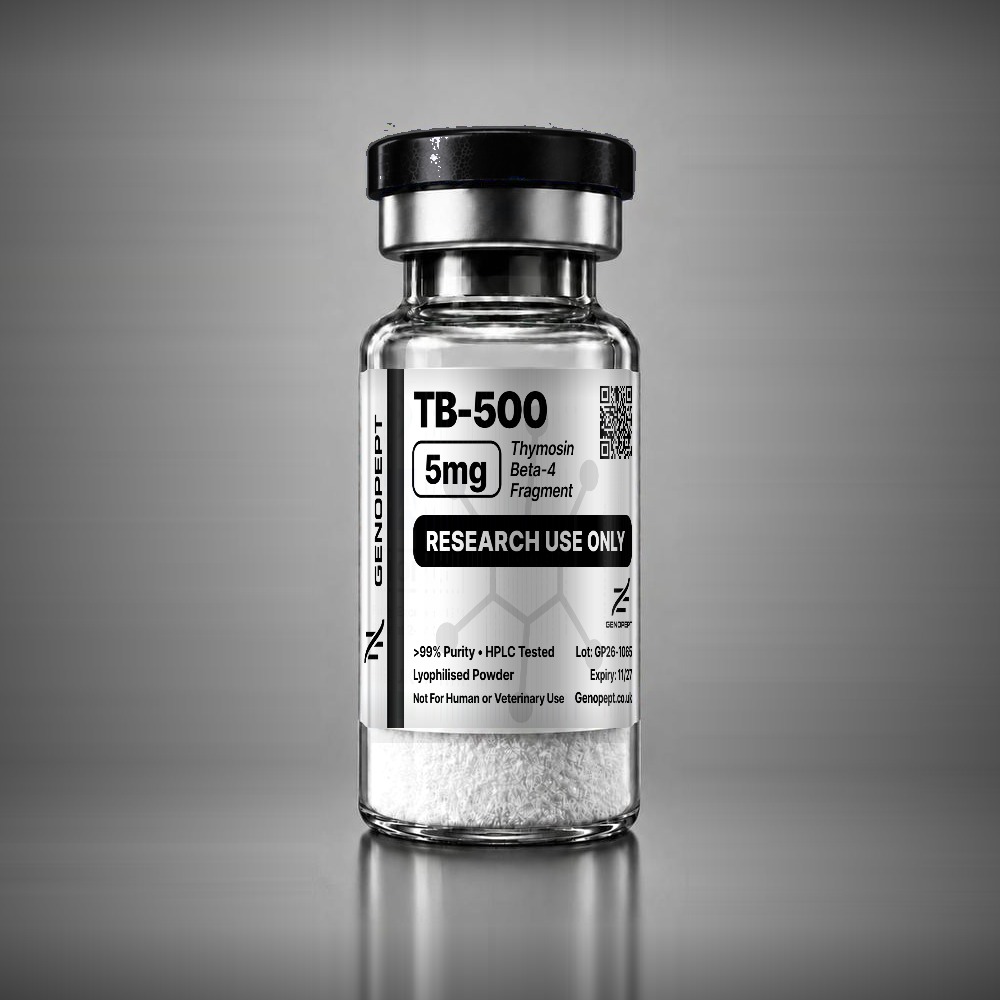
What is TB-500?
TB-500 is a synthetic research peptide derived from thymosin beta-4 (Tβ4), a naturally occurring 43-amino-acid protein that is the main actin-sequestering molecule in mammalian cells. The name TB-500 is used in the literature for the N-terminally acetylated seven-residue fragment Ac-Leu-Lys-Lys-Thr-Glu-Thr-Gln (Ac-LKKTETQ, residues 17–23), which contains the actin-binding motif of the parent protein.
Thymosin beta-4 itself was first isolated from calf thymus and is present at high concentration in platelets, wound fluid and migrating cells. Research interest in TB-500 stems from Tβ4 studies in dermal, corneal and cardiac injury models, where the protein is associated with cell migration, angiogenesis and reduced scarring.
GenoPept supplies TB-500 as a lyophilised powder in 2mg, 5mg, 10mg and 20mg vials for in-vitro laboratory research in the UK. The batch Certificate of Analysis confirms the mass of the material in every lot.
TB-500 research applications
The published TB-500 and thymosin beta-4 literature spans cell culture, rodent, pig and ex-vivo tissue models. The following areas are the most studied; none are approved uses.
Wound healing and dermal repair
Tβ4 has been investigated in full-thickness dermal wound models in rats, mice and diabetic animals, with researchers measuring keratinocyte and fibroblast migration, collagen deposition and wound contraction.
Cardiac and vascular injury
Studies in mice and pigs explore thymosin beta-4 after coronary ligation, examining cardiomyocyte survival, epicardial progenitor activation and vessel formation.
Corneal and ocular models
Tβ4 and its fragments have been studied in corneal epithelial wound and dry-eye models, and the parent protein has been assessed in early-phase clinical work for ocular indications.
Musculoskeletal and tendon research
Preclinical work has looked at TB-500 in models of tendon injury and skeletal muscle regeneration, frequently alongside BPC-157; see our TB-500 research guide for a summary.
Inflammation and fibrosis
Tβ4 has been reported to modulate NF-κB signalling and matrix metalloproteinase activity in cell models, which is why it appears in fibrosis and inflammation studies.
Mechanism of action (preclinical)
The core activity of thymosin beta-4 is sequestration of monomeric (G-) actin through its LKKTET binding motif, which regulates the pool of actin available for polymerisation and therefore cell motility. TB-500 reproduces this motif, and the fragment has been reported in cell assays to promote migration in a manner comparable to the parent protein.
Beyond actin binding, Tβ4 research describes up-regulation of laminin-5 and matrix metalloproteinases, activation of the integrin-linked kinase (ILK)-Akt pathway in cardiac cells, and dampening of NF-κB-driven inflammatory gene expression. Whether the short TB-500 fragment shares all of these actions is still being tested, and these findings are reported here purely as preclinical context.
TB-500 product specifications
The values below refer to the Ac-LKKTETQ fragment and are drawn from public chemical databases; LC-MS identity testing confirms the mass for each batch.
| Specification | Detail |
|---|---|
| Compound | TB-500 (thymosin beta-4 fragment 17–23, N-acetylated) |
| Also known as | Thymosin beta-4 fragment, Tβ4 (17–23), Ac-LKKTETQ, TB500, Ac-Tβ4 fragment |
| Sequence / class | N-acetylated 7-amino-acid synthetic fragment of thymosin beta-4 (Ac-Leu-Lys-Lys-Thr-Glu-Thr-Gln) |
| CAS number | 885340-08-9 |
| Molecular formula | C38H68N10O14 |
| Molecular weight | 889.0 g/mol |
| Form | Lyophilised powder, sealed sterile glass vial, black cap, lot and expiry on label |
| Available sizes | 2mg, 5mg, 10mg, 20mg |
| Purity | Batch-specific; see applicable report |
| Verification | Batch-specific; see applicable report |
| Storage (unopened) | –20 °C long term; 2–8 °C short term; protect from light |
| Intended use | In-vitro laboratory research only; not for human or veterinary use |
Available sizes
TB-500 is available in four vial sizes for pilot studies through to larger animal work:
- 2mg vial – ideal for cell-culture and pilot assays
- 5mg vial
- 10mg vial
- 20mg vial – for extended multi-arm studies
Bulk boxes of 10 vials save 20–50% against single-vial pricing; see the bulk and wholesale page for details. Orders of £200 or more qualify for free tracked UK delivery.
Reconstitution, handling and storage (laboratory)
Unopened vials should be stored at –20 °C for long-term storage, or at 2–8 °C for short periods, always protected from light. Keep vials sealed until the day they are needed.
To reconstitute, allow the vial to reach room temperature, then add bacteriostatic water or another sterile diluent slowly down the inside wall of the vial. Swirl gently until the powder dissolves; never shake, because shear can damage peptide chains. A 5mg TB-500 vial reconstituted with 2 ml of diluent gives a 2.5 mg/ml stock solution; adjust the volume to the concentration your protocol specifies.
Once in solution, keep the vial at 2–8 °C and use it within the period stated in your laboratory protocol. See our guides on how to reconstitute research peptides and how to store research peptides.
Quality assurance and Certificate of Analysis
Purity and identity results are batch-specific. Consult the applicable supplied report for its results and methods; confirm the batch covers current stock and verify the laboratory’s accreditation scope directly.
Use the “View Certificate of Analysis” button on this page to open the COA for the current batch, or browse the complete library at genopept.co.uk/coa-certificates. Our guide on what a Certificate of Analysis shows explains how to read the chromatogram and mass spectrum. Vials carry lot number and expiry so results trace to the exact material supplied.
Related research compounds
- BPC-157 (Body Protection Compound) – the gastric-derived pentadecapeptide most often co-investigated with TB-500.
- Wolverine Blend (BPC-157 + TB-500) – both peptides pre-combined in one vial for comparative repair studies.
- GLOW Blend (BPC-157 + TB-500 + GHK-Cu) – adds the copper tripeptide for skin and remodelling research.
- Thymosin Alpha-1 (Tα1) – a different thymus-derived peptide studied for immune modulation rather than actin binding.
TB-500 frequently asked questions
What is TB-500 used for in research?
TB-500 is used in preclinical research on cell migration and tissue repair. Laboratories study it in dermal wound, corneal, cardiac injury and tendon models, drawing on the wider thymosin beta-4 literature. Its actin-binding motif makes it a useful tool for cytoskeleton and motility assays. GenoPept supplies TB-500 exclusively for this kind of in-vitro laboratory research.
How is TB-500 supplied and what purity is it?
Purity and identity results are batch-specific. Consult the applicable supplied report for its results and methods; confirm the batch covers current stock and verify the laboratory’s accreditation scope directly.
How should TB-500 be stored?
Keep unopened TB-500 vials at –20 °C for long-term storage or at 2–8 °C for short-term use, protected from light. After reconstitution with bacteriostatic water the solution should be stored at 2–8 °C and used within the period stated in your laboratory protocol. Avoid repeated freezing and thawing of reconstituted material.
Is TB-500 for human use?
No. TB-500 from GenoPept is strictly for in-vitro laboratory research. It is not a medicine, is not approved for human or veterinary use in the UK or elsewhere, and is not for diagnostic or therapeutic use. We do not provide dosing or administration information, and buyers must confirm the material is for research purposes only.
What is the difference between TB-500 and thymosin beta-4?
Thymosin beta-4 is the full 43-amino-acid natural protein, while TB-500 is a synthetic seven-residue fragment (Ac-LKKTETQ) containing its actin-binding region. The fragment is smaller, cheaper to synthesise and easier to characterise by LC-MS, which is why it is preferred for many laboratory studies. Researchers comparing the two should check the sequence stated on the batch COA.
Research use only. This product is supplied strictly for in-vitro laboratory research in the UK. It is not for human or veterinary use, is not a medicine, and is not for diagnostic or therapeutic use. Nothing on this page is medical advice. See our research use only policy and UK legal guide.
Research guides: BPC-157 Research Guide · BPC-157 vs TB-500 · Peptide Reconstitution Calculator · TB-500 (Thymosin Beta-4) Research Guide · How to Read a Peptide Certificate of Analysis (COA)
Reviews
There are no reviews yet.