
What is IGF-1 DES(1-3)?
IGF-1 DES(1-3) is a 67-amino-acid truncated variant of human insulin-like growth factor-1 that lacks the three N-terminal residues Gly-Pro-Glu of the full 70-amino-acid hormone. It occurs naturally, having first been isolated from bovine colostrum and human brain tissue, and is also produced recombinantly for research.
Removal of the N-terminal tripeptide, and in particular Glu3, sharply reduces binding to the IGF-binding proteins (IGFBPs) while leaving affinity for the IGF-1 receptor largely intact. In preclinical assays IGF-1 DES(1-3) is therefore reported to be roughly ten times more potent than native IGF-1, because less of it is sequestered by binding proteins.
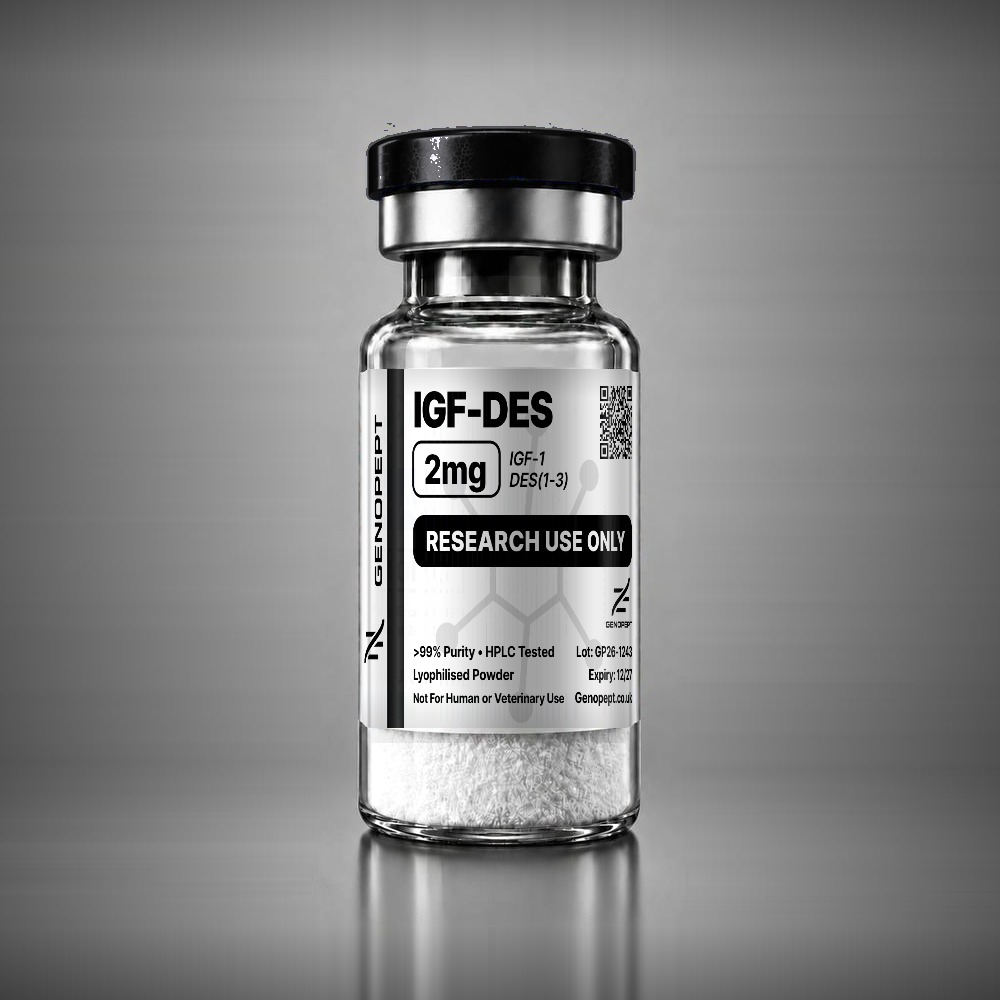
GenoPept supplies IGF-1 DES(1-3) to UK research laboratories as a 2mg lyophilised vial, third-party verified at ≥99% purity with a batch Certificate of Analysis.
IGF-1 DES(1-3) research applications
IGF-1 DES(1-3) is used as a high-potency IGF-1 receptor ligand in a range of published research settings:
- Muscle cell studies – it is investigated in myoblast and satellite-cell cultures to examine proliferation, differentiation and hypertrophy signalling with minimal IGFBP interference.
- IGFBP binding research – because DES(1-3) binds IGFBPs weakly, it is a useful comparator for dissecting how binding proteins modulate IGF-1 action.
- Gut and epithelial models – animal studies have explored IGF-1 DES(1-3) in intestinal growth and repair models, one of its earliest research applications.
- Neuroscience – the peptide has been studied in neuronal survival and neurotrophic assays, reflecting its natural occurrence in brain tissue.
- Cell-culture supplementation – it is applied as a mitogen in serum-free culture systems where potent, short-acting IGF-1R stimulation is required.
Mechanism of action (preclinical)
IGF-1 DES(1-3) activates the IGF-1 receptor tyrosine kinase, leading to IRS-1 phosphorylation and signalling through PI3K/Akt/mTOR and Ras/MAPK pathways. These cascades regulate protein synthesis, glucose uptake, cell survival and proliferation in responsive cells.
The defining feature of IGF-1 DES(1-3) is its very low affinity for IGFBPs, particularly IGFBP-3 and IGFBP-5. In vitro, this leaves a greater free fraction available to the receptor, producing higher apparent potency but a shorter effective duration than analogues such as IGF-1 LR3.
IGF-1 DES(1-3) product specifications
Each vial is supplied to the specification below. Rows are limited to values that can be verified from published sources.
| Specification | Detail |
|---|---|
| Compound | IGF-1 DES(1-3) (des(1-3) insulin-like growth factor-1) |
| Also known as | IGF-DES, DES(1-3) IGF-1, des-IGF-1, Truncated IGF-1, IGF-1 (4-70) |
| Sequence / class | 67-amino-acid truncated form of human IGF-1 (residues 4–70), recombinant |
| CAS number | 112603-35-7 |
| Molecular formula | C319H501N91O96S7 |
| Molecular weight | 7371.5 g/mol |
| Form | Lyophilised powder in a sealed, sterile glass vial (black cap), batch-labelled with lot and expiry |
| Available sizes | 2mg |
| Purity | ≥99% (HPLC) |
| Verification | HPLC purity and LC-MS identity by an independent ISO/IEC 17025 laboratory; batch COA supplied |
| Storage (unopened) | –20 °C long term; 2–8 °C short term; protect from light |
| Intended use | In-vitro laboratory research only. Not for human or veterinary use. |
Available sizes
- IGF-1 DES(1-3) 2mg vial, lyophilised powder
Bulk and wholesale boxes of 10 vials of IGF-1 DES(1-3) save 20–50% for laboratories running larger studies; see the bulk and wholesale page. Free UK delivery applies to orders of £200 or more.
Reconstitution, handling and storage (laboratory)
IGF-1 DES(1-3) is shipped as a lyophilised powder and should be stored unopened at –20 °C for long-term laboratory storage, or at 2–8 °C for short periods, protected from light. Allow the sealed vial to reach room temperature before opening to avoid condensation on the powder.
To reconstitute, add bacteriostatic water or another sterile diluent slowly down the inside wall of the vial, then swirl gently until dissolved. Never shake, as shear stress can denature the peptide. IGF-1 DES(1-3) is a folded protein with three disulfide bonds, so avoid vigorous mixing and repeated freeze–thaw cycles. After reconstitution keep the solution at 2–8 °C and use it within the period defined in your laboratory protocol.
Full step-by-step guidance is available in our articles on how to reconstitute research peptides and how to store research peptides. Handle with gloves and standard laboratory precautions.
Quality assurance and Certificate of Analysis
Every batch of IGF-1 DES(1-3) is tested by an independent third-party laboratory (Puralytix, ISO/IEC 17025 accredited). Purity is confirmed by HPLC at ≥99% and identity is confirmed by LC-MS, so the material in the vial matches the label.
A batch-specific Certificate of Analysis is available through the “View Certificate of Analysis” button on this page, and the complete library is published in the COA library. Our guide to what a Certificate of Analysis shows explains how to read the chromatogram and mass spectrum. Vials are batch-identified with lot number and expiry, and orders are dispatched discreetly by tracked Royal Mail Special Delivery within the UK.
Related research compounds
- IGF-1 LR3 – the extended-duration IGF-1 analogue most often compared with IGF-1 DES(1-3)
- MGF 2mg – the IGF-1 Ec splice-variant peptide used in satellite-cell research
- PEG-MGF 2mg – pegylated MGF for longer in-vitro exposure
- Somatropin HGH 191-AA Research Kits – upstream growth hormone for GH/IGF axis studies
IGF-1 DES(1-3) frequently asked questions
What is IGF-1 DES(1-3) used for in research?
IGF-1 DES(1-3) is used in laboratory studies as a potent IGF-1 receptor agonist with minimal IGF-binding-protein interference. Research applications include myoblast and satellite-cell culture, IGFBP binding studies, intestinal and neuronal cell models, and serum-free media supplementation. Supplied for in-vitro laboratory research only.
How is IGF-1 DES(1-3) supplied and what is its purity?
GenoPept supplies IGF-1 DES(1-3) as 2mg of lyophilised powder in a sealed, sterile glass vial with a black cap. Each batch is tested by an independent ISO/IEC 17025 laboratory, with purity of ≥99% by HPLC and identity confirmed by LC-MS. The batch Certificate of Analysis can be viewed on the product page.
How should IGF-1 DES(1-3) be stored?
Keep unopened IGF-1 DES(1-3) vials at –20 °C for long-term storage or 2–8 °C for short periods, away from light. Once reconstituted with bacteriostatic water, store at 2–8 °C, avoid freeze–thaw cycles and use within the period specified in your laboratory protocol.
Is IGF-1 DES(1-3) for human use?
No. IGF-1 DES(1-3) is supplied only for in-vitro laboratory research. It is not a medicine, has no approval for human or veterinary use and must not be used for diagnostic or therapeutic purposes. UK customers agree to our research use only policy when ordering.
How does IGF-1 DES(1-3) differ from IGF-1 LR3?
IGF-1 DES(1-3) is a 67-amino-acid truncated IGF-1 with the first three residues removed, while IGF-1 LR3 is an 83-amino-acid analogue with an Arg3 substitution and N-terminal extension. Both bind IGFBPs weakly, but DES(1-3) is reported as more potent and shorter-acting in vitro, whereas LR3 offers a longer effective duration in culture.
Research use only. This product is supplied strictly for in-vitro laboratory research. It is not for human or veterinary use, not a medicine, and not for diagnostic or therapeutic use. Read the GenoPept research use only policy before ordering.
Research guides: IGF-1 LR3, IGF-1 DES(1-3), MGF and PEG-MGF Research Guide
Reviews
There are no reviews yet.