
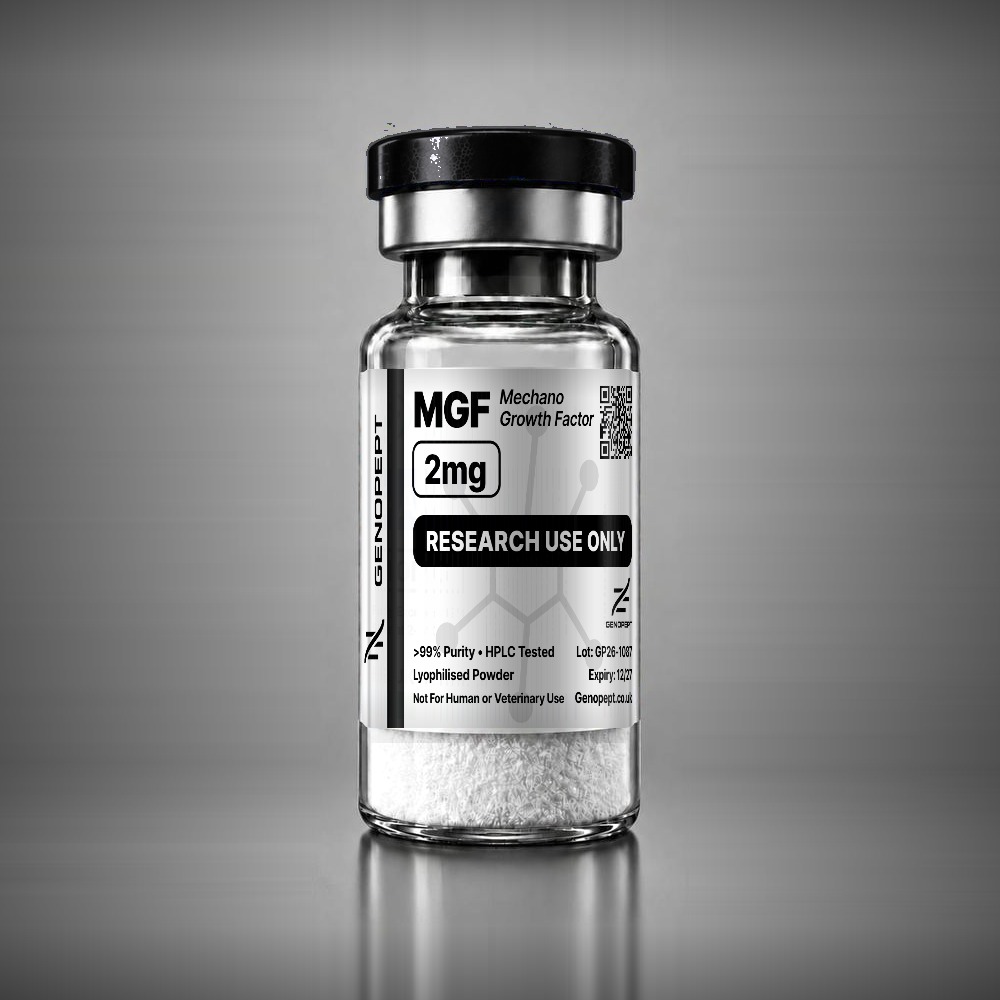
What is MGF?
MGF (Mechano Growth Factor) is a synthetic 24-amino-acid peptide that reproduces the unique C-terminal E-domain of IGF-1Ec, a splice variant of the insulin-like growth factor-1 gene expressed in skeletal muscle after mechanical loading or damage. Its sequence is YQPPSTNKNTKSQRRKGSTFEERK.
The IGF-1 gene can be spliced into several isoforms. In muscle, the IGF-1Ec transcript rises transiently after exercise or injury, and the resulting E-domain peptide was named mechano growth factor because its expression is mechanically regulated. Researchers synthesise the E-domain fragment alone to study whether it has activity independent of mature IGF-1.
GenoPept supplies MGF to UK laboratories as a 2mg lyophilised vial, independently verified at ≥99% purity with a batch Certificate of Analysis.
MGF research applications
MGF is investigated as a tool for studying the muscle response to mechanical stress. Published and preclinical work covers:
- Satellite cell activation – MGF has been studied in myoblast cultures for effects on proliferation and on delaying differentiation, a proposed mechanism for expanding the muscle stem-cell pool.
- Exercise and loading models – animal studies examine IGF-1Ec expression and E-domain peptide effects after resistance loading or muscle injury.
- Cardiac and neural tissue – MGF has been investigated in models of ischaemic cardiac injury and neuroprotection.
- Splice-variant biology – it is used to test whether the E-domain acts through IGF-1R or a distinct, still-uncharacterised pathway, a question the literature has not settled.
- Pharmacokinetic comparison – native MGF is short-lived in solution and serves as the reference for its pegylated derivative, PEG-MGF.
It should be noted that some published studies report no effect of the synthetic E-peptide on myoblasts or primary muscle stem cells, so the biology remains an active research question rather than an established fact.
Mechanism of action (preclinical)
Unlike mature IGF-1, the MGF E-domain peptide does not appear to bind the IGF-1 receptor with high affinity. Preclinical reports propose that it acts through an independent mechanism to promote myoblast proliferation while transiently inhibiting terminal differentiation, possibly involving ERK1/2 signalling; other studies have not reproduced these effects.
In the intact IGF-1Ec pro-hormone, the E-domain is thought to influence local IGF-1 processing and retention in the extracellular matrix. The synthetic 24-amino-acid MGF peptide allows this domain to be studied in isolation in cell-culture and animal models.
MGF product specifications
Each vial is supplied to the specification below. Rows are limited to values that can be verified from published sources.
| Specification | Detail |
|---|---|
| Compound | MGF (Mechano Growth Factor, IGF-1Ec E-domain peptide) |
| Also known as | Mechano Growth Factor, IGF-1Ec E-peptide, MGF C-terminal peptide, IGF-1Ec |
| Sequence / class | 24-amino-acid synthetic peptide (Tyr-Gln-Pro-Pro-Ser-Thr-Asn-Lys-Asn-Thr-Lys-Ser-Gln-Arg-Arg-Lys-Gly-Ser-Thr-Phe-Glu-Glu-Arg-Lys), IGF-1Ec E-domain |
| Molecular formula | C121H199N40O40 |
| Molecular weight | 2868.2 g/mol |
| Form | Lyophilised powder in a sealed, sterile glass vial (black cap), batch-labelled with lot and expiry |
| Available sizes | 2mg |
| Purity | ≥99% (HPLC) |
| Verification | HPLC purity and LC-MS identity by an independent ISO/IEC 17025 laboratory; batch COA supplied |
| Storage (unopened) | –20 °C long term; 2–8 °C short term; protect from light |
| Intended use | In-vitro laboratory research only. Not for human or veterinary use. |
Available sizes
- MGF 2mg vial, lyophilised powder
Bulk and wholesale boxes of 10 vials of MGF save 20–50% for laboratories running larger studies; see the bulk and wholesale page. Free UK delivery applies to orders of £200 or more.
Reconstitution, handling and storage (laboratory)
MGF is shipped as a lyophilised powder and should be stored unopened at –20 °C for long-term laboratory storage, or at 2–8 °C for short periods, protected from light. Allow the sealed vial to reach room temperature before opening to avoid condensation on the powder.
To reconstitute, add bacteriostatic water or another sterile diluent slowly down the inside wall of the vial, then swirl gently until dissolved. Never shake, as shear stress can denature the peptide. MGF is a short linear peptide with no disulfide bonds, but it is reported to have a short half-life in solution, so prepare fresh working solutions where possible. After reconstitution keep the solution at 2–8 °C and use it within the period defined in your laboratory protocol.
Full step-by-step guidance is available in our articles on how to reconstitute research peptides and how to store research peptides. Handle with gloves and standard laboratory precautions.
Quality assurance and Certificate of Analysis
Every batch of MGF is tested by an independent third-party laboratory (Puralytix, ISO/IEC 17025 accredited). Purity is confirmed by HPLC at ≥99% and identity is confirmed by LC-MS, so the material in the vial matches the label.
A batch-specific Certificate of Analysis is available through the “View Certificate of Analysis” button on this page, and the complete library is published in the COA library. Our guide to what a Certificate of Analysis shows explains how to read the chromatogram and mass spectrum. Vials are batch-identified with lot number and expiry, and orders are dispatched discreetly by tracked Royal Mail Special Delivery within the UK.
Related research compounds
- PEG-MGF 2mg – the pegylated MGF derivative with extended stability in solution
- IGF-1 LR3 – the mature IGF-1 analogue for comparison with the E-domain peptide
- IGF-1 DES(1-3) 2mg – the truncated IGF-1 variant used in the same muscle cell models
- Follistatin-344 1mg – a myostatin-binding protein studied in complementary muscle biology research
MGF frequently asked questions
What is MGF used for in research?
MGF is used in laboratory studies of how skeletal muscle responds to mechanical loading and injury. Researchers apply the synthetic E-domain peptide in myoblast and satellite-cell cultures, in animal models of muscle damage, and in cardiac and neural tissue models, as well as in studies comparing IGF-1 splice variants. Supplied for in-vitro laboratory research only.
How is MGF supplied and what is its purity?
GenoPept MGF is supplied as 2mg of lyophilised powder in a sealed, sterile glass vial with a black cap and batch label. Each lot is tested by an independent ISO/IEC 17025 laboratory, with ≥99% purity by HPLC and identity confirmed by LC-MS. The batch Certificate of Analysis is linked on the product page.
How should MGF be stored?
Store unopened MGF vials at –20 °C for long-term storage or at 2–8 °C short term, protected from light. After reconstitution with bacteriostatic water, keep the solution at 2–8 °C and use it promptly within the period set by your laboratory protocol, as native MGF has limited stability in solution.
Is MGF for human use?
No. MGF is sold exclusively for in-vitro laboratory research. It is not a medicine, is not licensed for human or veterinary use and is not intended for diagnostic or therapeutic purposes. UK customers must accept the research use only policy before ordering.
What is the difference between MGF and PEG-MGF?
MGF is the native 24-amino-acid IGF-1Ec E-domain peptide, which is reported to degrade within minutes in solution. PEG-MGF is the same peptide conjugated to polyethylene glycol, which increases its molecular size and extends its stability so that it persists for much longer in vitro. Researchers choose between them based on the exposure duration their protocol requires.
Research use only. This product is supplied strictly for in-vitro laboratory research. It is not for human or veterinary use, not a medicine, and not for diagnostic or therapeutic use. Read the GenoPept research use only policy before ordering.
Research guides: IGF-1 LR3, IGF-1 DES(1-3), MGF and PEG-MGF Research Guide

Reviews
There are no reviews yet.