
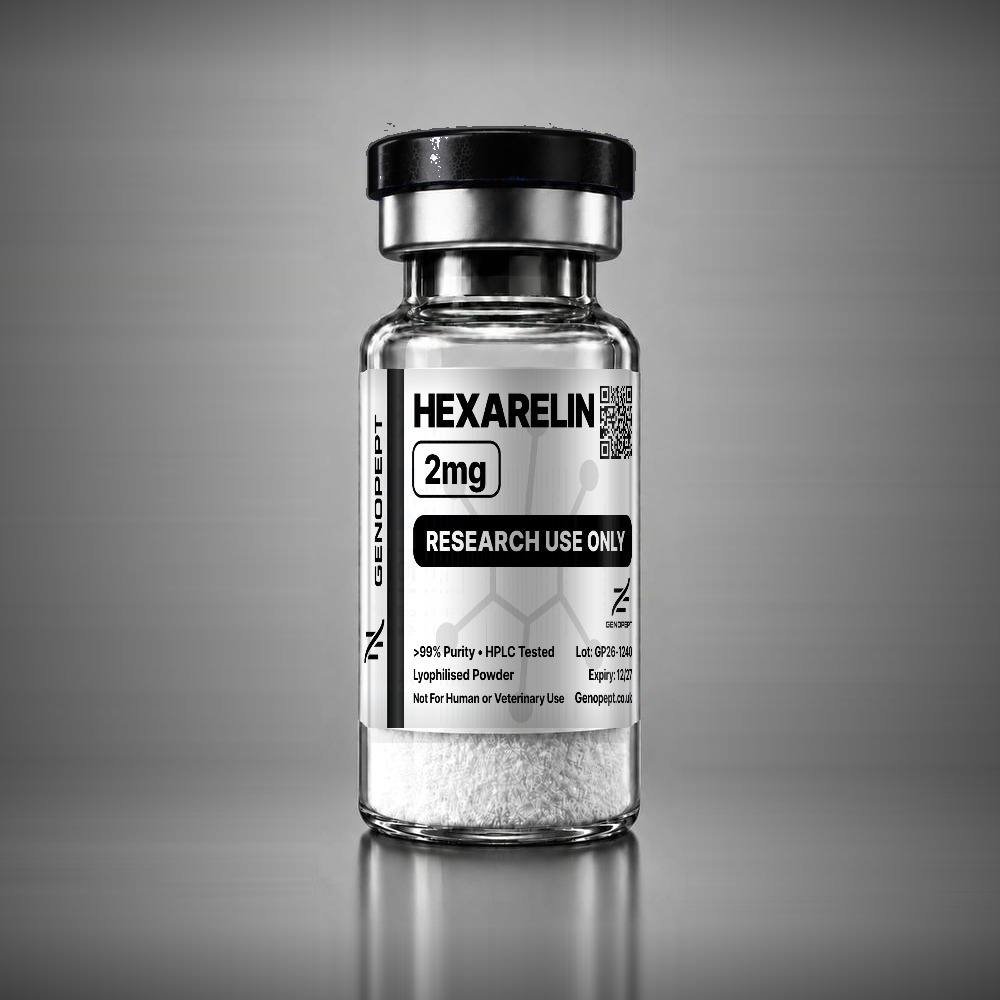
What is Hexarelin?
Hexarelin is a synthetic hexapeptide growth hormone secretagogue with the sequence His-D-2-methyl-Trp-Ala-Trp-D-Phe-Lys-NH2, known by the international non-proprietary name examorelin. It is a close analogue of GHRP-6 in which the D-tryptophan at position 2 carries a 2-methyl group, a change that improves stability and potency at the ghrelin receptor (GHSR-1a).
Hexarelin is reported to be among the most potent GHRP-family secretagogues in preclinical GH release assays, and it has a distinctive published literature in cardiovascular research, where it has been studied in models of cardiac function independent of GH release. It is also investigated for binding to the scavenger receptor CD36.
GenoPept supplies hexarelin in the UK as a lyophilised research peptide in 2mg and 5mg vials. Every batch is verified by independent HPLC and LC-MS testing and is intended strictly for laboratory research.
Hexarelin research applications
High-potency GH secretagogue studies
Hexarelin is used in pituitary cell and animal models as a potent GHSR-1a agonist for studies of GH release, receptor desensitisation and tachyphylaxis with repeated exposure.
Cardiovascular models
Published preclinical research has investigated hexarelin in rodent models of myocardial ischaemia, cardiac contractility and post-infarction remodelling.
CD36 receptor research
Hexarelin binds CD36, a scavenger receptor involved in fatty acid uptake and macrophage biology, and is used as a tool compound in atherosclerosis and lipid handling models.
Comparative secretagogue pharmacology
Researchers compare hexarelin with GHRP-6, GHRP-2 and ipamorelin to relate structure to potency and selectivity.
Neuroendocrine feedback
Like other early GHRPs, hexarelin raises cortisol and prolactin in animal models, making it useful for studying secretagogue cross-talk with the stress axis.
Mechanism of action (preclinical)
Hexarelin activates the ghrelin receptor GHSR-1a on pituitary somatotrophs and hypothalamic neurons. Gq coupling triggers phospholipase C, inositol trisphosphate and calcium release that drives GH exocytosis, while hypothalamic action increases GHRH release and reduces somatostatin tone.
The 2-methyl-D-tryptophan substitution gives hexarelin greater enzymatic stability and receptor potency than GHRP-6 in preclinical assays. In addition to GHSR-1a, hexarelin binds CD36 on cardiomyocytes and macrophages, which is thought to underlie the GH-independent cardiac effects reported in animal models.
Hexarelin product specifications
| Specification | Detail |
|---|---|
| Compound | Hexarelin |
| Also known as | Examorelin, EP-23905, MF-6003 |
| Sequence / class | Synthetic hexapeptide (His-D-2-methyl-Trp-Ala-Trp-D-Phe-Lys-NH2), ghrelin receptor agonist |
| CAS number | 140703-51-1 |
| Molecular formula | C47H58N12O6 |
| Molecular weight | 887.0 g/mol |
| Form | Lyophilised powder in sealed sterile glass vial |
| Available sizes | 2mg, 5mg |
| Purity | 99% or higher (HPLC) |
| Verification | Independent HPLC (purity) and LC-MS (identity) with batch COA |
| Storage (unopened) | Lyophilised powder at -20 °C long term; 2-8 °C short term, protected from light |
| Intended use | In-vitro laboratory research only; not for human or veterinary use |
Available sizes
- 2mg vial
- 5mg vial
Laboratories running larger studies can order bulk boxes of 10 vials, which save 20-50% against single-vial pricing; see the bulk and wholesale page. Orders over £200 ship free by tracked Royal Mail Special Delivery within the UK.
Reconstitution, handling and storage (laboratory)
Hexarelin is supplied as a lyophilised powder that is stable for long-term storage at -20 °C. Unopened vials may be kept at 2-8 °C for short periods, protected from light. Allow a vial to reach room temperature before opening to avoid condensation on the powder.
For reconstitution, add bacteriostatic water or a sterile diluent slowly down the inside wall of the vial, then swirl gently until the powder dissolves. Never shake a peptide vial, because mechanical stress can damage the molecule and reduce measured purity.
After reconstitution, keep the solution at 2-8 °C and use it within the period stated in your laboratory protocol. Full guidance is available in our articles on how to reconstitute research peptides and how to store research peptides.
Quality assurance and Certificate of Analysis
Every batch of Hexarelin sold by GenoPept is tested by an independent ISO/IEC 17025 laboratory (Puralytix). HPLC confirms purity of 99% or higher and LC-MS confirms molecular identity, so the compound in the vial matches the label.
Each product page carries a “View Certificate of Analysis” button, and the complete library is published at genopept.co.uk/coa-certificates. Vials are batch-identified with lot number and expiry date, and our guide to what a Certificate of Analysis shows explains how to read the report.
Related research compounds
- GHRP-6: the parent hexapeptide from which hexarelin was derived.
- GHRP-2 (Pralmorelin): another high-potency GHRP for comparative potency work.
- Ipamorelin: a selective secretagogue without the cortisol and prolactin response seen with hexarelin.
- CJC-1295 No DAC (Modified GRF 1-29): a GHRH analogue for two-pathway synergy studies.
Hexarelin frequently asked questions
What is hexarelin used for in research?
Hexarelin is used in laboratory research as a potent ghrelin receptor agonist. Applications include pituitary and animal models of GH release and receptor desensitisation, rodent cardiovascular models of ischaemia and contractility, CD36 receptor and lipid handling studies, and comparative pharmacology against GHRP-6, GHRP-2 and ipamorelin. Its dual GHSR-1a and CD36 activity makes it distinctive within the class. Supplied for in-vitro research only.
How is hexarelin supplied and what purity does GenoPept guarantee?
GenoPept hexarelin is supplied as a lyophilised powder in sealed, sterile glass vials of 2mg or 5mg. Each batch is analysed by an independent ISO/IEC 17025 laboratory using HPLC for purity, which must be 99% or higher, and LC-MS for molecular identity. The batch Certificate of Analysis is available from the product page and our online COA library.
How should hexarelin be stored?
Store unopened lyophilised hexarelin at -20 °C for long-term stability, or at 2-8 °C for short periods, protected from light. After reconstitution with bacteriostatic water, keep the solution refrigerated at 2-8 °C and use it within the period stated in your laboratory protocol. Add diluent slowly down the vial wall, swirl gently and never shake.
Is hexarelin for human use?
No. Hexarelin from GenoPept is a research compound for in-vitro laboratory use only. It is not a medicine, is not for human or veterinary use, and is not intended for diagnostic or therapeutic purposes. GenoPept does not provide dosing or administration guidance, and purchasers must confirm they are buying for legitimate research use in the UK.
What is the difference between hexarelin and GHRP-6?
Hexarelin is a direct analogue of GHRP-6 with a 2-methyl group on the D-tryptophan at position 2. This small change increases enzymatic stability and receptor potency in preclinical assays, and hexarelin also shows notable CD36 binding and cardiac effects in animal models. Both raise cortisol and prolactin, and research reports that hexarelin shows more pronounced desensitisation with repeated exposure.
Research use only. This product is supplied for in-vitro laboratory research only. It is not for human or veterinary use, not a medicine, and not for diagnostic or therapeutic use. See our research use only policy and UK legal guide.
Reviews
There are no reviews yet.