
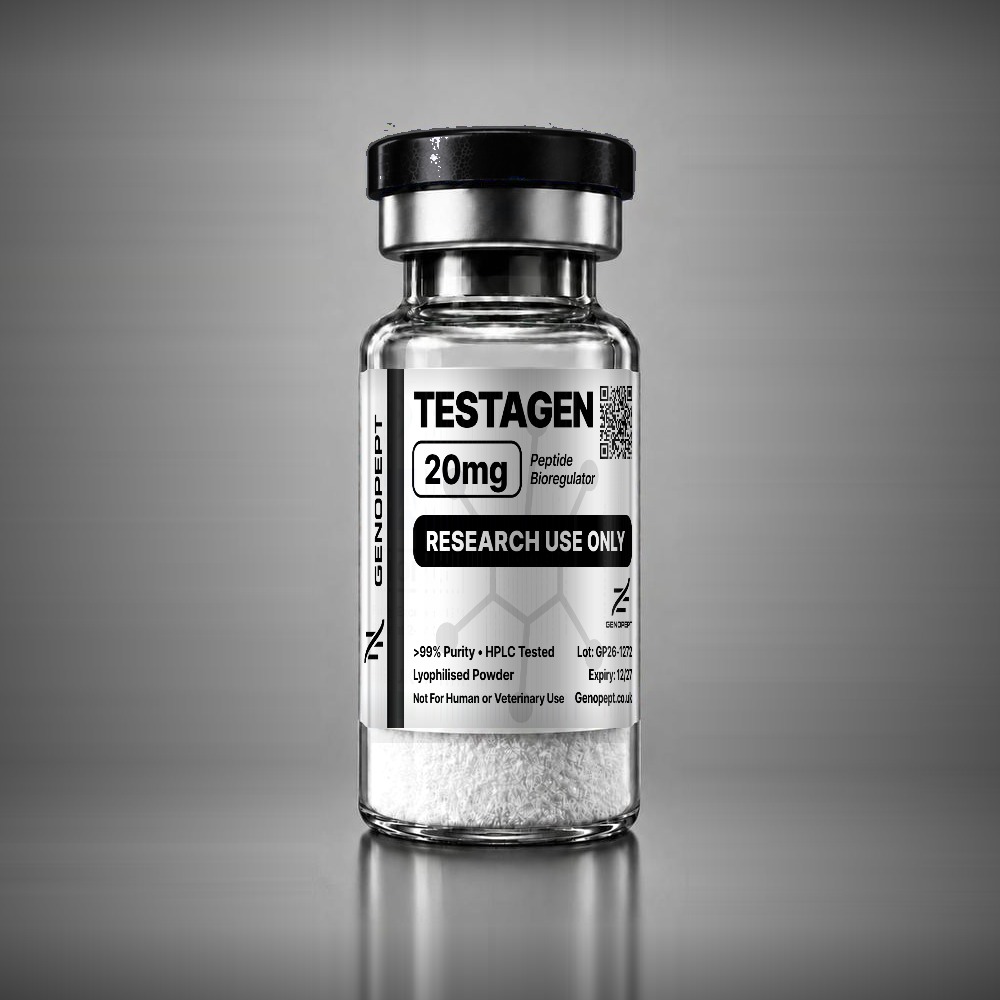
What is Testagen?
Testagen is a synthetic tetrapeptide bioregulator with the sequence Lys-Glu-Asp-Gly (KEDG), developed as a defined analogue of short peptides isolated from testicular tissue. It is part of the Khavinson bioregulator family and is studied in preclinical models of Leydig and Sertoli cell function and male reproductive-tissue ageing.
Testagen shares its Lys-Glu-Asp core with Prostamax and Vesugen, and its C-terminal glycine with Epitalon. GenoPept supplies Testagen UK laboratories as a 20mg lyophilised vial for in-vitro research use. The origin of the series and the naming of each tissue-specific peptide are covered in the GenoPept Khavinson bioregulator guide.
Testagen research applications
Research on this peptide is confined to preclinical settings, chiefly cell culture and rodent models, with a focus on testicular tissue. The areas below summarise where the published literature has investigated the KEDG sequence.
Leydig and Sertoli cell culture
Testagen has been investigated in cultured testicular cells, with reported endpoints including proliferation, expression of steroidogenic enzymes and markers of cell differentiation.
Steroidogenesis pathway models
Research explores whether the KEDG tetrapeptide influences the expression of genes in the steroid-synthesis pathway in cell and rodent models. Findings are hedged and confined to preclinical settings.
Testicular tissue ageing
Preclinical studies examine Testagen in aged animals, measuring histological changes in seminiferous tubules and transcription of genes tied to spermatogenic support.
Reproductive-axis peptide panels
Testagen is studied with Prostamax and with hypothalamic peptides such as gonadorelin to compare tissue-level versus axis-level regulation in reproductive research.
Mechanism of action (preclinical)
Testagen is proposed to act through the nuclear, gene-regulatory mechanism common to Khavinson peptides. The Lys-Glu-Asp-Gly sequence is thought to enter testicular cells and interact with DNA or histone proteins to modulate transcription of genes involved in steroidogenesis and cell renewal. Cell-culture research has reported increased expression of steroidogenic enzymes and proliferation markers after exposure to Testagen. These findings are preclinical and no cell-surface receptor has been described for the peptide.
Testagen product specifications
| Specification | Detail |
|---|---|
| Compound | Testagen |
| Also known as | Testagen peptide, KEDG peptide, Lys-Glu-Asp-Gly, testicular bioregulator |
| Sequence / class | 4-amino-acid synthetic tetrapeptide (Lys-Glu-Asp-Gly, KEDG) |
| Molecular formula | C17H29N5O9 |
| Molecular weight | 447.4 g/mol (calculated from sequence) |
| Form | Lyophilised powder, sealed sterile glass vial, black cap |
| Available sizes | 20mg vial |
| Purity | ≥99% (HPLC) |
| Verification | HPLC purity and LC-MS identity by independent ISO/IEC 17025 laboratory (Puralytix), batch COA |
| Storage (unopened) | –20 °C long term; 2–8 °C short term, protect from light |
| Intended use | In-vitro laboratory research only |
Available sizes
- 20mg vial (lyophilised powder)
One size is available to UK laboratories. For multi-vial studies, bulk boxes of 10 save 20–50% and wholesale enquiries are handled via our bulk and wholesale page.
Reconstitution, handling and storage (laboratory)
Testagen is supplied as a lyophilised powder and should be reconstituted only under laboratory conditions. Use bacteriostatic water or a sterile diluent appropriate to your assay. Add the solvent slowly down the inside wall of the vial, swirl gently until the powder dissolves and never shake, as agitation can degrade short peptides. Detailed steps are in our guide to reconstituting research peptides.
Unopened vials should be stored at –20 °C for long-term use, or at 2–8 °C for short periods, protected from light. After reconstitution, keep the solution at 2–8 °C and use it within the period stated in your laboratory protocol. See how to store research peptides for a full summary. Wear gloves and eye protection, work in a clean environment and dispose of residues according to local laboratory rules.
Quality assurance and Certificate of Analysis
Short peptides such as Testagen are easy to mislabel, so identity testing matters as much as purity. Each batch is analysed by Puralytix (ISO/IEC 17025) with HPLC for purity of 99% or above and LC-MS to confirm the molecular mass of the Lys-Glu-Asp-Gly sequence. The lot-specific Certificate of Analysis is linked from this page and archived in our COA library; see what a Certificate of Analysis shows for guidance.
Related research compounds
- Prostamax 20mg – the prostate tetrapeptide (Lys-Glu-Asp-Pro) differing from Testagen by one residue
- Vesugen 20mg – the vascular tripeptide sharing the Lys-Glu-Asp core
- Pancragen 20mg – the pancreatic tetrapeptide used as a non-reproductive comparator
- Kisspeptin-10 – a kisspeptin fragment studied upstream in the reproductive axis
Testagen frequently asked questions
What is Testagen studied for?
Testagen is studied in laboratory models of testicular tissue, including Leydig and Sertoli cell cultures and aged rodent models. Investigators use the Lys-Glu-Asp-Gly tetrapeptide to examine proliferation, steroidogenic enzyme expression and age-related histological change. GenoPept supplies Testagen for in-vitro research use only.
What is the format and purity of Testagen from GenoPept?
Testagen is supplied as 20mg of lyophilised powder in a sealed, sterile glass vial with a black cap and lot-numbered label. Each batch is independently verified by an ISO/IEC 17025 laboratory at 99% or higher purity by HPLC, with LC-MS identity confirmation on the Certificate of Analysis linked from the product page.
How is Testagen stored?
Store unopened Testagen vials at minus 20 degrees Celsius long term, or at 2 to 8 degrees Celsius for short periods, protected from light. Once reconstituted, refrigerate at 2 to 8 degrees Celsius and use within the period defined in your laboratory protocol. Do not shake reconstituted solutions.
Is Testagen for human use?
No. Testagen is for in-vitro laboratory research only. It is not a medicine, not for human or veterinary use and not for diagnostic or therapeutic purposes. GenoPept provides no dosing or administration information and sells only for legitimate research in the UK.
How does Testagen relate to Epitalon?
Testagen (Lys-Glu-Asp-Gly) and Epitalon (Ala-Glu-Asp-Gly) differ only at the N-terminal residue, lysine versus alanine. Epitalon is associated with the pineal gland and telomerase research, whereas Testagen is associated with testicular tissue. The pair is used to study how a single residue substitution shifts tissue selectivity.
Research use only. Testagen is supplied strictly for in-vitro laboratory research. Not for human or veterinary use, not a medicine, and not for diagnostic or therapeutic use. Full terms: research use only and UK legal status of research peptides.
Reviews
There are no reviews yet.