
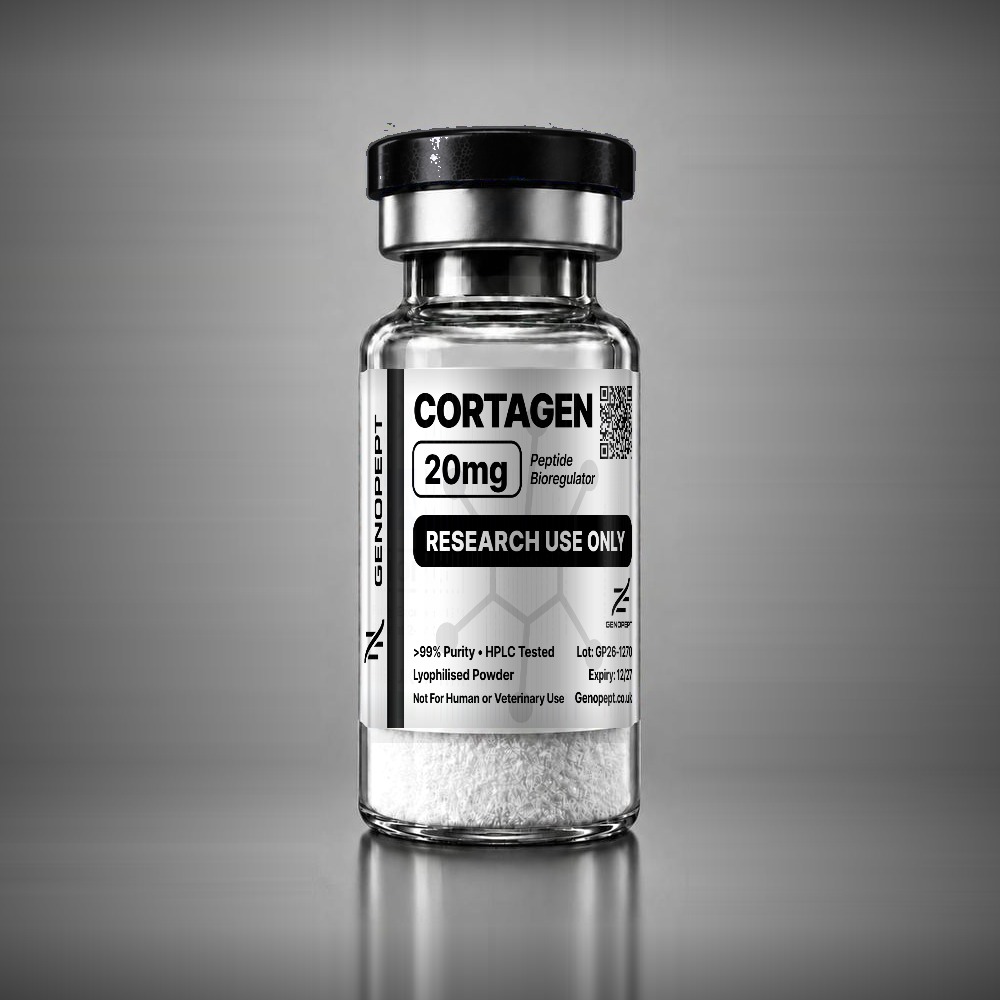
What is Cortagen?
Cortagen is a synthetic tetrapeptide bioregulator with the sequence Ala-Glu-Asp-Pro (AEDP). It was designed as a chemically defined analogue of short peptides identified in a bovine cerebral-cortex peptide complex, and it is associated in the Khavinson literature with neurons and glial cells of the cortex.
Cortagen has a molecular weight of about 430 g/mol and is studied as a tool compound in neuroprotection and nerve-regeneration models. GenoPept supplies Cortagen UK-wide as a 20mg lyophilised vial for in-vitro neuroscience research. For background on the whole family, read our guide to Khavinson peptide bioregulators.
Cortagen research applications
Research on this peptide is confined to preclinical settings, chiefly cell culture and rodent models, with a focus on cerebral cortex and nervous tissue. The areas below summarise where the published literature has investigated the AEDP sequence.
Neuronal cell culture
Cortagen has been investigated in primary cortical neuron and neuroblastoma cultures, where reported endpoints include neurite outgrowth, survival under oxidative or excitotoxic stress and expression of neurotrophic markers.
Nerve-regeneration models
Preclinical studies have examined Cortagen in animal models of peripheral nerve injury, reporting histological and electrophysiological readouts. These are exploratory findings from rodent work.
Cerebral ischaemia models
Research explores whether the AEDP peptide alters outcomes in cell and animal models of oxygen-glucose deprivation, with focus on apoptosis-related signalling and antioxidant enzyme expression.
Neuronal gene-expression studies
Cortagen is used in transcriptomic and immunocytochemical studies of cortical cells to compare its effects with those of Pinealon (Glu-Asp-Arg), the other brain-associated tripeptide in the family.
Mechanism of action (preclinical)
Cortagen is proposed to act through nuclear gene regulation, consistent with other Khavinson peptides. The Ala-Glu-Asp-Pro sequence is thought to cross neuronal membranes, interact with DNA or histone proteins and modulate transcription of genes linked to neuronal survival and plasticity. Cell-culture research has reported increased expression of neurotrophic and antioxidant markers and reduced apoptosis signalling after exposure. As with the rest of the family, these are preclinical observations without an identified receptor for the peptide.
Cortagen product specifications
| Specification | Detail |
|---|---|
| Compound | Cortagen |
| Also known as | Cortagen peptide, AEDP peptide, Ala-Glu-Asp-Pro, cortical bioregulator |
| Sequence / class | 4-amino-acid synthetic tetrapeptide (Ala-Glu-Asp-Pro, AEDP) |
| Molecular formula | C17H26N4O9 |
| Molecular weight | 430.4 g/mol (calculated from sequence) |
| Form | Lyophilised powder, sealed sterile glass vial, black cap |
| Available sizes | 20mg vial |
| Purity | ≥99% (HPLC) |
| Verification | HPLC purity and LC-MS identity by independent ISO/IEC 17025 laboratory (Puralytix), batch COA |
| Storage (unopened) | –20 °C long term; 2–8 °C short term, protect from light |
| Intended use | In-vitro laboratory research only |
Available sizes
- 20mg vial (lyophilised powder)
This bioregulator is stocked in the UK in a single vial size. Laboratories running larger studies can order bulk boxes of 10 vials at 20–50% off through our bulk and wholesale page.
Reconstitution, handling and storage (laboratory)
Cortagen is supplied as a lyophilised powder and should be reconstituted only under laboratory conditions. Use bacteriostatic water or a sterile diluent appropriate to your assay. Add the solvent slowly down the inside wall of the vial, swirl gently until the powder dissolves and never shake, as agitation can degrade short peptides. Detailed steps are in our guide to reconstituting research peptides.
Unopened vials should be stored at –20 °C for long-term use, or at 2–8 °C for short periods, protected from light. After reconstitution, keep the solution at 2–8 °C and use it within the period stated in your laboratory protocol. See how to store research peptides for a full summary. Wear gloves and eye protection, work in a clean environment and dispose of residues according to local laboratory rules.
Quality assurance and Certificate of Analysis
Every batch of Cortagen we supply is tested by Puralytix, an independent ISO/IEC 17025 laboratory, using HPLC to confirm purity of at least 99% and LC-MS to confirm identity against the expected mass of the Ala-Glu-Asp-Pro sequence. The batch Certificate of Analysis is available through the View Certificate of Analysis button on this page and in our COA library. Our explainer on what a Certificate of Analysis shows describes how to read the chromatogram and mass spectrum.
Related research compounds
- Pinealon Neuroprotective Peptide – the brain-associated tripeptide (Glu-Asp-Arg) most often compared with Cortagen
- Vilon 20mg – the thymic dipeptide, a non-neural control in bioregulator panels
- Cardiogen 20mg – the cardiac tetrapeptide, a comparator for tissue selectivity
- Semax Nootropic Peptide – a heptapeptide widely used in neuronal survival and BDNF-related research
Cortagen frequently asked questions
What is Cortagen studied for?
Cortagen is studied in laboratory models of cortical neurons, glial cells and nerve regeneration. Researchers use the Ala-Glu-Asp-Pro tetrapeptide in cell cultures and rodent injury or ischaemia models to examine neuronal survival, neurite growth and neurotrophic gene expression. GenoPept supplies it for in-vitro research use only.
How is Cortagen supplied?
GenoPept Cortagen is a 20mg lyophilised powder in a sealed, sterile glass vial with a black cap, labelled with lot number and expiry. Every batch is tested by an independent ISO/IEC 17025 laboratory, with HPLC purity of 99% or higher and LC-MS identity confirmation documented on the batch Certificate of Analysis.
How should Cortagen be stored?
Keep unopened Cortagen at minus 20 degrees Celsius for long-term storage or at 2 to 8 degrees Celsius short term, protected from light. After reconstitution, store at 2 to 8 degrees Celsius and use within the period set by your laboratory protocol. Avoid repeated freeze-thaw cycles of the solution.
Is Cortagen intended for human use?
No. Cortagen is for in-vitro laboratory research only. It is not a medicine, is not for human or veterinary use and is not for diagnostic or therapeutic purposes. GenoPept provides no dosing or administration information and sells only for legitimate research in the UK.
What is the difference between Cortagen and Pinealon?
Cortagen (Ala-Glu-Asp-Pro) is a tetrapeptide modelled on cortical peptide fractions and is used mainly in neuroprotection and nerve-regeneration models. Pinealon (Glu-Asp-Arg) is a tripeptide associated with brain and pineal tissue that is more often studied in oxidative-stress and neuronal ageing assays. The two are frequently compared in cortical cell studies.
Research use only. Cortagen is sold for in-vitro laboratory research only. It is not for human or veterinary use, not a medicine, and not for diagnostic or therapeutic use. See our research use only policy and UK legal guidance on research peptides.
Reviews
There are no reviews yet.