
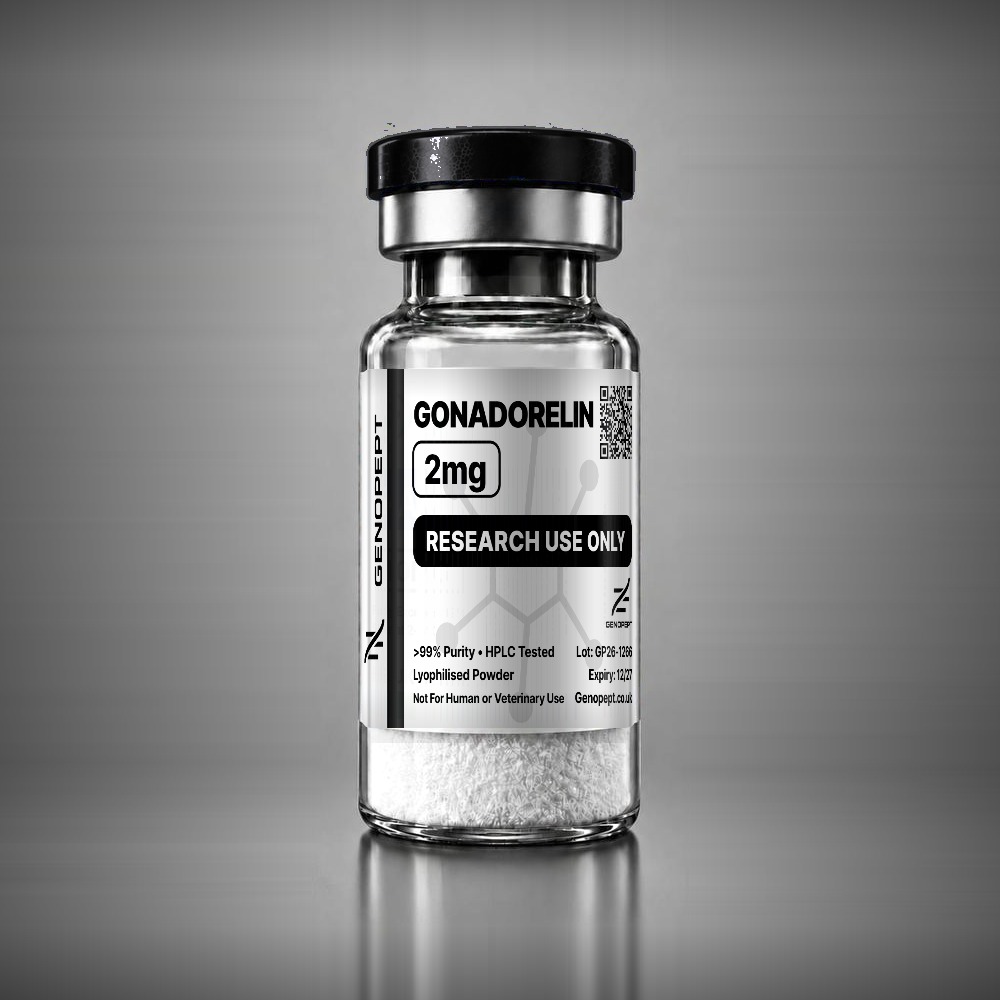
What is Gonadorelin?
Gonadorelin is a synthetic decapeptide with the same 10-amino-acid sequence as native gonadotropin-releasing hormone (GnRH), the hypothalamic peptide that binds the pituitary GnRH receptor and drives pulsatile release of luteinising hormone (LH) and follicle-stimulating hormone (FSH). It is also known as LHRH (luteinising hormone-releasing hormone). GenoPept supplies gonadorelin UK researchers as a lyophilised research peptide in 2mg, 5mg and 10mg vials, each batch tested for purity and identity.
Because the sequence is identical to endogenous GnRH, gonadorelin is the reference agonist against which longer-acting analogues such as triptorelin are compared in laboratory work. Its short biological half-life in preclinical models (minutes rather than hours) makes it a useful tool for studying the pulsatile nature of hypothalamic-pituitary-gonadal (HPG) axis signalling rather than sustained receptor occupancy.
Gonadorelin research applications
Gonadorelin peptide is used across reproductive endocrinology, neuroendocrine and receptor-pharmacology research. The areas below describe how it is investigated in cell-culture and animal models; none are claims about use in people.
Hypothalamic-pituitary-gonadal axis signalling
Gonadorelin is the standard tool for probing GnRH receptor responsiveness in pituitary cell preparations and animal models. Researchers use it to characterise LH and FSH secretory dynamics, receptor desensitisation after continuous versus pulsatile exposure, and how upstream inputs such as kisspeptin modulate GnRH output.
GnRH receptor pharmacology
As the native ligand, gonadorelin is used to establish baseline binding affinity, calcium-flux and inositol-phosphate responses at the GnRH receptor, against which agonists and antagonists are benchmarked in in-vitro assays.
Reproductive biology models
Animal studies investigate gonadorelin in models of ovulation timing, gonadal steroidogenesis and gametogenesis, including comparative work across species in which GnRH signalling is conserved.
Pituitary stimulation assays
Gonadorelin has a long history in published clinical literature as a diagnostic stimulation agent for assessing pituitary gonadotroph function. In the laboratory, this same property is used to validate ex-vivo pituitary explant and cell-line assays.
Comparative analogue research
Research explores how substitutions at positions 6 and 10 of the GnRH sequence, as found in triptorelin and other analogues, change receptor affinity, enzymatic stability and the shift from stimulation to downregulation.
Mechanism of action (preclinical)
Gonadorelin binds the GnRH receptor (GnRHR), a class A G protein-coupled receptor expressed on pituitary gonadotroph cells. Receptor activation couples primarily through Gq/11, activating phospholipase C, raising intracellular calcium and inositol trisphosphate, and stimulating protein kinase C. This cascade drives synthesis and exocytosis of LH and FSH.
In preclinical models the pattern of exposure determines the outcome: pulsatile gonadorelin sustains gonadotropin release, whereas continuous exposure leads to receptor desensitisation, internalisation and suppression of LH and FSH. This biphasic behaviour underlies much of the comparative research between gonadorelin and long-acting GnRH agonists.
Gonadorelin product specifications
| Specification | Detail |
|---|---|
| Compound | Gonadorelin (synthetic gonadotropin-releasing hormone, GnRH) |
| Also known as | GnRH, LHRH, Luteinising hormone-releasing hormone, Gonadorelin acetate |
| Sequence / class | 10-amino-acid synthetic decapeptide, identical to native human GnRH (pGlu-His-Trp-Ser-Tyr-Gly-Leu-Arg-Pro-Gly-NH2) |
| CAS number | 33515-09-2 |
| Molecular formula | C55H75N17O13 |
| Molecular weight | 1182.3 g/mol |
| Form | Lyophilised (freeze-dried) powder in a sealed, sterile glass vial with black cap; lot number and expiry on the label |
| Available sizes | 2mg, 5mg, 10mg |
| Purity | ≥99% (HPLC) |
| Verification | Independent third-party HPLC purity and LC-MS identity testing (Puralytix, ISO/IEC 17025); batch Certificate of Analysis |
| Storage (unopened) | –20 °C long term; 2–8 °C short term; protect from light |
| Intended use | In-vitro laboratory research only. Not for human or veterinary use, not a medicine, not for diagnostic or therapeutic use |
Available sizes
GenoPept stocks gonadorelin in three vial sizes so laboratories can match quantity to study scale, from single receptor assays to larger animal-model programmes:
- 2mg vial
- 5mg vial
- 10mg vial
Laboratories running larger studies can order it in bulk boxes of 10 vials at 20–50% below single-vial pricing through our bulk and wholesale page, with UK-only retail delivery.
Reconstitution, handling and storage (laboratory)
This compound is supplied as a lyophilised powder and should be stored unopened at –20 °C for long-term holding, or at 2–8 °C for short periods, always protected from light. As a native-sequence decapeptide, gonadorelin is susceptible to enzymatic and oxidative degradation once in solution, so prepare only what a protocol needs and avoid repeated freeze-thaw cycles.
To reconstitute for in-vitro work, add bacteriostatic water or another sterile diluent slowly down the inside wall of the vial, then swirl gently until the powder dissolves. Never shake the vial, because shear can damage the molecule. After reconstitution keep the solution at 2–8 °C and use it within the period stated in the laboratory protocol. UK laboratories can also read our guides on how to reconstitute research peptides and how to store research peptides.
Quality assurance and Certificate of Analysis
Every batch of Gonadorelin sold by GenoPept is tested by an independent third-party laboratory, Puralytix (ISO/IEC 17025 accredited), using HPLC for purity and LC-MS for identity confirmation. The resulting batch Certificate of Analysis (COA) is linked from the “View Certificate of Analysis” button on this page, and the complete library is available at genopept.co.uk/coa-certificates.
For a short peptide such as gonadorelin, the LC-MS identity check confirms the expected mass of the decapeptide while HPLC quantifies purity against related impurities and truncated sequences. Our article on what a Certificate of Analysis shows explains how to read the purity chromatogram and mass spectrum. Orders are dispatched from the UK by tracked Royal Mail Special Delivery (£10, free on orders over £200), with automatic basket discounts of 5% over £300, 10% over £500 and 15% over £1,000. We accept bank transfer and crypto.
Related research compounds
- Triptorelin 2mg – a D-Trp6 GnRH analogue with higher receptor affinity and longer duration, the natural comparator to gonadorelin.
- Kisspeptin-10 – the upstream regulator of GnRH neurons, studied alongside gonadorelin in HPG-axis models.
- HCG (Human Chorionic Gonadotropin) – an LH-receptor agonist for studying downstream gonadal responses.
- HMG 75 IU – a urinary FSH/LH preparation for research on gonadotropin action.
Gonadorelin frequently asked questions
What is gonadorelin used for in research?
Gonadorelin is used to study the hypothalamic-pituitary-gonadal axis, GnRH receptor pharmacology and gonadotropin (LH and FSH) secretion in cell-culture and animal models. Because its sequence is identical to native GnRH, it is the reference agonist for benchmarking synthetic analogues, and it is used to model pulsatile versus continuous receptor stimulation in preclinical work.
How is gonadorelin supplied and what purity is it?
GenoPept supplies gonadorelin as a lyophilised powder in sealed, sterile glass vials of 2mg, 5mg or 10mg. Every batch is manufactured to ≥99% purity and independently verified by Puralytix, an ISO/IEC 17025 laboratory, using HPLC for purity and LC-MS for identity. The batch Certificate of Analysis is available from the button on this product page.
How should gonadorelin be stored in the laboratory?
Store unopened gonadorelin vials at –20 °C for long-term holding, or at 2–8 °C for short periods, and keep them protected from light. Once reconstituted with bacteriostatic water or sterile diluent, hold the solution at 2–8 °C and use it within the timeframe set out in your laboratory protocol, avoiding repeated freeze-thaw cycles.
Is gonadorelin for human use?
No. Gonadorelin from GenoPept is sold strictly for in-vitro laboratory research. It is not for human or veterinary use, it is not a medicine, and it must not be used for diagnostic or therapeutic purposes. We do not provide dosing or administration information, and nothing on this page should be read as medical advice.
What is the difference between gonadorelin and triptorelin?
Gonadorelin has the exact native GnRH sequence and a short duration of action in preclinical models, so it is used to study physiological, pulsatile signalling. Triptorelin substitutes D-tryptophan at position 6, which increases receptor affinity and resistance to enzymatic breakdown; in continuous-exposure models it produces receptor downregulation. Both are GnRH receptor agonists, but they answer different research questions.
Research use only. Gonadorelin is supplied strictly for in-vitro laboratory research. It is not for human or veterinary use, it is not a medicine, and it is not for diagnostic or therapeutic use. Nothing on this page is medical advice. Read our research use only policy and guide to research peptides and UK law before ordering.
Research guides: Reproductive Hormone Peptides Research Guide
Reviews
There are no reviews yet.