
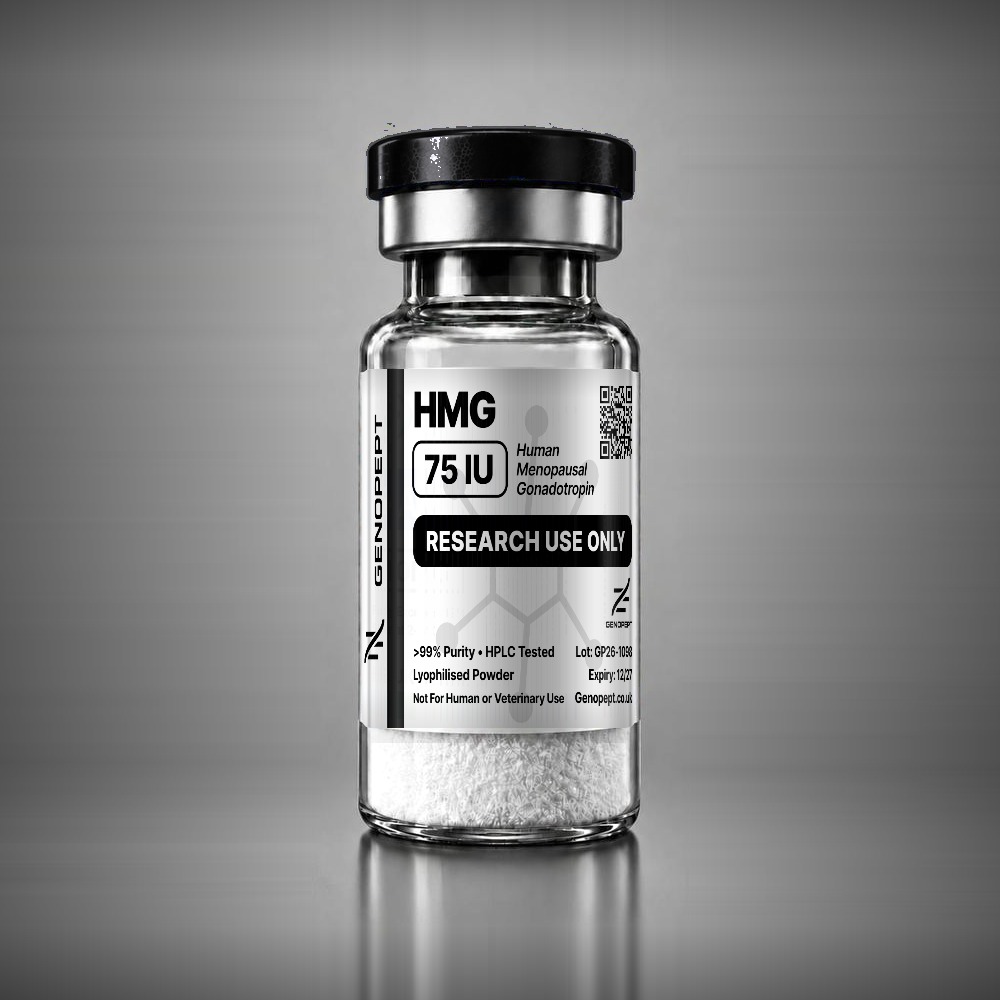
What is HMG (Human Menopausal Gonadotropin) 75 IU?
HMG (Human Menopausal Gonadotropin), also called menotropins, is a purified preparation of the two pituitary gonadotropins, follicle-stimulating hormone (FSH) and luteinising hormone (LH), extracted from the urine of postmenopausal women. The 75 IU research vial supplied by GenoPept to HMG UK laboratories provides FSH and LH activity in a lyophilised, batch-identified form.
After the menopause, the loss of ovarian feedback causes the pituitary to secrete large amounts of FSH and LH, which are excreted in urine and can be purified. HMG therefore delivers a naturally derived mixture of both gonadotropins, unlike recombinant single-hormone preparations, and this dual activity is the reason it is chosen for research on combined gonadotropin signalling.
HMG (Human Menopausal Gonadotropin) 75 IU research applications
HMG is used as a research reagent in reproductive biology, ovarian and testicular physiology, receptor pharmacology and glycoprotein analysis. The following areas describe how it is investigated in preclinical and in-vitro models and make no claims about use in people.
Folliculogenesis and ovarian stimulation models
HMG is widely used in animal models and in-vitro follicle culture to study how FSH and LH act together on granulosa and theca cells to drive follicle recruitment, growth and oestradiol synthesis.
FSH and LH receptor co-signalling
Research explores how simultaneous activation of the FSH receptor and the LH/CG receptor changes cAMP signalling, steroidogenic enzyme expression and gene transcription in ovarian and testicular cell models.
Spermatogenesis and testicular function
Animal studies investigate HMG as a combined gonadotropin stimulus for Sertoli and Leydig cell function, sperm production and testicular steroidogenesis in models of hypogonadotropic states.
Assisted-reproduction and embryology research
HMG is used in laboratory embryology and in-vitro maturation protocols in animal models, where its two-hormone composition is compared with recombinant FSH, recombinant LH and HCG.
Glycoprotein characterisation
Urinary gonadotropins carry heterogeneous glycosylation patterns, and HMG is used in analytical research on glycoform diversity, bioactivity assays and comparison with recombinant hormones.
Mechanism of action (preclinical)
The FSH component of HMG binds the FSH receptor (FSHR) on granulosa cells and Sertoli cells, while the LH component binds the LH/CG receptor (LHCGR) on theca cells, Leydig cells and mature granulosa cells. Both are class A G protein-coupled receptors that signal primarily through Gs and adenylyl cyclase, raising intracellular cAMP and activating protein kinase A.
In preclinical models this dual receptor activation supports the two-cell, two-gonadotropin model of ovarian steroidogenesis: LH stimulates theca cells to produce androgens, which FSH-stimulated granulosa cells aromatise to oestradiol.
HMG (Human Menopausal Gonadotropin) 75 IU product specifications
| Specification | Detail |
|---|---|
| Compound | Human menopausal gonadotropin (menotropins), urinary FSH and LH glycoprotein preparation |
| Also known as | hMG, Menotropins, Menotrophin, Urinary gonadotropins |
| Sequence / class | Purified mixture of the glycoprotein hormones FSH and LH extracted from the urine of postmenopausal women; each is a heterodimer of a common alpha subunit and a hormone-specific beta subunit |
| CAS number | 61489-71-2 |
| Form | Lyophilised (freeze-dried) powder in a sealed, sterile glass vial with black cap; lot number and expiry on the label; activity expressed in International Units (IU) |
| Available sizes | 75 IU |
| Purity | ≥99% (HPLC) |
| Verification | Independent third-party HPLC purity and LC-MS identity testing (Puralytix, ISO/IEC 17025); batch Certificate of Analysis |
| Storage (unopened) | –20 °C long term; 2–8 °C short term; protect from light |
| Intended use | In-vitro laboratory research only. Not for human or veterinary use, not a medicine, not for diagnostic or therapeutic use |
Available sizes
HMG is supplied in a single research vial size, with the combined activity expressed in International Units:
- 75 IU vial
Laboratories running larger studies can order it in bulk boxes of 10 vials at 20–50% below single-vial pricing through our bulk and wholesale page, with UK-only retail delivery.
Reconstitution, handling and storage (laboratory)
This compound is supplied as a lyophilised powder and should be stored unopened at –20 °C for long-term holding, or at 2–8 °C for short periods, always protected from light. HMG contains two large glycoproteins that are sensitive to heat and mechanical stress, so reconstitute slowly, never vortex, and keep working solutions on ice or at 2–8 °C.
To reconstitute for in-vitro work, add bacteriostatic water or another sterile diluent slowly down the inside wall of the vial, then swirl gently until the powder dissolves. Never shake the vial, because shear can damage the molecule. After reconstitution keep the solution at 2–8 °C and use it within the period stated in the laboratory protocol. UK laboratories can also read our guides on how to reconstitute research peptides and how to store research peptides.
Quality assurance and Certificate of Analysis
Every batch of HMG sold by GenoPept is tested by an independent third-party laboratory, Puralytix (ISO/IEC 17025 accredited), using HPLC for purity and LC-MS for identity confirmation. The resulting batch Certificate of Analysis (COA) is linked from the “View Certificate of Analysis” button on this page, and the complete library is available at genopept.co.uk/coa-certificates.
Because HMG is a naturally derived mixture, batch-to-batch consistency matters; the COA for each GenoPept batch reports the HPLC purity profile and the LC-MS identity confirmation of the glycoprotein content. Our article on what a Certificate of Analysis shows explains how to read the purity chromatogram and mass spectrum. Orders are dispatched from the UK by tracked Royal Mail Special Delivery (£10, free on orders over £200), with automatic basket discounts of 5% over £300, 10% over £500 and 15% over £1,000. We accept bank transfer and crypto.
Related research compounds
- HCG (Human Chorionic Gonadotropin) – a pure LH-receptor agonist for comparison with the combined FSH and LH activity of HMG.
- Gonadorelin – native GnRH for stimulating endogenous gonadotropin release in pituitary models.
- Kisspeptin-10 – the upstream hypothalamic regulator of FSH and LH secretion.
- Triptorelin 2mg – a GnRH agonist used to suppress endogenous gonadotropins before exogenous stimulation studies.
HMG (Human Menopausal Gonadotropin) 75 IU frequently asked questions
What is HMG used for in research?
HMG is used to study combined FSH and LH signalling in ovarian and testicular models, including folliculogenesis, the two-cell model of oestradiol synthesis, spermatogenesis and in-vitro oocyte maturation in animal systems. It is also used in analytical research comparing urinary and recombinant gonadotropin glycoforms. All applications are preclinical or in-vitro.
How is HMG supplied and what purity is it?
GenoPept supplies HMG as a lyophilised powder in a sealed, sterile 75 IU glass vial with a black cap and a batch-identified label showing lot number and expiry. Each batch is independently tested by Puralytix (ISO/IEC 17025) by HPLC for purity and LC-MS for identity, and the batch Certificate of Analysis can be viewed from this product page.
How should HMG be stored in the laboratory?
Keep unopened HMG vials at –20 °C for long-term storage, or at 2–8 °C for short periods, protected from light. After reconstitution with bacteriostatic water or sterile diluent, store the solution at 2–8 °C and use it within the period set out in your laboratory protocol. Avoid heat, vigorous shaking and repeated freeze-thaw cycles, which can denature the glycoproteins.
Is HMG for human use?
No. HMG from GenoPept is supplied strictly for in-vitro laboratory research and is not for human or veterinary use. It is not a medicine and is not for diagnostic or therapeutic purposes. We do not provide dosing, administration or treatment information, and nothing on this page constitutes medical advice.
What is the difference between HMG and recombinant FSH?
HMG is purified from postmenopausal urine and contains both FSH and LH activity, with naturally heterogeneous glycosylation. Recombinant FSH is produced in cell culture, contains FSH only and has a more uniform glycoform profile. Researchers use HMG when a combined, physiologically mixed gonadotropin stimulus is required, and recombinant FSH when the FSH receptor is to be studied in isolation.
Research use only. HMG is supplied strictly for in-vitro laboratory research. It is not for human or veterinary use, it is not a medicine, and it is not for diagnostic or therapeutic use. Nothing on this page is medical advice. Read our research use only policy and guide to research peptides and UK law before ordering.
Research guides: Reproductive Hormone Peptides Research Guide
Reviews
There are no reviews yet.