
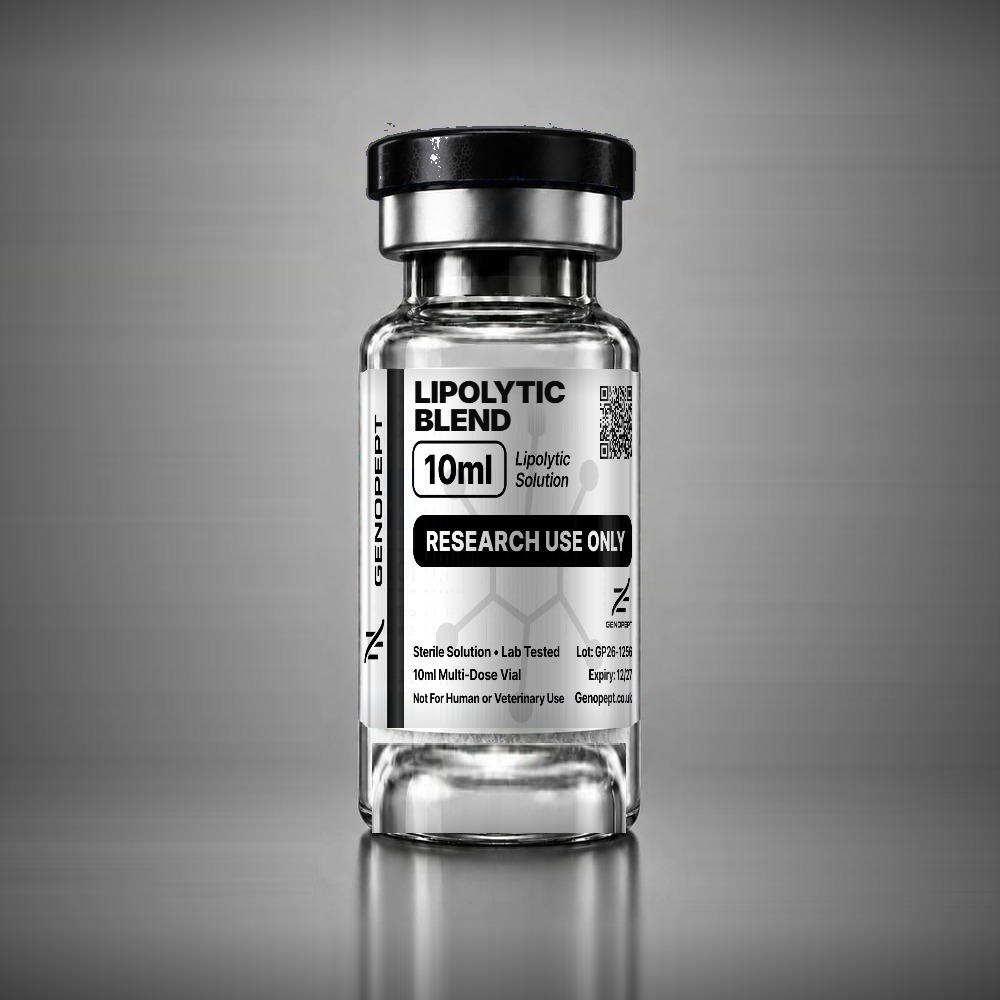
What is Lipolytic Blend 10ml?
Lipolytic Blend 10ml is a proprietary liquid research solution containing riboflavin (vitamin B2, CAS 83-88-5, C17H20N4O6, 376.37 g/mol) together with lipotropic compounds, supplied in a 10 ml multi-dose vial for laboratory research on adipose lipolysis and lipid metabolism. It is not a peptide and has no single receptor. Riboflavin is the precursor of the flavin cofactors FMN and FAD used by the dehydrogenases of fatty-acid oxidation, and lipotropic agents in the research literature are methyl-donor and phospholipid-precursor molecules of the methionine, inositol and choline type.
The exact quantitative formula is not published by GenoPept, so this page names riboflavin as a declared component and describes the other components by class. The solution’s yellow colour comes from riboflavin. UK laboratories buy Lipolytic Blend as a pre-mixed lipolytic research solution for adipocyte and tissue models.
Lipolytic Blend 10ml research applications
Adipocyte lipolysis assays
Lipolytic solutions are studied in cultured adipocytes and adipose explants, where glycerol and free fatty-acid release into the medium are measured as markers of triglyceride hydrolysis.
Flavoprotein-dependent fatty-acid oxidation
Because riboflavin is converted to FAD, the cofactor of acyl-CoA dehydrogenases and electron-transfer flavoprotein, Lipolytic Blend is used in models that examine flavin status and beta-oxidation capacity.
Adipose tissue remodelling models
Rodent studies investigate lipolytic and lipotropic mixtures in subcutaneous fat depots, with adipocyte size, lipid-droplet markers and local inflammatory readouts as endpoints.
Photochemistry and stability research
Riboflavin is a photosensitiser, and the blend is used in studies of light-dependent oxidative reactions in lipid systems.
Comparative lipotropic research
Lipolytic Blend is compared with Lipo-C, Lipo-B and Fat Blaster to separate lipolytic from lipotropic activity in the same models.
Mechanism of action (preclinical)
Lipolysis in preclinical models is carried out by adipose triglyceride lipase, hormone-sensitive lipase and monoacylglycerol lipase, which sequentially hydrolyse stored triglyceride to glycerol and free fatty acids. Compounds that raise cyclic AMP or modulate lipid-droplet proteins increase this flux, and lipolytic research solutions are studied for their combined influence on these enzymes.
Riboflavin contributes through its cofactor forms FMN and FAD, which are required by acyl-CoA dehydrogenases, electron-transfer flavoprotein and succinate dehydrogenase, linking released fatty acids to mitochondrial oxidation. Lipotropic components support phosphatidylcholine synthesis and hepatic lipid export. Lipolytic Blend is therefore investigated as a pathway-level combination rather than a single-target agent.
Lipolytic Blend 10ml product specifications
| Specification | Detail |
|---|---|
| Product type | Lipolytic research solution with riboflavin (proprietary formula) |
| Form | Liquid research solution in a sealed multi-dose glass vial |
| Volume | 10 ml |
| Key components (class-level) | Riboflavin (vitamin B2, CAS 83-88-5) with lipotropic compounds of the methionine, inositol and choline class; exact composition not published |
| Appearance | Yellow liquid (riboflavin), clear, free from particulates |
| Verification | Component identity by LC-MS and purity by HPLC, Puralytix (ISO/IEC 17025), batch COA |
| Storage | 2–8 °C, protect from light, do not freeze |
| Intended use | In-vitro laboratory research only |
Available sizes
- Lipolytic Blend 10 ml multi-dose research solution vial
Lipolytic Blend is supplied in a single 10 ml vial size from UK stock. Boxes of 10 vials save 20 to 50% through the bulk and wholesale page.
Reconstitution, handling and storage (laboratory)
Lipolytic Blend is supplied as a 10 ml multi-dose research solution and does not require reconstitution. Store unopened vials at 2 to 8 °C, protected from light, and do not freeze; freezing can cause components to precipitate. Allow the vial to reach room temperature before drawing so that volumes are accurate.
Swab the stopper before each draw and use a fresh sterile needle every time to protect the multi-dose seal. Record the first-puncture date on the label, return the vial to the refrigerator between uses, and discard it at the end of the period set by your protocol or if the solution changes colour, turns cloudy or shows particulates. Riboflavin photodegrades rapidly, so keep the vial in its carton or an amber container at all times. General guidance is in the storage guide on the site.
Quality assurance and Certificate of Analysis
Every batch of Lipolytic Blend 10ml supplied by GenoPept is tested by an independent UK third-party laboratory (Puralytix, ISO/IEC 17025 accredited). Testing confirms riboflavin and other declared components by LC-MS and checks purity of the active compounds by HPLC. The batch Certificate of Analysis (COA) is available through the “View Certificate of Analysis” button on this page, and the full library is published at genopept.co.uk/coa-certificates.
Each vial is sealed, batch-identified with lot number and expiry date, and dispatched by tracked Royal Mail Special Delivery within the UK (free on orders of £200 or more). Read what a Certificate of Analysis shows to interpret the report.
Related research compounds
- Lipo-C Fat Metabolism Complex 10ml: a lipotropic and B-vitamin complex for lipotropic comparison.
- Lipo-B 10ml: a lipotropic solution with vitamin B12.
- Fat Blaster 10ml: a multi-component lipotropic research blend.
- L-Carnitine: the fatty-acid carrier that links lipolysis to mitochondrial oxidation.
Lipolytic Blend 10ml frequently asked questions
What is Lipolytic Blend used for in research?
Lipolytic Blend is used as a riboflavin-containing lipolytic research solution in laboratory models of adipose tissue and lipid metabolism. Researchers apply it to cultured adipocytes, explant tissue and rodent models to study lipid-droplet breakdown, glycerol and free fatty-acid release, and the role of flavin cofactors in fatty-acid oxidation. It is supplied for in-vitro laboratory research only.
What does lipolytic mean in a research context?
Lipolytic describes activity that promotes lipolysis, the enzymatic hydrolysis of stored triglyceride into glycerol and free fatty acids, as measured in cell and animal models. Lipotropic compounds, by contrast, act on fat export from the liver. In this catalogue the term refers to the class of research activity studied in the laboratory, not to any effect in people.
How is Lipolytic Blend supplied and verified?
GenoPept supplies Lipolytic Blend as a 10 ml multi-dose liquid research solution in a sealed, batch-identified glass vial. Riboflavin is a declared component and gives the solution its yellow colour; the remaining lipotropic compounds are described at class level because the exact formula is proprietary. Each batch is tested by an independent ISO/IEC 17025 laboratory with a linked COA.
How should Lipolytic Blend be stored in the laboratory?
Store Lipolytic Blend at 2 to 8 °C, protected from light, and do not freeze. Riboflavin is strongly light-sensitive and photodegrades in solution, so keep the vial in its carton or an amber container at all times. After the first puncture, date the label, swab the stopper and use a fresh sterile needle for each draw. Discard if the colour fades or the solution turns cloudy.
Is Lipolytic Blend for human use?
No. Lipolytic Blend is sold strictly for in-vitro laboratory research. It is not a medicine, cosmetic, injectable or fat-dissolving product, is not for human or veterinary use, and is not intended for diagnostic or therapeutic use. Purchasers must be researchers who accept the research use only terms before ordering.
Research use only. This product is supplied for in-vitro laboratory research only. It is not for human or veterinary use, is not a medicine, and is not intended for diagnostic or therapeutic use. See the research use only policy for full terms.
Reviews
There are no reviews yet.