
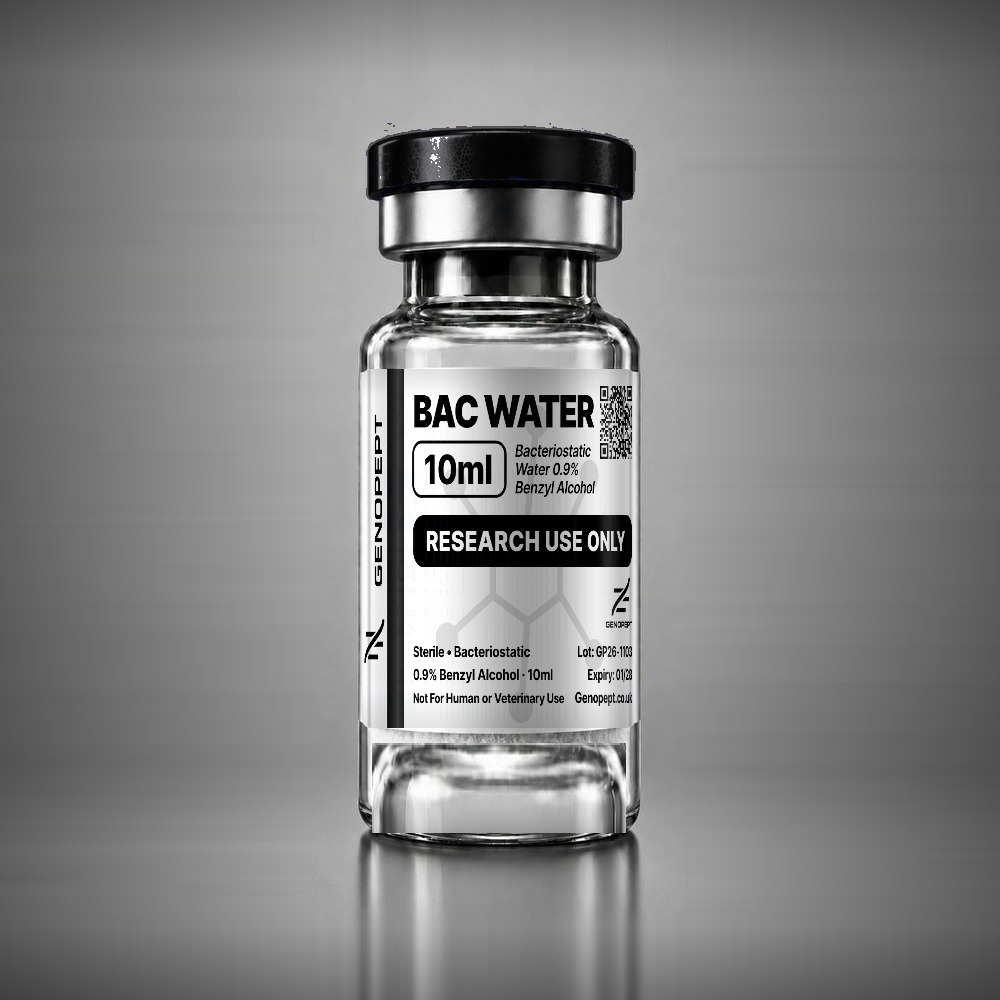
What is Bacteriostatic Water (0.9% Benzyl Alcohol)?
Bacteriostatic Water (0.9% Benzyl Alcohol) is a sterile, non-pyrogenic aqueous diluent in which purified water is preserved with 0.9% w/v benzyl alcohol, supplied for the reconstitution and dilution of research peptides in the laboratory. It is not a peptide and has no biological target of its own; its role is to dissolve lyophilised powders into a stable, sample-ready solution. Benzyl alcohol (CAS 100-51-6, C7H8O, 108.14 g/mol) is the bacteriostatic agent that distinguishes this diluent from plain sterile water.
Researchers in the UK buy bacteriostatic water alongside lyophilised peptides because almost every GenoPept powder vial is reconstituted before use. The 3ml and 10ml vial sizes suit single-peptide reconstitution and larger multi-vial workflows respectively.
Bacteriostatic Water (0.9% Benzyl Alcohol) research applications
Reconstitution of lyophilised peptides
The primary use of bacteriostatic water in research is dissolving freeze-dried peptides such as BPC-157, semaglutide or GHK-Cu into a known concentration for assay work. Adding the diluent down the vial wall and swirling gently preserves peptide structure.
Multi-dose sampling
Because the preservative suppresses microbial growth, a reconstituted vial can be sampled repeatedly across an experiment rather than being discarded after one draw. This is the practical reason bacteriostatic water is preferred to plain sterile water for multi-day laboratory protocols.
Serial dilution and stock preparation
Bacteriostatic water is also used to prepare intermediate dilutions of a peptide stock, and as the diluent in the GenoPept somatropin research kit, where each box is supplied with bacteriostatic water for the ten vials.
Compatibility considerations
Benzyl alcohol is compatible with the great majority of peptides, but some protein and cell-culture protocols call for preservative-free diluent. Check the specific assay requirements before choosing a reconstitution solvent.
Mechanism of action (preclinical)
Benzyl alcohol acts as a bacteriostat rather than a bactericide: at 0.9% w/v it disrupts bacterial cell membranes and inhibits the replication of many common contaminants, holding microbial numbers in check between draws rather than sterilising an already contaminated solution. Its activity has been characterised in published pharmaceutical literature as a multi-dose vial preservative for many decades.
The concentration is low enough to leave the physical properties of water essentially unchanged, so peptides reconstituted in bacteriostatic water behave as they would in plain water for the purposes of routine laboratory dilution. Bacteriostatic water is not isotonic; where an isotonic research diluent is required, an alternative sterile diluent should be selected.
Bacteriostatic Water (0.9% Benzyl Alcohol) product specifications
| Specification | Detail |
|---|---|
| Product type | Sterile aqueous reconstitution diluent |
| Composition | Purified water with 0.9% w/v benzyl alcohol as bacteriostatic preservative |
| Preservative | Benzyl alcohol, CAS 100-51-6, C7H8O, 108.14 g/mol |
| Form | Clear, colourless liquid in a sealed multi-dose glass vial |
| Vial sizes | 3ml and 10ml |
| Sterility | Sterile, non-pyrogenic, free from visible particulates; sealed vial with batch lot and expiry on label |
| Storage (unopened) | Controlled room temperature, protect from light and freezing |
| Storage (opened) | Room temperature, protect from light; laboratory convention is to discard 28 days after first puncture |
| Intended use | In-vitro laboratory research only, as a diluent for research peptides |
Available sizes
- 3ml vial of bacteriostatic water (0.9% benzyl alcohol)
- 10ml vial of bacteriostatic water (0.9% benzyl alcohol)
Laboratories using larger quantities can order bulk boxes of 10 vials with savings of 20 to 50% through the bulk and wholesale page. Bacteriostatic water is one of the most commonly added items to a UK research peptide order because it is needed for every lyophilised vial.
Reconstitution, handling and storage (laboratory)
Bacteriostatic water is used as supplied and does not itself need reconstitution. To reconstitute a lyophilised peptide, swab the stoppers of both vials, draw the required volume of bacteriostatic water and add it slowly down the inside wall of the peptide vial. Swirl gently until the powder dissolves and never shake, which can shear peptide chains.
Store unopened vials at controlled room temperature, protected from light, and do not freeze; UK laboratories typically hold stock at 15 to 25 °C. Once punctured, label the vial with the opening date and discard after 28 days in line with standard laboratory practice for preserved multi-dose vials. Reconstituted peptides should then be kept at 2 to 8 °C and used within the period specified in your protocol. See the guides on how to reconstitute research peptides and how to store research peptides.
Quality assurance and Certificate of Analysis
Bacteriostatic water supplied by GenoPept is sourced as a sterile, batch-identified diluent and is checked for clarity, absence of particulates and intact seals before dispatch. Each vial carries a lot number and expiry date so a diluent batch can be traced in your laboratory records alongside the peptide batch it was used with.
The peptides you reconstitute with it are independently tested by Puralytix (ISO/IEC 17025) with HPLC purity and LC-MS identity results on each Certificate of Analysis. The full COA library is at genopept.co.uk/coa-certificates, and orders ship by tracked Royal Mail Special Delivery within the UK, free on orders of £200 or more.
Related research compounds
- Somatropin HGH 191-AA Research Kits: supplied with bacteriostatic water for the ten vials in each kit.
- BPC-157: the most frequently reconstituted research peptide in the GenoPept range.
- Semaglutide: a GLP-1 research peptide typically reconstituted in bacteriostatic water.
- Glutathione (GSH): a high-mass lyophilised vial that benefits from the 10ml diluent size.
Bacteriostatic Water (0.9% Benzyl Alcohol) frequently asked questions
What is bacteriostatic water used for in research?
Bacteriostatic water is used by UK laboratories to reconstitute lyophilised research peptides and to dilute research solutions. The 0.9% benzyl alcohol content inhibits bacterial growth in a multi-dose vial, so one vial can be drawn from several times under aseptic technique. It is supplied as a companion to the research peptide range for in-vitro laboratory use only.
Why does bacteriostatic water contain benzyl alcohol?
Benzyl alcohol at 0.9% w/v is a long-established bacteriostatic preservative that suppresses the growth of microorganisms that may be introduced each time a needle enters a multi-dose vial. Without it, sterile water is a single-use diluent that should be discarded after first opening. The preservative keeps a reconstituted research peptide vial usable across repeated sampling.
How long can bacteriostatic water be used after the first puncture?
Common laboratory practice is to discard an opened vial of bacteriostatic water 28 days after the first puncture, in line with the convention used for multi-dose preserved vials. Record the opening date on the label, store the vial at controlled room temperature away from light, and discard sooner if the solution becomes cloudy or shows particulates.
What is the difference between bacteriostatic water and sterile water?
Sterile water for laboratory use contains no preservative, so it is intended for single use and any remainder should be discarded after opening. Bacteriostatic water contains 0.9% benzyl alcohol, which inhibits bacterial growth and allows multi-dose use. For reconstituting a research peptide vial that will be sampled several times, the preserved diluent is the usual choice.
Is bacteriostatic water suitable for human use?
No. The bacteriostatic water sold by GenoPept is supplied strictly for in-vitro laboratory research as a reconstitution diluent. It is not a medicine, is not for injection into humans or animals, and is not for diagnostic or therapeutic use. Buyers must be researchers or laboratories who accept the research use only terms.
Research use only. This product is supplied for in-vitro laboratory research only. It is not for human or veterinary use, is not a medicine, and is not intended for diagnostic or therapeutic use. See the research use only policy for full terms.
Research guides: Bacteriostatic Water for Research Peptides · BPC-157 Research Guide · Epitalon (Epithalon) Research Guide · How to Choose a Research Peptide Supplier in the UK · How to Reconstitute Research Peptides
Reviews
There are no reviews yet.