
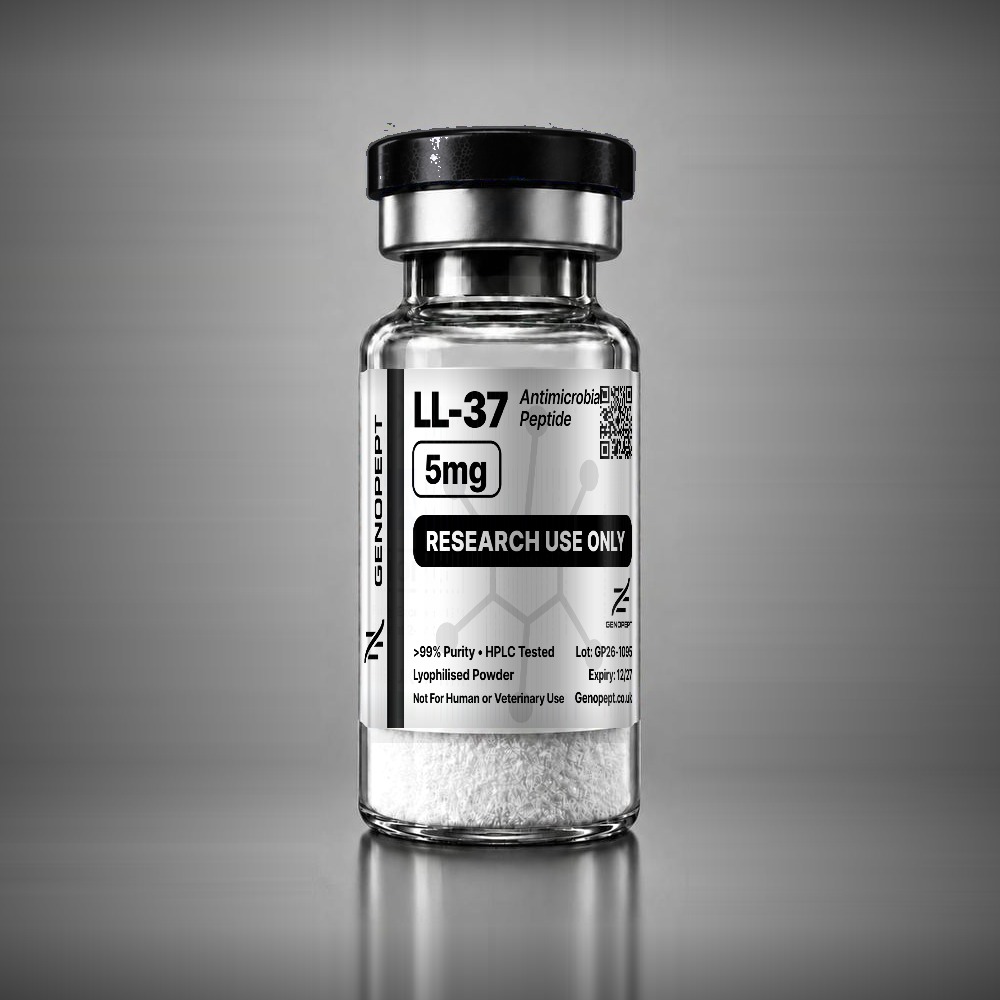
What is LL-37?
LL-37 is a 37-amino-acid cationic, amphipathic alpha-helical peptide and the only cathelicidin-family antimicrobial peptide found in humans. It is cleaved from the C-terminus of the precursor protein hCAP18, encoded by the CAMP gene, by proteinase 3 in neutrophils and by kallikreins in skin. The name comes from its two N-terminal leucine residues and its length; the sequence is LLGDFFRKSKEKIGKEFKRIVQRIKDFLRNLVPRTES.
LL-37 is produced by neutrophils, macrophages, epithelial cells and keratinocytes, and its expression is up-regulated by vitamin D and by infection or injury. It is studied as a host-defence peptide with direct antimicrobial activity against bacteria, fungi and enveloped viruses, and as an immunomodulatory signal acting on receptors such as formyl peptide receptor 2 (FPR2/ALX) and P2X7.
GenoPept supplies LL-37 as a lyophilised powder in 5mg and 10mg vials for in-vitro laboratory research in the UK, each batch verified by an independent laboratory.
LL-37 research applications
LL-37 is one of the most studied antimicrobial peptides, with data from microbiology, cell-culture and animal models. The main directions of research are described below; none are approved uses.
Antimicrobial and biofilm assays
LL-37 is tested against Gram-positive and Gram-negative bacteria, Candida species and enveloped viruses in minimum inhibitory concentration and biofilm disruption assays, including work on Pseudomonas aeruginosa and Staphylococcus aureus biofilms.
Wound healing and re-epithelialisation
Studies in keratinocyte cultures, ex-vivo skin and rodent wound models examine LL-37 for keratinocyte migration, angiogenesis and re-epithelialisation, and the peptide has been assessed in early clinical research in chronic wounds.
Innate immune signalling
Researchers investigate LL-37 as a chemoattractant for neutrophils, monocytes and T cells via FPR2, and for its ability to neutralise bacterial lipopolysaccharide (LPS) and modulate Toll-like receptor responses.
Inflammatory and autoimmune disease models
Because LL-37 can bind self-DNA and RNA and activate plasmacytoid dendritic cells, it is studied in models of psoriasis, lupus and rosacea, where its over-expression is implicated.
Cancer cell biology
Cell-culture work examines context-dependent effects of LL-37 on tumour cell proliferation and migration in different tissue types.
Mechanism of action (preclinical)
The direct antimicrobial action of LL-37 arises from its cationic, amphipathic helix, which binds negatively charged microbial membranes and disrupts them through a carpet or toroidal-pore mechanism, causing leakage and cell death. The same helix allows LL-37 to bind and neutralise LPS and lipoteichoic acid, reducing their activation of host Toll-like receptors.
As a signalling molecule, LL-37 activates formyl peptide receptor 2 (FPR2/ALX) to attract immune cells, engages the P2X7 receptor and transactivates the epidermal growth factor receptor (EGFR) in keratinocytes, which has been linked to migration and wound closure in cell models. It can also complex with extracellular nucleic acids to trigger TLR7 and TLR9 in dendritic cells. All of these findings are preclinical and described for research context only.
LL-37 product specifications
The values below are drawn from public chemical databases and are confirmed for each batch by LC-MS identity testing.
| Specification | Detail |
|---|---|
| Compound | LL-37, human cathelicidin antimicrobial peptide (hCAP18 residues 134–170) |
| Also known as | Cathelicidin LL-37, hCAP18 (134–170), CAP-18 (104–140), Ropocamptide, Human cathelicidin antimicrobial peptide |
| Sequence / class | 37-amino-acid cationic amphipathic alpha-helical peptide (LLGDFFRKSKEKIGKEFKRIVQRIKDFLRNLVPRTES), C-terminal fragment of hCAP18 |
| CAS number | 154947-66-7 |
| Molecular formula | C205H340N60O53 |
| Molecular weight | 4493.3 g/mol |
| Form | Lyophilised powder, sealed sterile glass vial, black cap, lot and expiry on label |
| Available sizes | 5mg, 10mg |
| Purity | Batch-specific; see applicable report |
| Verification | Batch-specific; see applicable report |
| Storage (unopened) | –20 °C long term; 2–8 °C short term; protect from light |
| Intended use | In-vitro laboratory research only; not for human or veterinary use |
Available sizes
LL-37 is offered in two vial sizes:
- 5mg vial – suited to antimicrobial screening and cell-culture work
- 10mg vial – for larger or repeated experiments
Bulk boxes of 10 vials save 20–50% against single-vial pricing; see the bulk and wholesale page for details. Orders of £200 or more qualify for free tracked UK delivery.
Reconstitution, handling and storage (laboratory)
Unopened vials should be stored at –20 °C for long-term storage, or at 2–8 °C for short periods, always protected from light. Keep vials sealed until the day they are needed.
To reconstitute, allow the vial to reach room temperature, then add bacteriostatic water or another sterile diluent slowly down the inside wall of the vial. Swirl gently until the powder dissolves; never shake, because shear can damage peptide chains. LL-37 is cationic and can adsorb to plastics, so low-binding tubes are advisable; a 5mg vial in 1 ml of diluent gives a 5 mg/ml stock (about 1.1 mM) for dilution to your working range.
Once in solution, keep the vial at 2–8 °C and use it within the period stated in your laboratory protocol. See our guides on how to reconstitute research peptides and how to store research peptides.
Quality assurance and Certificate of Analysis
Purity and identity results are batch-specific. Consult the applicable supplied report for its results and methods; confirm the batch covers current stock and verify the laboratory’s accreditation scope directly.
Use the “View Certificate of Analysis” button on this page to open the COA for the current batch, or browse the complete library at genopept.co.uk/coa-certificates. Our guide on what a Certificate of Analysis shows explains how to read the chromatogram and mass spectrum. Vials carry lot number and expiry so results trace to the exact material supplied.
Related research compounds
- KPV – an alpha-MSH tripeptide studied for NF-κB inhibition, useful as a comparator in inflammation assays.
- Thymosin Alpha-1 (Tα1) – a thymic peptide studied for adaptive immune modulation.
- BPC-157 (Body Protection Compound) – a repair peptide often studied alongside LL-37 in wound models.
- GHK-Cu Copper Peptide – a copper tripeptide studied in dermal wound and matrix models.
LL-37 frequently asked questions
What is LL-37 used for in research?
LL-37 is used in microbiology and immunology research, including antimicrobial and biofilm assays against bacteria, fungi and viruses, studies of innate immune signalling through FPR2 and Toll-like receptors, and keratinocyte and rodent wound-healing models. It is also studied in models of psoriasis, lupus and rosacea. GenoPept supplies LL-37 solely for in-vitro laboratory research of this kind.
How is LL-37 supplied and what purity is it?
Purity and identity results are batch-specific. Consult the applicable supplied report for its results and methods; confirm the batch covers current stock and verify the laboratory’s accreditation scope directly.
How should LL-37 be stored?
Store unopened LL-37 vials at –20 °C for long-term storage or 2–8 °C for short-term use, protected from light. After reconstitution with bacteriostatic water, keep the solution at 2–8 °C and use it within the period stated in your laboratory protocol. Because LL-37 is cationic and prone to adsorption, use low-binding tubes and avoid repeated freeze-thaw cycles.
Is LL-37 for human use?
No. LL-37 from GenoPept is for in-vitro laboratory research only. It is not a medicine, is not approved for human or veterinary use, and is not for diagnostic or therapeutic purposes. We do not provide dosing or administration information, and purchasers must confirm that the peptide is being bought for legitimate laboratory research.
What is the difference between LL-37 and hCAP18?
hCAP18 is the full-length human cathelicidin precursor protein encoded by the CAMP gene; it has an N-terminal cathelin domain and is largely inactive until processed. LL-37 is the 37-residue C-terminal fragment released from hCAP18 by proteinase 3 or kallikreins, and it is this fragment that carries the antimicrobial and immunomodulatory activity studied in the laboratory.
Research use only. This product is supplied strictly for in-vitro laboratory research in the UK. It is not for human or veterinary use, is not a medicine, and is not for diagnostic or therapeutic use. Nothing on this page is medical advice. See our research use only policy and UK legal guide.
Research guides: Immune and Antimicrobial Peptides Research Guide
Reviews
There are no reviews yet.