
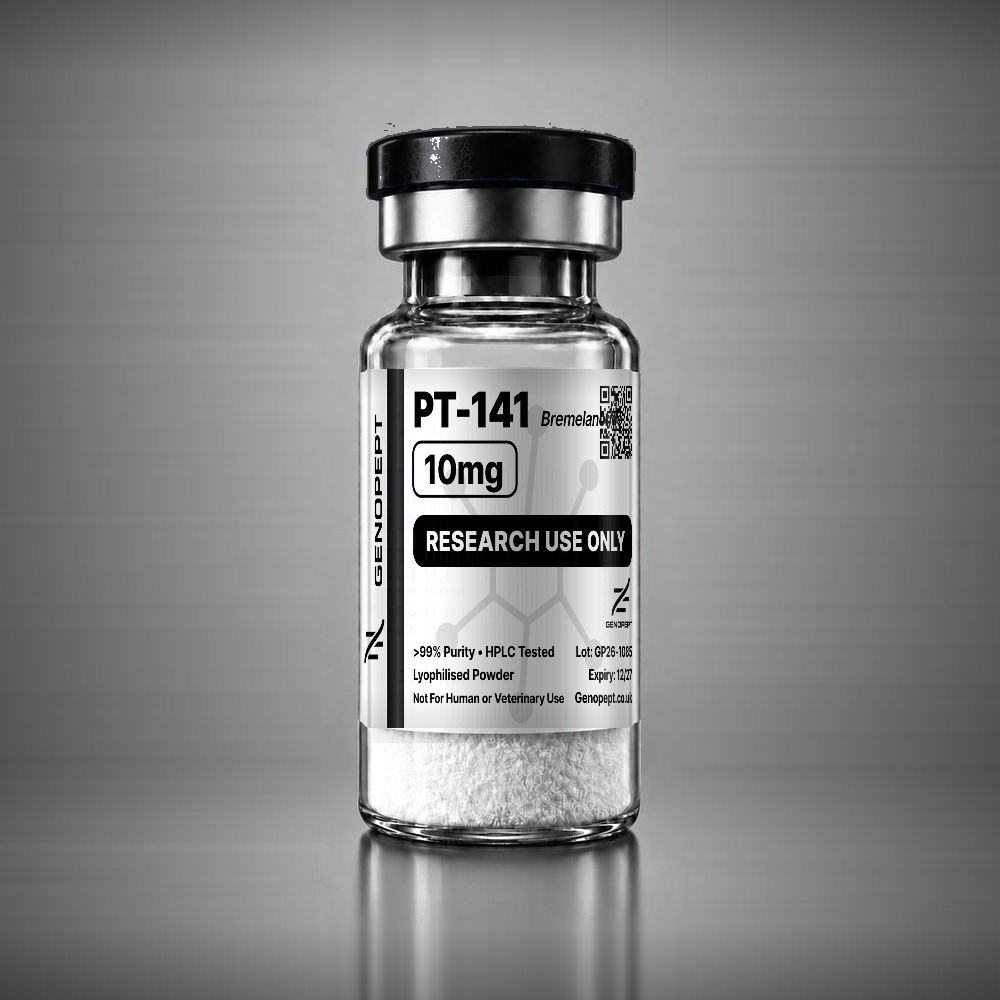
What is PT-141 (Bremelanotide) 10mg?
PT-141 (Bremelanotide) is a synthetic cyclic heptapeptide analogue of the endogenous melanocortin peptide alpha-melanocyte-stimulating hormone (alpha-MSH). It was derived from melanotan II by replacing the C-terminal amide with a free carboxylic acid, and it is a lactam-cyclised peptide with the sequence Ac-Nle-cyclo[Asp-His-D-Phe-Arg-Trp-Lys]-OH. GenoPept supplies PT-141 UK laboratories as a 10mg lyophilised research peptide.
PT-141 is a non-selective agonist at melanocortin receptors MC1, MC3, MC4 and MC5, but its activity at MC3 and MC4 receptors in the central nervous system is the focus of most published research. The compound is the peptide studied in a licensed medicine for the compound class, and a substantial body of published clinical literature exists, although GenoPept supplies it strictly as a research reagent.
PT-141 (Bremelanotide) 10mg research applications
PT-141 peptide is used in neuropharmacology, receptor biology and behavioural research. The applications below summarise preclinical and in-vitro investigations and are not claims about effects in people.
Central melanocortin receptor signalling
PT-141 is used to probe MC3 and MC4 receptor pathways in the hypothalamus and other brain regions in animal models, where these receptors regulate autonomic outflow, energy balance and behaviour.
Behavioural neuroscience models
Animal studies have investigated PT-141 in models of sexual motivation and arousal, where its effects are attributed to central melanocortin signalling rather than vascular mechanisms, distinguishing it from other compound classes studied in this field.
Melanocortin receptor pharmacology
In-vitro assays use PT-141 as a reference cyclic agonist to characterise receptor binding, cAMP signalling and selectivity across MC1 to MC5 receptors, and to compare linear versus lactam-cyclised alpha-MSH analogues.
Comparative analogue studies
Research explores how PT-141 differs from melanotan II, its parent compound, in receptor affinity and pigmentation-related MC1 activity, helping to define structure-activity relationships within the melanocortin agonist family.
Energy-balance and inflammation research
Because MC3 and MC4 receptors are involved in feeding behaviour and inflammatory signalling, PT-141 is also used in animal models of appetite regulation and melanocortin-mediated anti-inflammatory pathways.
Mechanism of action (preclinical)
PT-141 binds melanocortin receptors, a family of Gs-coupled G protein-coupled receptors, and stimulates adenylyl cyclase to raise intracellular cAMP. Its lactam bridge between the Asp and Lys side chains locks the His-D-Phe-Arg-Trp core pharmacophore into a receptor-active conformation, increasing affinity and metabolic stability compared with linear alpha-MSH.
In preclinical models the behavioural effects of PT-141 are mediated by MC4 and, to a lesser extent, MC3 receptors on hypothalamic neurons, with downstream involvement of dopaminergic pathways in the medial preoptic area. Activity at the MC1 receptor on melanocytes is retained but is weaker than that of melanotan II.
PT-141 (Bremelanotide) 10mg product specifications
| Specification | Detail |
|---|---|
| Compound | PT-141 (bremelanotide), cyclic melanocortin receptor agonist |
| Also known as | Bremelanotide, PT141, Bremelanotide acetate |
| Sequence / class | Cyclic heptapeptide lactam analogue of alpha-MSH (Ac-Nle-cyclo[Asp-His-D-Phe-Arg-Trp-Lys]-OH) |
| CAS number | 189691-06-3 |
| Molecular formula | C50H68N14O10 |
| Molecular weight | 1025.2 g/mol |
| Form | Lyophilised (freeze-dried) powder in a sealed, sterile glass vial with black cap; lot number and expiry on the label |
| Available sizes | 10mg |
| Purity | Batch-specific; see applicable report |
| Verification | Batch-specific; see applicable report |
| Storage (unopened) | –20 °C long term; 2–8 °C short term; protect from light |
| Intended use | In-vitro laboratory research only. Not for human or veterinary use, not a medicine, not for diagnostic or therapeutic use |
Available sizes
PT-141 is currently supplied in a single research vial size that suits receptor assays and small animal-model studies:
- 10mg vial
Laboratories running larger studies can order it in bulk boxes of 10 vials at 20–50% below single-vial pricing through our bulk and wholesale page, with UK-only retail delivery.
Reconstitution, handling and storage (laboratory)
This compound is supplied as a lyophilised powder and should be stored unopened at –20 °C for long-term holding, or at 2–8 °C for short periods, always protected from light. PT-141 contains tryptophan and histidine residues that are sensitive to oxidation and light, so keep vials in the dark and prepare working solutions fresh.
To reconstitute for in-vitro work, add bacteriostatic water or another sterile diluent slowly down the inside wall of the vial, then swirl gently until the powder dissolves. Never shake the vial, because shear can damage the molecule. After reconstitution keep the solution at 2–8 °C and use it within the period stated in the laboratory protocol. UK laboratories can also read our guides on how to reconstitute research peptides and how to store research peptides.
Quality assurance and Certificate of Analysis
Purity and identity results are batch-specific. Consult the applicable supplied report for its results and methods; confirm the batch covers current stock and verify the laboratory’s accreditation scope directly.
For PT-141 the LC-MS identity check confirms the mass of the cyclic heptapeptide and distinguishes it from melanotan II, which differs by a single terminal group. Our article on what a Certificate of Analysis shows explains how to read the purity chromatogram and mass spectrum. Orders are dispatched from the UK by tracked Royal Mail Special Delivery (£10, free on orders of £200 or more), with automatic cart discounts of 5% from £300, 10% from £500 and 15% from £1,000. We accept card, Apple Pay, Google Pay and cryptocurrency payments.
Related research compounds
- Melanotan II (MT2) – the parent cyclic melanocortin agonist from which PT-141 was derived.
- Melanotan 1 (MT1) 10mg – a linear alpha-MSH analogue selective for the MC1 receptor.
- Oxytocin – a neuropeptide studied alongside melanocortins in social and reproductive behaviour research.
- Kisspeptin-10 – a reproductive-axis peptide for complementary neuroendocrine studies.
PT-141 (Bremelanotide) 10mg frequently asked questions
What is PT-141 used for in research?
PT-141 is used to study central melanocortin MC3 and MC4 receptor signalling in animal and cell models, including behavioural neuroscience, energy balance and inflammatory pathway research. It also serves as a reference cyclic agonist for melanocortin receptor pharmacology and for structure-activity comparisons with melanotan II and alpha-MSH. All uses are preclinical or in-vitro.
How is PT-141 supplied and what purity is it?
Purity and identity results are batch-specific. Consult the applicable supplied report for its results and methods; confirm the batch covers current stock and verify the laboratory’s accreditation scope directly.
How should PT-141 be stored?
Store unopened PT-141 vials at –20 °C for long-term holding, or at 2–8 °C short term, protected from light. After reconstitution with bacteriostatic water or sterile diluent, keep the solution at 2–8 °C and use it within the period stated in your laboratory protocol. Avoid repeated freeze-thaw cycles and never shake the vial.
Is PT-141 for human use?
No. PT-141 from GenoPept is sold strictly for in-vitro laboratory research. It is not for human or veterinary use, it is not a medicine, and it is not for diagnostic or therapeutic purposes. We do not provide dosing or administration information, and nothing on this page should be taken as medical advice.
What is the difference between PT-141 and melanotan II?
PT-141 is a metabolite and analogue of melanotan II in which the C-terminal amide is replaced by a carboxylic acid. Both are lactam-cyclised heptapeptides that activate MC1, MC3, MC4 and MC5 receptors, but PT-141 shows reduced MC1 activity in preclinical assays, so it is used when researchers want to study central MC3 and MC4 signalling with less pigmentation-related activity.
Research use only. PT-141 is supplied strictly for in-vitro laboratory research. It is not for human or veterinary use, it is not a medicine, and it is not for diagnostic or therapeutic use. Nothing on this page is medical advice. Read our research use only policy and guide to research peptides and UK law before ordering.
Research guides: Melanocortin Peptides Research Guide
Reviews
There are no reviews yet.