
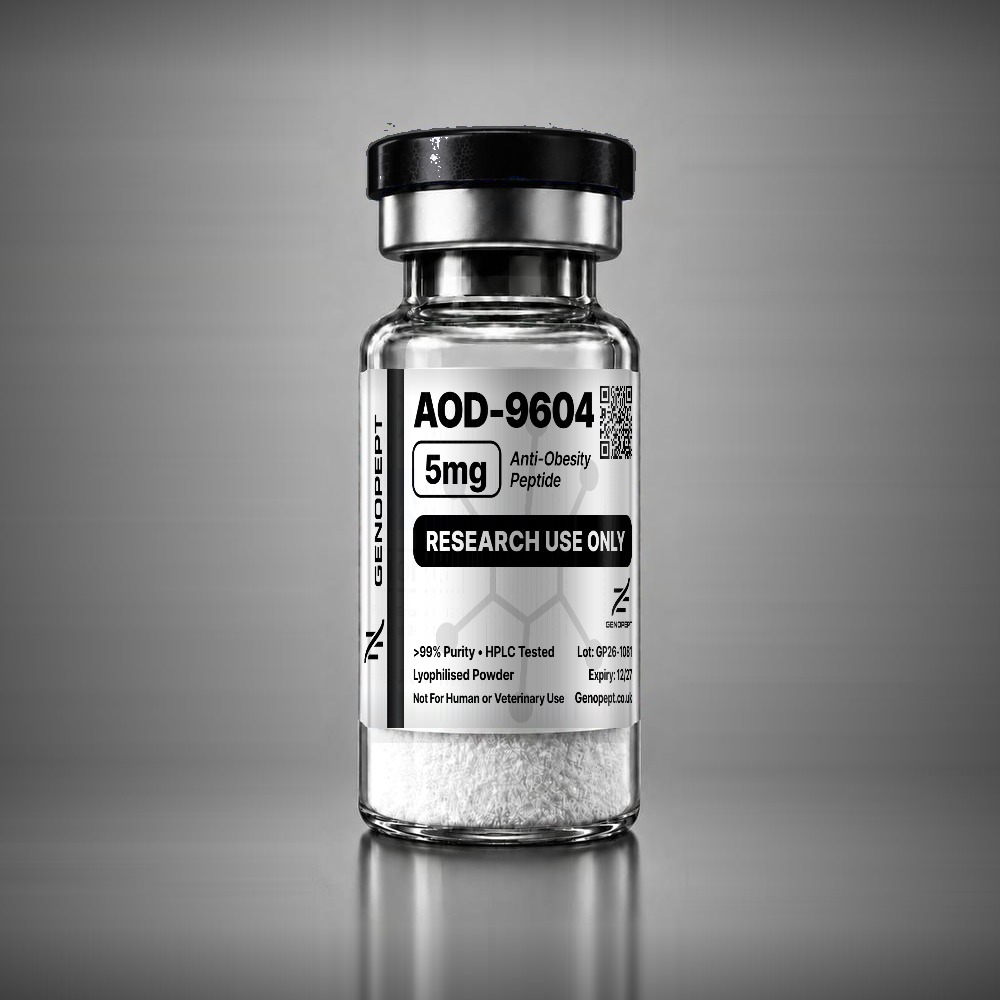
What is AOD-9604?
AOD-9604 is a synthetic peptide derived from the C-terminal region of human growth hormone. It reproduces residues 177 to 191 of the hormone with a tyrosine residue added at the N-terminus in place of the native phenylalanine at position 176, giving the sequence YLRIVQCRSVEGSCGF with a disulfide bridge between the two cysteines. The modification was introduced to improve stability.
The compound was developed in Australia in the late 1990s as an investigational agent targeting the lipid-metabolism domain of growth hormone without its growth-promoting or IGF-1-raising activity. It progressed through early clinical trials in the compound class before development ended in 2007 on efficacy grounds. AOD-9604 has since become a widely used research peptide for studying growth hormone fragment biology.
GenoPept supplies AOD-9604 to UK laboratories in 2mg, 5mg and 10mg lyophilised vials, each batch verified at ≥99% purity with a third-party Certificate of Analysis.
AOD-9604 research applications
AOD-9604 is studied in several preclinical and cell-based settings:
- Adipocyte metabolism – the peptide has been investigated in isolated adipocyte and rodent models for effects on lipolysis, lipogenesis and fat oxidation, the central focus of its original development.
- Obesity and metabolic models – animal studies in obese and high-fat-diet models have explored body composition and glucose handling in response to AOD-9604.
- Growth hormone domain mapping – it is used to confirm that the C-terminal region can act independently of the GH receptor and IGF-1 axis.
- Cartilage and joint models – more recent preclinical work has investigated AOD-9604 in models of osteoarthritis and cartilage repair, alone and combined with hyaluronic acid.
- Analogue comparison – AOD-9604 is the reference for evaluating native HGH Fragment 176-191 and other C-terminal variants.
The published clinical literature reports that AOD-9604 was well tolerated but did not meet efficacy endpoints, so its current value is as a research tool rather than a therapeutic candidate.
Mechanism of action (preclinical)
AOD-9604 does not activate the growth hormone receptor and, in preclinical models, does not raise IGF-1, alter glucose uptake or cause insulin resistance. Its proposed mechanism involves adipose tissue enzymes: rodent studies report increased hormone-sensitive lipase activity and decreased fatty acid synthase expression after exposure to the peptide.
Additional work suggests involvement of beta-3 adrenergic receptors in adipose tissue, and cell-based studies have examined effects on adipocyte differentiation. The exact receptor, if any, remains unidentified and is an open research question.
AOD-9604 product specifications
Each vial is supplied to the specification below. Rows are limited to values that can be verified from published sources.
| Specification | Detail |
|---|---|
| Compound | AOD-9604 (modified human growth hormone fragment 176-191) |
| Also known as | AOD9604, Tyr-hGH 176-191, Anti-obesity drug 9604, Modified GH fragment 177-191 |
| Sequence / class | Synthetic peptide: Tyr-Leu-Arg-Ile-Val-Gln-Cys-Arg-Ser-Val-Glu-Gly-Ser-Cys-Gly-Phe (human growth hormone C-terminal fragment with N-terminal tyrosine; disulfide-bridged) |
| CAS number | 221231-10-3 |
| Molecular formula | C78H123N23O23S2 |
| Molecular weight | 1815.1 g/mol |
| Form | Lyophilised powder in a sealed, sterile glass vial (black cap), batch-labelled with lot and expiry |
| Available sizes | 2mg, 5mg, 10mg |
| Purity | ≥99% (HPLC) |
| Verification | HPLC purity and LC-MS identity by an independent ISO/IEC 17025 laboratory; batch COA supplied |
| Storage (unopened) | –20 °C long term; 2–8 °C short term; protect from light |
| Intended use | In-vitro laboratory research only. Not for human or veterinary use. |
Available sizes
- AOD-9604 2mg vial, lyophilised powder
- AOD-9604 5mg vial, lyophilised powder
- AOD-9604 10mg vial, lyophilised powder
Bulk and wholesale boxes of 10 vials of AOD-9604 save 20–50% for laboratories running larger studies; see the bulk and wholesale page. Free UK delivery applies to orders of £200 or more.
Reconstitution, handling and storage (laboratory)
AOD-9604 is shipped as a lyophilised powder and should be stored unopened at –20 °C for long-term laboratory storage, or at 2–8 °C for short periods, protected from light. Allow the sealed vial to reach room temperature before opening to avoid condensation on the powder.
To reconstitute, add bacteriostatic water or another sterile diluent slowly down the inside wall of the vial, then swirl gently until dissolved. Never shake, as shear stress can denature the peptide. AOD-9604 contains a disulfide bridge, so avoid reducing agents in the diluent. After reconstitution keep the solution at 2–8 °C and use it within the period defined in your laboratory protocol.
Full step-by-step guidance is available in our articles on how to reconstitute research peptides and how to store research peptides. Handle with gloves and standard laboratory precautions.
Quality assurance and Certificate of Analysis
Every batch of AOD-9604 is tested by an independent third-party laboratory (Puralytix, ISO/IEC 17025 accredited). Purity is confirmed by HPLC at ≥99% and identity is confirmed by LC-MS, so the material in the vial matches the label.
A batch-specific Certificate of Analysis is available through the “View Certificate of Analysis” button on this page, and the complete library is published in the COA library. Our guide to what a Certificate of Analysis shows explains how to read the chromatogram and mass spectrum. Vials are batch-identified with lot number and expiry, and orders are dispatched discreetly by tracked Royal Mail Special Delivery within the UK.
Related research compounds
- HGH Fragment 176-191 – the unmodified native C-terminal GH fragment for direct comparison with AOD-9604
- 5-Amino-1MQ – an NNMT inhibitor studied in adipocyte and metabolic models
- MOTS-c – a mitochondrial-derived peptide investigated in metabolic regulation
- Hyaluronic Acid 5mg – co-investigated with AOD-9604 in preclinical cartilage models
AOD-9604 frequently asked questions
What is AOD-9604 used for in research?
AOD-9604 is used in laboratory research on the metabolic domain of growth hormone. Applications include adipocyte lipolysis and lipogenesis assays, rodent models of obesity and glucose handling, growth hormone structure–function mapping, preclinical cartilage and osteoarthritis models and comparisons with native HGH Fragment 176-191. Supplied for in-vitro laboratory research only.
How is AOD-9604 supplied and what is its purity?
GenoPept supplies AOD-9604 as lyophilised powder in sealed, sterile glass vials of 2mg, 5mg or 10mg with a black cap and batch label. Every lot is tested by an independent ISO/IEC 17025 laboratory, with ≥99% purity by HPLC and identity confirmed by LC-MS. The batch Certificate of Analysis is linked on the product page and in the COA library.
How should AOD-9604 be stored?
Store unopened AOD-9604 vials at –20 °C for long-term storage or at 2–8 °C for short periods, protected from light. After reconstitution with bacteriostatic water, keep the solution at 2–8 °C, avoid freeze–thaw cycles and use within the period specified in your laboratory protocol.
Is AOD-9604 for human use?
No. AOD-9604 is supplied exclusively for in-vitro laboratory research. It is not a licensed medicine, is not approved for human or veterinary use and is not for diagnostic or therapeutic purposes. UK customers must accept the research use only policy before their order is processed.
How does AOD-9604 differ from HGH Fragment 176-191?
AOD-9604 is the growth hormone 176-191 fragment with a tyrosine substituted at the N-terminal position, giving the sequence YLRIVQCRSVEGSCGF and a molecular weight of about 1815 g/mol, compared with 1799 g/mol for the native FLRIVQCRSVEGSCGF fragment. The modification improves stability, and AOD-9604 is the only one of the two with published clinical trial data.
Research use only. This product is supplied strictly for in-vitro laboratory research. It is not for human or veterinary use, not a medicine, and not for diagnostic or therapeutic use. Read the GenoPept research use only policy before ordering.
Research guides: AOD-9604 vs HGH Fragment 176-191
Reviews
There are no reviews yet.