
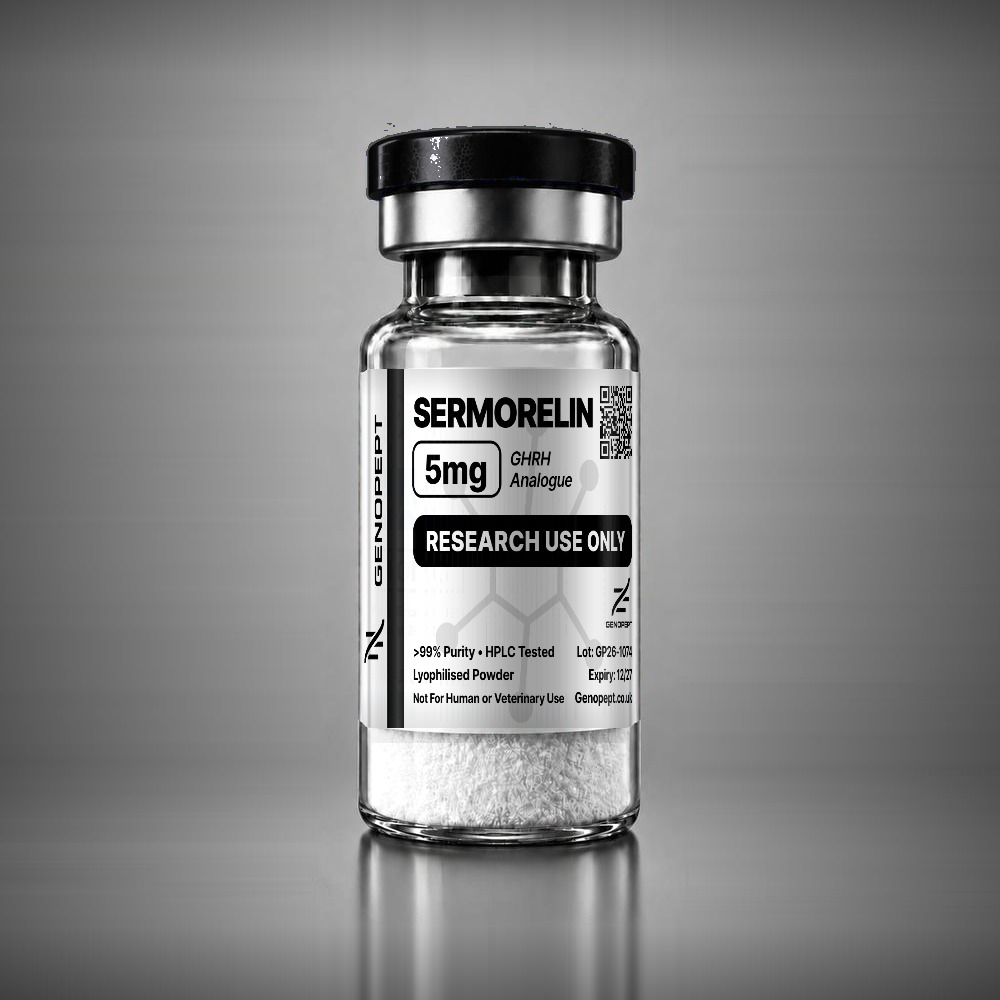
What is Sermorelin?
Sermorelin is a synthetic peptide analogue of human growth hormone-releasing hormone (GHRH), consisting of the first 29 amino acids of the native 44-amino-acid hormone with a C-terminal amide. This fragment, also called GRF (1-29) NH2, is the shortest sequence reported to retain the full biological activity of GHRH at the growth hormone-releasing hormone receptor (GHRHR).
Sermorelin was originally developed as a diagnostic and pharmaceutical agent, and its acetate salt has been described in published clinical literature on the GHRH class. In research settings it is used as a reference GHRH agonist for studying pituitary somatotroph signalling, growth hormone (GH) pulsatility and the GH/IGF-1 axis.
GenoPept supplies sermorelin in the UK as a lyophilised research peptide in 2mg, 5mg, 10mg and 15mg vials. Every batch is verified by independent third-party HPLC and LC-MS testing and is intended strictly for laboratory research.
Sermorelin research applications
Pituitary somatotroph signalling
Sermorelin is used in cell-culture and animal models to study how GHRH receptor activation drives GH synthesis and release from anterior pituitary somatotrophs, including cAMP signalling and gene transcription.
GH and IGF-1 axis research
Preclinical studies use sermorelin to investigate pulsatile GH secretion and downstream insulin-like growth factor 1 (IGF-1) production, often in comparison with native GHRH or longer-acting analogues.
Neuroendocrine ageing models
Research explores how responsiveness to GHRH analogues changes with age in animal models, using sermorelin as a probe of somatotroph reserve.
Peptide stability and pharmacokinetics
Because sermorelin is rapidly cleaved by dipeptidyl peptidase-4 (DPP-4), it is a useful comparator for studying the stability improvements built into modified GRF (1-29) and CJC-1295.
Receptor pharmacology
Sermorelin serves as a standard agonist in GHRHR binding and functional assays, including studies of receptor desensitisation and cross-talk with ghrelin receptor agonists such as ipamorelin.
Mechanism of action (preclinical)
Sermorelin binds the GHRH receptor, a class B G-protein-coupled receptor expressed on pituitary somatotrophs. Receptor activation stimulates adenylyl cyclase, raising intracellular cAMP and activating protein kinase A, which promotes GH gene transcription and the release of stored GH.
In preclinical models the GH pulse produced by sermorelin remains subject to normal feedback control by somatostatin and IGF-1. Its short plasma half-life, driven by DPP-4 cleavage at the N-terminus, means that its action is brief compared with substituted analogues such as CJC-1295.
Sermorelin product specifications
| Specification | Detail |
|---|---|
| Compound | Sermorelin |
| Also known as | GRF (1-29) NH2, GHRH (1-29), sermorelin acetate |
| Sequence / class | 29-amino-acid synthetic GHRH analogue (Tyr-Ala-Asp-Ala-Ile-Phe-Thr-Asn-Ser-Tyr-Arg-Lys-Val-Leu-Gly-Gln-Leu-Ser-Ala-Arg-Lys-Leu-Leu-Gln-Asp-Ile-Met-Ser-Arg-NH2) |
| CAS number | 86168-78-7 |
| Molecular formula | C149H246N44O42S |
| Molecular weight | 3357.9 g/mol |
| Form | Lyophilised powder in sealed sterile glass vial |
| Available sizes | 2mg, 5mg, 10mg, 15mg |
| Purity | 99% or higher (HPLC) |
| Verification | Independent HPLC (purity) and LC-MS (identity) with batch COA |
| Storage (unopened) | Lyophilised powder at -20 °C long term; 2-8 °C short term, protected from light |
| Intended use | In-vitro laboratory research only; not for human or veterinary use |
Available sizes
- 2mg vial
- 5mg vial
- 10mg vial
- 15mg vial
Laboratories running larger studies can order bulk boxes of 10 vials, which save 20-50% against single-vial pricing; see the bulk and wholesale page. Orders over £200 ship free by tracked Royal Mail Special Delivery within the UK.
Reconstitution, handling and storage (laboratory)
Sermorelin is supplied as a lyophilised powder that is stable for long-term storage at -20 °C. Unopened vials may be kept at 2-8 °C for short periods, protected from light. Allow a vial to reach room temperature before opening to avoid condensation on the powder.
For reconstitution, add bacteriostatic water or a sterile diluent slowly down the inside wall of the vial, then swirl gently until the powder dissolves. Never shake a peptide vial, because mechanical stress can damage the molecule and reduce measured purity.
After reconstitution, keep the solution at 2-8 °C and use it within the period stated in your laboratory protocol. Full guidance is available in our articles on how to reconstitute research peptides and how to store research peptides.
Quality assurance and Certificate of Analysis
Every batch of Sermorelin sold by GenoPept is tested by an independent ISO/IEC 17025 laboratory (Puralytix). HPLC confirms purity of 99% or higher and LC-MS confirms molecular identity, so the compound in the vial matches the label.
Each product page carries a “View Certificate of Analysis” button, and the complete library is published at genopept.co.uk/coa-certificates. Vials are batch-identified with lot number and expiry date, and our guide to what a Certificate of Analysis shows explains how to read the report.
Related research compounds
- CJC-1295 No DAC (Modified GRF 1-29): the DPP-4-resistant version of the same 29-amino-acid GHRH fragment, useful for direct stability comparisons.
- CJC-1295 with DAC: a long-acting GHRH analogue for studies of sustained GHRHR activation.
- Ipamorelin: a selective ghrelin receptor agonist often co-investigated with GHRH analogues.
- Tesamorelin: a full-length 44-amino-acid stabilised GHRH analogue studied in metabolic models.
Sermorelin frequently asked questions
What is sermorelin used for in research?
Sermorelin is used as a reference GHRH receptor agonist in laboratory research. Cell-culture and animal studies use it to investigate pituitary GH release, cAMP signalling in somatotrophs, GH pulsatility and downstream IGF-1 production. It is also a common comparator when researchers study the stability of modified GHRH analogues such as CJC-1295. Supplied for in-vitro research only.
How is sermorelin supplied and what purity does GenoPept guarantee?
GenoPept sermorelin is supplied as a lyophilised powder in sealed, sterile glass vials of 2mg, 5mg, 10mg or 15mg. Each batch is tested by an independent ISO/IEC 17025 laboratory using HPLC for purity, which must be 99% or higher, and LC-MS for identity. The Certificate of Analysis for the batch is available from the product page.
How should sermorelin be stored in the laboratory?
Store unopened lyophilised sermorelin at -20 °C for long-term stability, or at 2-8 °C for short periods, always protected from light. Once reconstituted with bacteriostatic water, keep the solution refrigerated at 2-8 °C and use it within the timeframe set by your laboratory protocol. Avoid repeated freeze-thaw cycles and never shake the vial.
Is sermorelin for human use?
No. Sermorelin from GenoPept is a research chemical supplied for in-vitro laboratory research only. It is not a medicine, is not for human or veterinary use, and is not intended for diagnostic or therapeutic purposes. GenoPept does not provide dosing or administration information, and purchasers must confirm they are buying for legitimate research use in the UK.
What is the difference between sermorelin and CJC-1295?
Sermorelin is the unmodified GRF (1-29) sequence and is cleaved quickly by DPP-4, giving a short duration of action in preclinical models. CJC-1295 No DAC (modified GRF 1-29) carries four amino acid substitutions that resist enzymatic breakdown, while CJC-1295 with DAC adds a lysine-linked drug affinity complex that binds albumin and extends the half-life to several days.
Research use only. This product is supplied for in-vitro laboratory research only. It is not for human or veterinary use, not a medicine, and not for diagnostic or therapeutic use. See our research use only policy and UK legal guide.
Research guides: Growth Hormone Secretagogues Research Guide
Reviews
There are no reviews yet.