
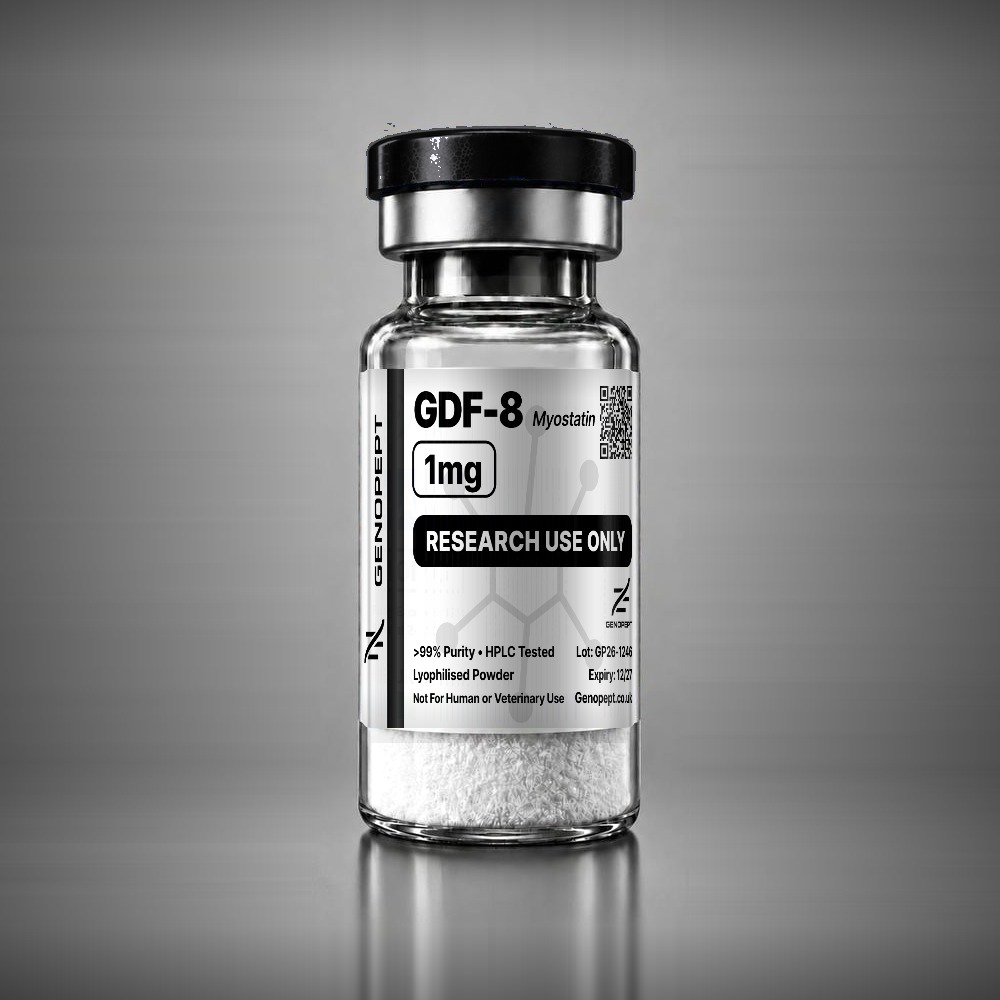
What is GDF-8 (Myostatin)?
GDF-8 (Myostatin) is a member of the TGF-beta superfamily encoded by the MSTN gene and expressed predominantly in skeletal muscle. It is synthesised as a 375-residue precursor that is cleaved to release a 109-amino-acid C-terminal mature domain; two of these chains link by a disulfide bond to form the active homodimer of roughly 25 kDa. The mature sequence is identical in human, mouse and rat.
Myostatin is the best-characterised negative regulator of muscle mass. Natural loss-of-function mutations produce markedly increased muscle in cattle, dogs and mice, which is why the protein and its antagonists are studied so intensively. The research-grade material supplied here is the recombinant mature dimer used as a ligand in binding assays and bioassays.
GenoPept supplies GDF-8 (Myostatin) to UK laboratories as a 1mg lyophilised vial, independently verified at ≥99% purity with a batch Certificate of Analysis. As a recombinant protein it has no single CAS number.
GDF-8 (Myostatin) research applications
GDF-8 (Myostatin) is primarily a reference ligand and positive control in muscle and TGF-beta signalling research:
- Myostatin inhibitor screening – recombinant GDF-8 is required to test antagonists such as follistatin, ACE-031, neutralising antibodies and small molecules in binding and reporter assays.
- SMAD reporter bioassays – it is used to stimulate SMAD2/3-dependent luciferase reporters and to induce haemoglobin expression in K562 cells, a standard activity assay.
- Myoblast differentiation studies – GDF-8 has been investigated for inhibition of myoblast proliferation and differentiation in C2C12 and primary cultures.
- Adipose and metabolic research – the protein is studied for its reported inhibition of preadipocyte differentiation and its links with insulin sensitivity in animal models.
- Muscle wasting models – exogenous myostatin is applied in animal studies to model cachexia and disuse atrophy.
Mechanism of action (preclinical)
Mature GDF-8 (Myostatin) binds activin type II receptors, primarily ActRIIB and to a lesser extent ActRIIA, on the muscle cell surface. This recruits type I receptors ALK4 or ALK5, which phosphorylate SMAD2 and SMAD3; the SMAD complex then translocates to the nucleus and represses myogenic transcription factors such as MyoD and myogenin.
Myostatin signalling also suppresses Akt/mTOR activity and promotes protein degradation pathways, giving it a dual anti-anabolic and catabolic effect in preclinical models. In circulation it is held in a latent complex with its propeptide, and proteolytic release by BMP-1/tolloid proteases activates it.
GDF-8 (Myostatin) product specifications
Each vial is supplied to the specification below. Rows are limited to values that can be verified from published sources.
| Specification | Detail |
|---|---|
| Compound | GDF-8 (Myostatin), recombinant mature protein |
| Also known as | Myostatin, GDF-8, GDF8, Growth differentiation factor 8, MSTN |
| Sequence / class | Recombinant mature human myostatin: disulfide-linked homodimer of the 109-amino-acid C-terminal domain (approximately 12.4 kDa per monomer, about 25 kDa dimer) |
| Form | Lyophilised powder in a sealed, sterile glass vial (black cap), batch-labelled with lot and expiry |
| Available sizes | 1mg |
| Purity | ≥99% (HPLC) |
| Verification | HPLC purity and LC-MS identity by an independent ISO/IEC 17025 laboratory; batch COA supplied |
| Storage (unopened) | –20 °C long term; 2–8 °C short term; protect from light |
| Intended use | In-vitro laboratory research only. Not for human or veterinary use. |
Available sizes
- GDF-8 (Myostatin) 1mg vial, lyophilised powder
Bulk and wholesale boxes of 10 vials of GDF-8 (Myostatin) save 20–50% for laboratories running larger studies; see the bulk and wholesale page. Free UK delivery applies to orders of £200 or more.
Reconstitution, handling and storage (laboratory)
GDF-8 (Myostatin) is shipped as a lyophilised powder and should be stored unopened at –20 °C for long-term laboratory storage, or at 2–8 °C for short periods, protected from light. Allow the sealed vial to reach room temperature before opening to avoid condensation on the powder.
To reconstitute, add bacteriostatic water or another sterile diluent slowly down the inside wall of the vial, then swirl gently until dissolved. Never shake, as shear stress can denature the peptide. GDF-8 is a hydrophobic dimeric protein; some recombinant preparations require an acidic diluent for full solubility, so consult the COA and your protocol before reconstitution. After reconstitution keep the solution at 2–8 °C and use it within the period defined in your laboratory protocol.
Full step-by-step guidance is available in our articles on how to reconstitute research peptides and how to store research peptides. Handle with gloves and standard laboratory precautions.
Quality assurance and Certificate of Analysis
Every batch of GDF-8 (Myostatin) is tested by an independent third-party laboratory (Puralytix, ISO/IEC 17025 accredited). Purity is confirmed by HPLC at ≥99% and identity is confirmed by LC-MS, so the material in the vial matches the label.
A batch-specific Certificate of Analysis is available through the “View Certificate of Analysis” button on this page, and the complete library is published in the COA library. Our guide to what a Certificate of Analysis shows explains how to read the chromatogram and mass spectrum. Vials are batch-identified with lot number and expiry, and orders are dispatched discreetly by tracked Royal Mail Special Delivery within the UK.
Related research compounds
- Follistatin-344 1mg – the endogenous myostatin-binding protein for neutralisation assays
- ACE-031 1mg – an ActRIIB-Fc decoy receptor for ligand-trap studies with GDF-8
- IGF-1 LR3 – the anabolic counterpart signal in muscle cell research
- MGF 2mg – IGF-1Ec E-domain peptide studied in the same myoblast models
GDF-8 (Myostatin) frequently asked questions
What is GDF-8 (Myostatin) used for in research?
GDF-8 (Myostatin) is used mainly as a reference ligand in laboratory research on muscle growth regulation. Typical uses include screening myostatin inhibitors such as follistatin and ACE-031, SMAD reporter bioassays, myoblast differentiation studies, adipose and metabolic research and animal models of muscle wasting. Supplied for in-vitro laboratory research only.
How is GDF-8 (Myostatin) supplied and what is its purity?
GenoPept supplies GDF-8 (Myostatin) as 1mg of lyophilised recombinant protein in a sealed, sterile glass vial with a black cap and batch label. Each lot is verified by an independent ISO/IEC 17025 laboratory, with ≥99% purity by HPLC and identity confirmed by LC-MS. The batch Certificate of Analysis can be viewed on the product page.
How should GDF-8 (Myostatin) be stored?
Store unopened GDF-8 (Myostatin) vials at –20 °C for long-term storage, or at 2–8 °C for short periods, protected from light. After reconstitution keep the solution at 2–8 °C, use low-binding tubes, avoid freeze–thaw cycles and use within the period stated in your laboratory protocol.
Is GDF-8 (Myostatin) for human use?
No. GDF-8 (Myostatin) is supplied strictly for in-vitro laboratory research. It is not a medicine, is not approved for human or veterinary use and is not for diagnostic or therapeutic purposes. UK customers must accept the research use only policy when ordering.
What is the difference between GDF-8 and GDF-11?
GDF-8 (Myostatin) and GDF-11 are closely related TGF-beta family members whose mature domains share about 90% sequence identity and signal through the same ActRIIB/SMAD2/3 pathway. Myostatin is expressed mainly in skeletal muscle and regulates muscle mass, whereas GDF-11 is more widely expressed and studied in development and ageing. Their similarity means many inhibitors bind both.
Research use only. This product is supplied strictly for in-vitro laboratory research. It is not for human or veterinary use, not a medicine, and not for diagnostic or therapeutic use. Read the GenoPept research use only policy before ordering.
Reviews
There are no reviews yet.