
What is Liraglutide?
Liraglutide is a synthetic 31-amino-acid analogue of human glucagon-like peptide-1 (GLP-1) that shares 97% sequence homology with the native GLP-1(7-37) hormone. It carries a lysine-to-arginine substitution at position 34 and a C16 palmitic acid chain attached to lysine 26 through a glutamic acid spacer. The fatty acid promotes self-association and albumin binding, slowing absorption and degradation and giving a plasma half-life of roughly 13 hours in published studies.
Liraglutide is the peptide studied in licensed medicines and is one of the most thoroughly characterised GLP-1 receptor agonists in the scientific literature. GenoPept supplies liraglutide as a research peptide for UK laboratories that require an intermediate-acting GLP-1 analogue. It is for in-vitro research use only and is not a medicine.
Liraglutide research applications
Liraglutide has been used in preclinical research for nearly two decades. The areas below describe typical laboratory and animal-model applications.
Beta-cell biology and glucose regulation
Liraglutide is applied to islet preparations and beta-cell lines to study glucose-dependent insulin secretion, beta-cell proliferation and protection from cytokine or lipid-induced apoptosis.
Appetite and body-weight models
In rodent obesity models, the peptide has been investigated for its effects on food intake, body weight and hypothalamic signalling, and it serves as a comparator for longer-acting analogues such as semaglutide.
Neuroprotection research
Liraglutide is widely studied in models of Alzheimer’s disease, Parkinson’s disease and stroke, where research explores GLP-1 receptor-mediated effects on neuroinflammation, synaptic plasticity and neuronal survival.
Cardiovascular and endothelial studies
Preclinical work examines the compound in models of atherosclerosis, myocardial ischaemia and endothelial dysfunction, with readouts including plaque formation, nitric oxide signalling and inflammatory cytokines.
Hepatic and renal models
Liraglutide has been investigated in models of fatty liver disease and diabetic kidney injury, measuring lipid accumulation, oxidative stress and fibrosis markers.
Mechanism of action (preclinical)
Liraglutide binds and activates the GLP-1 receptor, a class B G-protein-coupled receptor, stimulating adenylyl cyclase and increasing cyclic AMP. In beta cells this enhances glucose-dependent insulin secretion, promotes insulin gene transcription and suppresses glucagon release from alpha cells.
Beyond the pancreas, liraglutide acts on GLP-1 receptors in the hypothalamus and hindbrain to reduce food intake and slows gastric emptying in preclinical models. Its palmitoyl side chain enables reversible albumin binding, which protects the peptide from DPP-4 cleavage and renal clearance and explains its extended action compared with native GLP-1.
Liraglutide product specifications
| Specification | Detail |
|---|---|
| Compound | Liraglutide |
| Also known as | NN2211, GLP-1(7-37) analogue, liraglutide acetate, GLP-1 receptor agonist |
| Sequence / class | 31-amino-acid synthetic GLP-1(7-37) analogue with an Arg34 substitution and a C16 palmitoyl fatty acid attached at Lys26 via a glutamic acid spacer |
| CAS number | 204656-20-2 |
| Molecular formula | C172H265N43O51 |
| Molecular weight | 3751.2 g/mol |
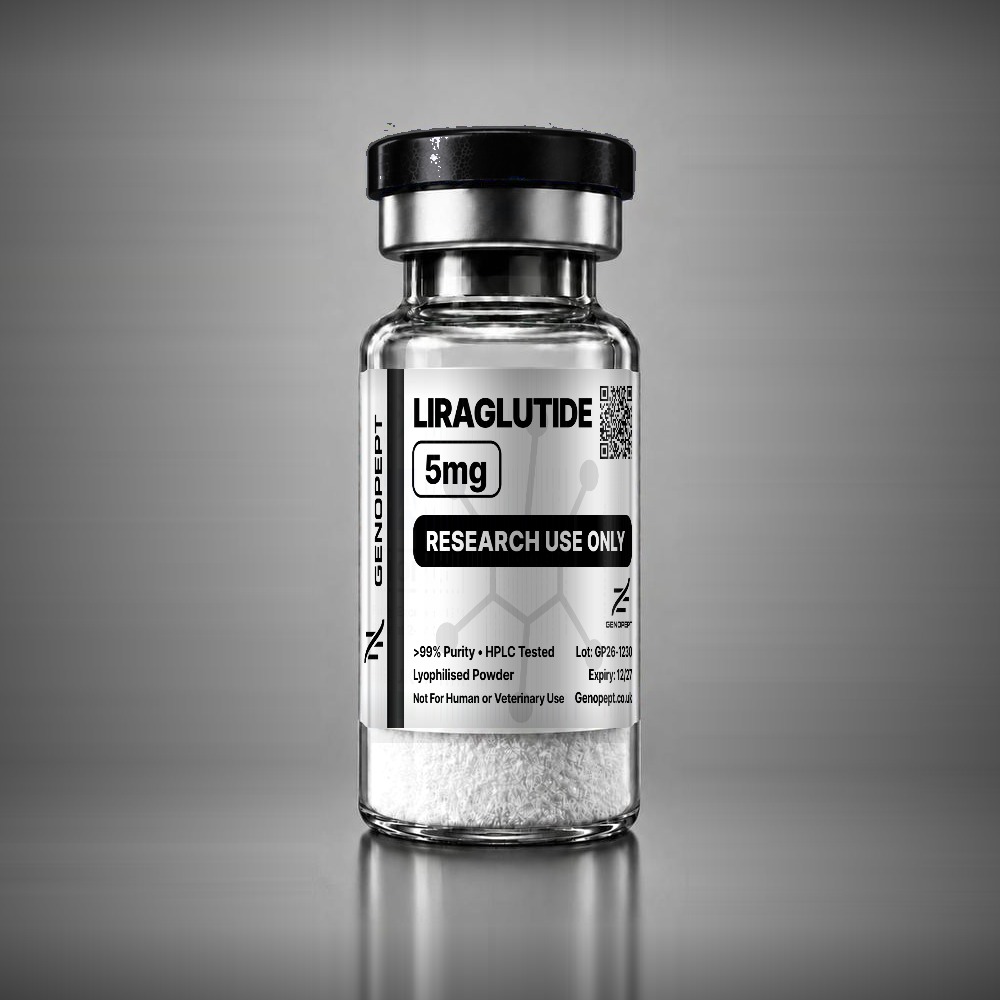
| Form | Lyophilised (freeze-dried) powder in a sealed sterile glass vial, black cap, lot and expiry on label |
| Available sizes | 5mg, 10mg, 30mg |
| Purity | ≥99% (HPLC) |
| Verification | Batch HPLC purity and LC-MS identity testing by an independent ISO/IEC 17025 laboratory (Puralytix), with Certificate of Analysis |
| Storage (unopened) | −20 °C long term; 2–8 °C short term; protect from light |
| Intended use | In-vitro laboratory research only. Not for human or veterinary use |
Available sizes
Liraglutide is available in the following vial sizes:
- 5mg vial
- 10mg vial
- 30mg vial
Laboratories that need larger quantities can order in bulk boxes of 10 vials, which save 20–50% against single-vial pricing. Retail baskets also receive automatic discounts at £300, £500 and £1,000, and delivery is free on UK orders of £200 or more.
Reconstitution, handling and storage (laboratory)
Unopened Liraglutide vials should be stored at −20 °C for long-term storage, or at 2–8 °C for short periods, and protected from light. Allow the vial to reach room temperature before opening to avoid condensation on the lyophilised cake.
To reconstitute for in-vitro work, add bacteriostatic water or another sterile diluent slowly down the inside wall of the vial, then swirl gently until the powder dissolves. Do not shake, as agitation can damage large acylated peptides. Reconstituted solution should be kept at 2–8 °C and used within the period specified in the laboratory’s own protocol. See our guides on how to reconstitute research peptides and how to store research peptides for step-by-step handling notes.
Quality assurance and Certificate of Analysis
Every batch of Liraglutide is tested by an independent third-party laboratory (Puralytix, ISO/IEC 17025 accredited) using HPLC for purity and LC-MS for identity confirmation. Results are published in a batch-specific Certificate of Analysis (COA), and each vial is labelled with its lot number and expiry date so the paperwork can be matched to the product on the bench.
Use the “View Certificate of Analysis” button on this page to open the current batch COA, or browse the full COA library. Our article on what a Certificate of Analysis shows explains how to read the chromatogram and mass spectrum.
Related research compounds
- Semaglutide: the once-weekly successor to liraglutide with a longer half-life.
- Tirzepatide: a dual GIP/GLP-1 receptor agonist for comparative incretin work.
- Cagrilintide: an amylin analogue often co-investigated with GLP-1 receptor agonists.
- AOD-9604: a growth hormone fragment studied in lipid metabolism models.
Liraglutide frequently asked questions
What is liraglutide used for in research?
Liraglutide is used in laboratories as a well-characterised GLP-1 receptor agonist. Published preclinical research applies it in beta-cell and islet studies, rodent obesity models, neurodegeneration models, cardiovascular research and studies of liver and kidney injury. It is supplied for these in-vitro and animal-model research uses only, not for any human or veterinary application.
How is liraglutide supplied and what purity can I expect?
It is supplied as lyophilised powder in a sealed sterile glass vial with a black cap, labelled with lot number and expiry. Every batch is tested by an independent ISO/IEC 17025 laboratory using HPLC to confirm purity of at least 99% and LC-MS to confirm identity, and the Certificate of Analysis is available on the product page.
How should liraglutide be stored?
Keep unopened vials at minus 20 degrees Celsius for long-term storage, or at 2 to 8 degrees Celsius for short periods, protected from light. After reconstitution with bacteriostatic water or another sterile diluent, store the solution at 2 to 8 degrees Celsius and use it within the timeframe set by your laboratory protocol.
Is liraglutide from GenoPept for human use?
No. This product is supplied by GenoPept strictly for in-vitro laboratory research. It is not a medicine, is not prepared for administration, and must not be used for human or veterinary purposes, diagnosis or treatment. Buyers are responsible for handling it in accordance with UK research use only requirements and institutional policies.
What is the difference between liraglutide and semaglutide?
Both are 31-amino-acid GLP-1(7-37) analogues, but liraglutide carries a C16 palmitoyl chain and has a half-life of around 13 hours, whereas semaglutide has an Aib8 substitution and a C18 diacid chain giving a half-life of about one week. Researchers often use liraglutide when a shorter-acting GLP-1 receptor agonist is needed for washout or time-course experiments.
Research use only. Liraglutide is supplied by GenoPept strictly for in-vitro laboratory research. It is not a medicine, is not for human or veterinary use, and is not intended for diagnostic or therapeutic purposes. Read our research use only policy and UK legal guide before ordering.
Reviews
There are no reviews yet.