
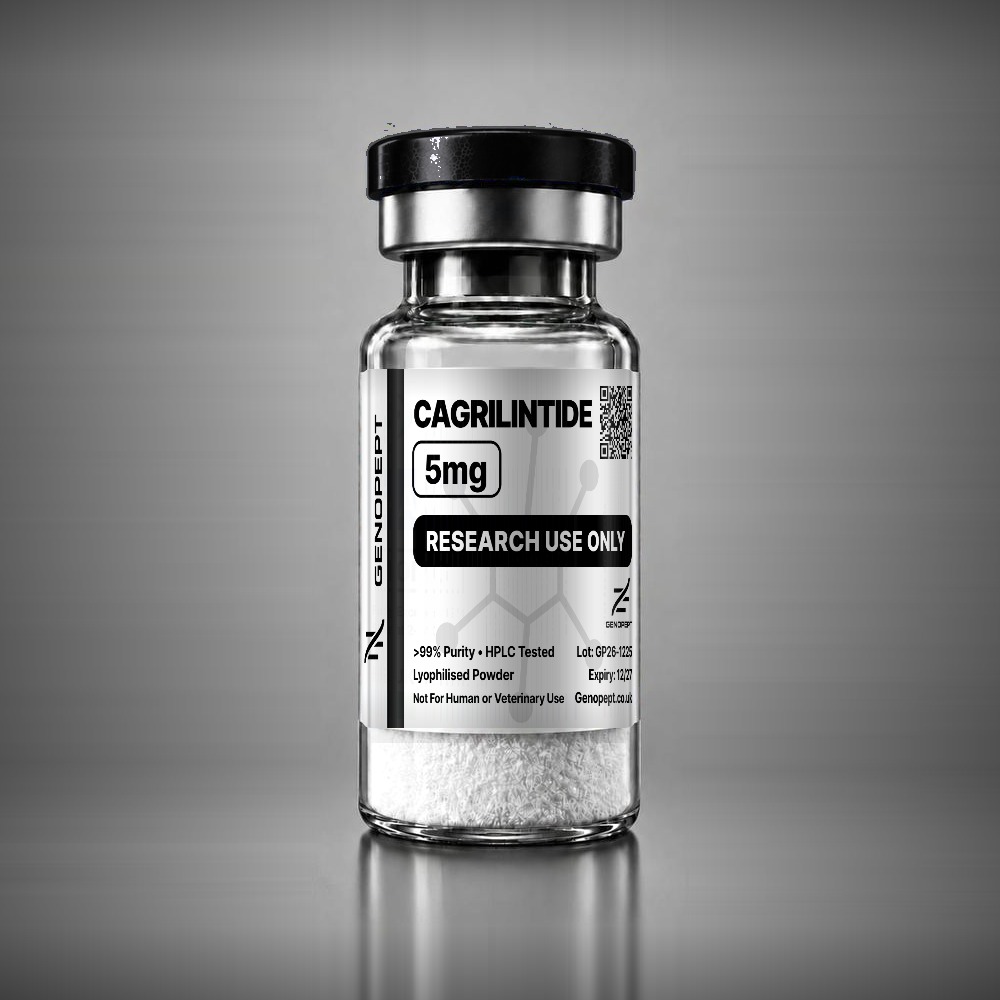
What is Cagrilintide?
Cagrilintide is a synthetic, long-acting analogue of amylin, the 37-amino-acid hormone co-secreted with insulin by pancreatic beta cells. Amino-acid substitutions reduce the fibrillation tendency of native amylin and a C20 fatty diacid side chain provides albumin binding, extending the half-life to roughly one week in published studies. Cagrilintide is a non-selective agonist that activates both amylin receptors and the calcitonin receptor.
Cagrilintide, previously coded NN9838 and AM833, is an investigational compound being studied on its own and in combination with semaglutide in late-stage clinical trials. It has not been licensed as a medicine. GenoPept supplies cagrilintide as a research peptide for UK laboratories investigating amylin receptor biology. It is for in-vitro research use only.
Cagrilintide research applications
Cagrilintide gives researchers a stable, long-acting tool for studying the amylin system. The main preclinical research areas are described below.
Amylin and calcitonin receptor pharmacology
Cagrilintide is used in cAMP assays on cells expressing calcitonin receptors with and without receptor activity-modifying proteins (RAMPs) to characterise its potency at amylin receptor subtypes AMY1, AMY2 and AMY3 and at the calcitonin receptor itself.
Satiety and food-intake models
In rodent models cagrilintide has been investigated for its effects on meal size, food intake and body weight, with research focusing on the area postrema and hypothalamic circuits through which amylin signals satiety.
Combination with GLP-1 receptor agonists
Research explores whether cagrilintide and GLP-1 receptor agonists such as semaglutide act additively on body weight in diet-induced obesity models, since amylin and GLP-1 engage distinct satiety pathways.
Gastric emptying and glucose handling
Cagrilintide is studied for its effects on gastric emptying rate and post-prandial glucagon secretion, both established actions of native amylin in preclinical models.
Peptide stability studies
Because native amylin aggregates readily, cagrilintide is also used in biophysical work comparing the fibrillation behaviour of amylin analogues.
Mechanism of action (preclinical)
Cagrilintide activates amylin receptors, which are heterodimers of the calcitonin receptor and one of three receptor activity-modifying proteins (RAMP1, RAMP2 or RAMP3), and also activates the calcitonin receptor alone. These class B G-protein-coupled receptors signal through Gs and cyclic AMP.
In preclinical models, amylin receptor activation in the area postrema and nucleus of the solitary tract reduces food intake and meal size, slows gastric emptying and suppresses post-prandial glucagon release. Because these effects run through pathways distinct from GLP-1 receptor signalling, cagrilintide is frequently co-investigated with incretin peptides.
Cagrilintide product specifications
| Specification | Detail |
|---|---|
| Compound | Cagrilintide |
| Also known as | NN9838, AM833, long-acting amylin analogue, cagrilintide acetate |
| Sequence / class | Long-acting acylated analogue of the 37-amino-acid hormone amylin, with a C20 fatty diacid side chain; dual amylin and calcitonin receptor agonist |
| CAS number | 1415456-99-3 |
| Molecular formula | C194H312N54O59S2 |
| Molecular weight | 4409.0 g/mol |
| Form | Lyophilised (freeze-dried) powder in a sealed sterile glass vial, black cap, lot and expiry on label |
| Available sizes | 5mg, 10mg, 20mg |
| Purity | ≥99% (HPLC) |
| Verification | Batch HPLC purity and LC-MS identity testing by an independent ISO/IEC 17025 laboratory (Puralytix), with Certificate of Analysis |
| Storage (unopened) | −20 °C long term; 2–8 °C short term; protect from light |
| Intended use | In-vitro laboratory research only. Not for human or veterinary use |
Available sizes
Cagrilintide is available in the following vial sizes:
- 5mg vial
- 10mg vial
- 20mg vial
Laboratories that need larger quantities can order in bulk boxes of 10 vials, which save 20–50% against single-vial pricing. Retail baskets also receive automatic discounts at £300, £500 and £1,000, and delivery is free on UK orders of £200 or more.
Reconstitution, handling and storage (laboratory)
Unopened Cagrilintide vials should be stored at −20 °C for long-term storage, or at 2–8 °C for short periods, and protected from light. Allow the vial to reach room temperature before opening to avoid condensation on the lyophilised cake.
To reconstitute for in-vitro work, add bacteriostatic water or another sterile diluent slowly down the inside wall of the vial, then swirl gently until the powder dissolves. Do not shake, as agitation can damage large acylated peptides. Reconstituted solution should be kept at 2–8 °C and used within the period specified in the laboratory’s own protocol. See our guides on how to reconstitute research peptides and how to store research peptides for step-by-step handling notes.
Quality assurance and Certificate of Analysis
Every batch of Cagrilintide is tested by an independent third-party laboratory (Puralytix, ISO/IEC 17025 accredited) using HPLC for purity and LC-MS for identity confirmation. Results are published in a batch-specific Certificate of Analysis (COA), and each vial is labelled with its lot number and expiry date so the paperwork can be matched to the product on the bench.
Use the “View Certificate of Analysis” button on this page to open the current batch COA, or browse the full COA library. Our article on what a Certificate of Analysis shows explains how to read the chromatogram and mass spectrum.
Related research compounds
- Cagrilintide + Semaglutide Blend: a pre-combined vial for amylin and GLP-1 co-investigation.
- Semaglutide: the GLP-1 receptor agonist most often paired with cagrilintide in research.
- Retatrutide + Cagrilintide Blend: combines the amylin analogue with a triple incretin agonist.
- Tirzepatide: a dual GIP/GLP-1 receptor agonist for alternative combination studies.
Cagrilintide frequently asked questions
What is cagrilintide used for in research?
Cagrilintide is used in laboratories as a long-acting amylin and calcitonin receptor agonist. Preclinical research applies it to receptor pharmacology assays, satiety and food-intake models, gastric emptying studies and combination experiments with GLP-1 receptor agonists such as semaglutide. It is supplied for these in-vitro and animal-model research uses only, never for human or veterinary use.
How is cagrilintide supplied and what purity can I expect?
It is supplied as lyophilised powder in a sealed sterile glass vial with a black cap, labelled with lot number and expiry date. Each batch is tested by an independent ISO/IEC 17025 laboratory using HPLC for purity of at least 99% and LC-MS for identity, and the Certificate of Analysis can be viewed from the product page.
How should cagrilintide be stored?
Store unopened vials at minus 20 degrees Celsius for long-term storage, or at 2 to 8 degrees Celsius for short periods, protected from light. After reconstitution with bacteriostatic water or sterile diluent, keep the solution refrigerated at 2 to 8 degrees Celsius and use it within the period defined by your laboratory protocol.
Is cagrilintide from GenoPept for human use?
No. This product is supplied by GenoPept strictly for in-vitro laboratory research. It is an investigational compound, not a licensed medicine, and must not be used for human or veterinary purposes, diagnosis or treatment. Purchasers are responsible for complying with UK research use only requirements and their institutional safety policies.
What is the difference between cagrilintide and semaglutide?
Cagrilintide is an amylin analogue that activates amylin and calcitonin receptors, whereas semaglutide is a GLP-1 receptor agonist. They act through different receptors and different brain regions, which is why researchers study them together to test for additive effects on food intake and body weight. GenoPept also offers a pre-combined cagrilintide and semaglutide blend for co-investigation.
Research use only. Cagrilintide is supplied by GenoPept strictly for in-vitro laboratory research. It is not a medicine, is not for human or veterinary use, and is not intended for diagnostic or therapeutic purposes. Read our research use only policy and UK legal guide before ordering.
Research guides: Cagrilintide and Amylin Analogue Research
Reviews
There are no reviews yet.