
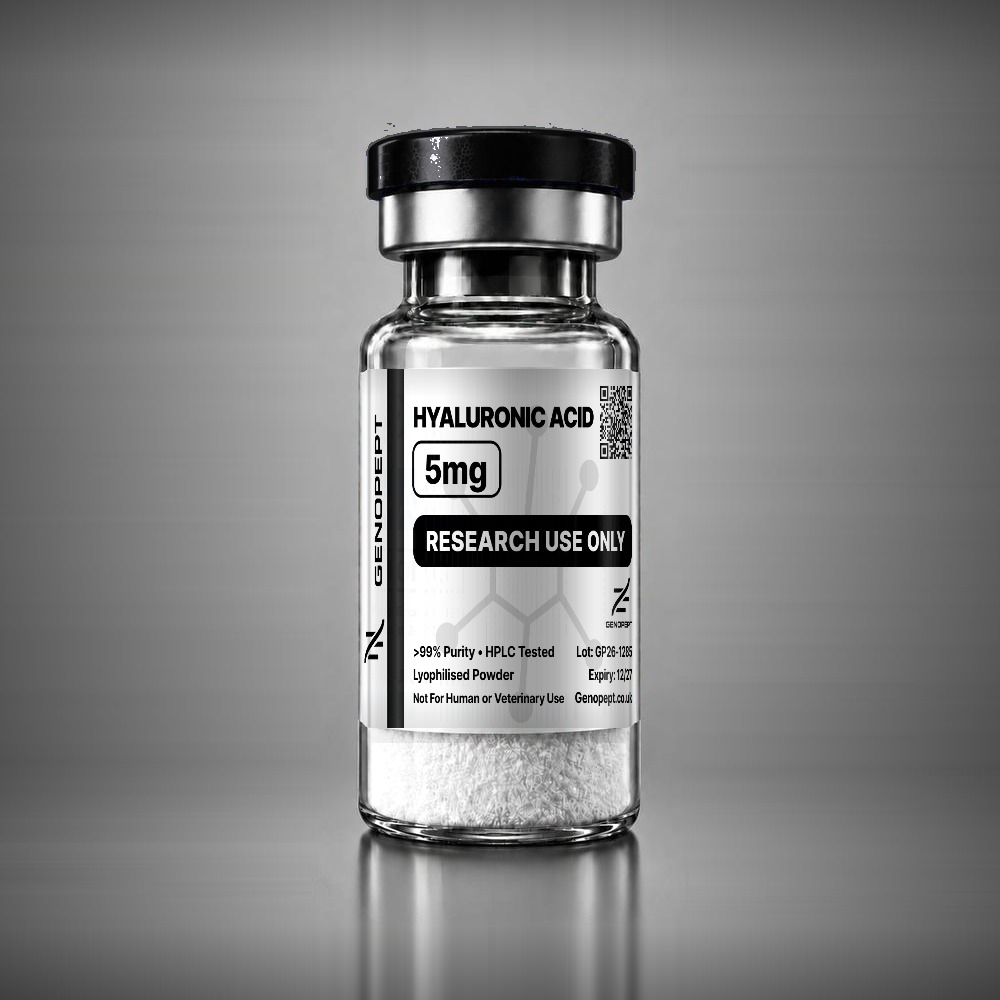
What is Hyaluronic Acid 5mg?
Hyaluronic Acid 5mg is a research-grade preparation of hyaluronan, an anionic, non-sulfated glycosaminoglycan composed of repeating disaccharide units of D-glucuronic acid and N-acetyl-D-glucosamine joined by alternating beta-(1,4) and beta-(1,3) glycosidic bonds. Unlike other glycosaminoglycans it is synthesised at the plasma membrane by hyaluronan synthases (HAS1, HAS2 and HAS3) rather than in the Golgi. GenoPept supplies hyaluronic acid UK laboratories as a lyophilised research compound.
Hyaluronic acid is distributed throughout connective, epithelial and neural tissues and is a major component of the extracellular matrix, skin, cartilage and synovial fluid. Its chain length varies enormously, from a few thousand daltons to several million, and molecular weight strongly influences its biological signalling in cell models.
Hyaluronic Acid 5mg research applications
Hyaluronic acid is used as a research reagent in extracellular-matrix biology, dermatological cell science, cartilage and joint models, and biomaterials development. The applications below summarise in-vitro and preclinical work and are not claims about effects in people.
Extracellular-matrix hydration and structure
Hyaluronic acid binds large volumes of water and organises matrix proteoglycans; cell-culture and tissue-model research uses it to study matrix viscoelasticity, hydration and the physical environment sensed by fibroblasts and keratinocytes.
CD44 and RHAMM receptor signalling
Research explores how hyaluronic acid of different molecular weights engages CD44 and RHAMM to regulate cell adhesion, migration and proliferation, with high- and low-molecular-weight fragments often producing opposite signals in inflammatory cell models.
Skin and dermal fibroblast models
In reconstructed skin equivalents and fibroblast cultures, hyaluronic acid is used to investigate keratinocyte differentiation, dermal hydration, wound-closure assays and interactions with collagen-stimulating peptides.
Cartilage, synovial and joint biology
Chondrocyte and synoviocyte cultures use hyaluronic acid to model synovial fluid viscosity, lubrication and the effects of hyaluronan fragments on inflammatory mediator release in preclinical joint models.
Biomaterials and drug-delivery scaffolds
Hyaluronic acid is widely used to construct hydrogels, cross-linked scaffolds and nanoparticle carriers for tissue-engineering and controlled-release research.
Mechanism of action (preclinical)
Hyaluronic acid exerts its biological effects through physical and receptor-mediated mechanisms. Physically, its highly hydrated, negatively charged chains create a viscoelastic matrix that regulates tissue hydration, molecular diffusion and cell movement. Receptor-mediated signalling occurs mainly through CD44, a transmembrane glycoprotein, and RHAMM (receptor for hyaluronan-mediated motility), both of which influence cytoskeletal organisation, migration and proliferation in preclinical models.
The response depends strongly on chain length: high-molecular-weight hyaluronan is generally reported to be anti-inflammatory and anti-angiogenic in cell models, whereas low-molecular-weight fragments generated by hyaluronidases or oxidative cleavage can activate Toll-like receptors and promote inflammatory signalling.
Hyaluronic Acid 5mg product specifications
| Specification | Detail |
|---|---|
| Compound | Hyaluronic acid (hyaluronan), non-sulfated glycosaminoglycan |
| Also known as | Hyaluronan, Sodium hyaluronate, HA, Hyaluronate |
| Sequence / class | Linear polysaccharide of repeating D-glucuronic acid and N-acetyl-D-glucosamine disaccharides linked by alternating beta-(1,4) and beta-(1,3) glycosidic bonds |
| CAS number | 9004-61-9 |
| Molecular formula | (C14H21NO11)n |
| Molecular weight | Polydisperse; disaccharide repeat unit approximately 379.3 g/mol |
| Form | Lyophilised (freeze-dried) powder in a sealed, sterile glass vial with black cap; lot number and expiry on the label |
| Available sizes | 5mg |
| Purity | Batch-specific; see applicable report |
| Verification | Batch-specific; see applicable report |
| Storage (unopened) | –20 °C long term; 2–8 °C short term; protect from light |
| Intended use | In-vitro laboratory research only. Not for human or veterinary use, not a medicine, not for diagnostic or therapeutic use |
Available sizes
Hyaluronic acid is currently supplied in a single research vial size suitable for cell-culture, hydrogel and matrix-model work:
- 5mg vial
Laboratories running larger studies can order it in bulk boxes of 10 vials at 20–50% below single-vial pricing through our bulk and wholesale page, with UK-only retail delivery.
Reconstitution, handling and storage (laboratory)
This compound is supplied as a lyophilised powder and should be stored unopened at –20 °C for long-term holding, or at 2–8 °C for short periods, always protected from light. Hyaluronic acid dissolves slowly and forms a viscous solution; allow adequate time for hydration, swirl gently rather than shaking, and avoid heat, which can fragment the polymer chains.
To reconstitute for in-vitro work, add bacteriostatic water or another sterile diluent slowly down the inside wall of the vial, then swirl gently until the powder dissolves. Never shake the vial, because shear can damage the molecule. After reconstitution keep the solution at 2–8 °C and use it within the period stated in the laboratory protocol. UK laboratories can also read our guides on how to reconstitute research peptides and how to store research peptides.
Quality assurance and Certificate of Analysis
Purity and identity results are batch-specific. Consult the applicable supplied report for its results and methods; confirm the batch covers current stock and verify the laboratory’s accreditation scope directly.
For a polysaccharide such as hyaluronic acid, the batch COA reports identity confirmation and purity analysis so that laboratories can document the material used in their matrix and cell-model studies. Our article on what a Certificate of Analysis shows explains how to read the purity chromatogram and mass spectrum. Orders are dispatched from the UK by tracked Royal Mail Special Delivery (£10, free on orders of £200 or more), with automatic cart discounts of 5% from £300, 10% from £500 and 15% from £1,000. We accept card, Apple Pay, Google Pay and cryptocurrency payments.
Related research compounds
- GHK-Cu Copper Peptide – a copper tripeptide studied for extracellular-matrix synthesis and dermal remodelling.
- Palmitoyl Pentapeptide-4 (Pal-KTTKS) 10mg – a collagen-fragment signal peptide for fibroblast matrix research.
- Acetyl Octapeptide-3 10mg – a SNARE-targeting cosmetic research peptide often studied alongside hyaluronic acid.
- GLOW Blend – BPC-157, TB-500 & GHK-Cu – a repair and skin research blend for complementary matrix studies.
Hyaluronic Acid 5mg frequently asked questions
What is hyaluronic acid used for in research?
Hyaluronic acid is used in extracellular-matrix biology, dermal fibroblast and reconstructed skin models, chondrocyte and synoviocyte cultures, and biomaterials research including hydrogels and drug-delivery scaffolds. It is also a key reagent for studying CD44 and RHAMM receptor signalling and how hyaluronan molecular weight influences inflammation and cell migration in vitro.
How is hyaluronic acid supplied and what purity is it?
Purity and identity results are batch-specific. Consult the applicable supplied report for its results and methods; confirm the batch covers current stock and verify the laboratory’s accreditation scope directly.
How should hyaluronic acid be stored?
Keep unopened hyaluronic acid vials at –20 °C for long-term storage, or at 2–8 °C for short periods, protected from light. After reconstitution with bacteriostatic water or sterile diluent, allow the polymer to hydrate fully, store the solution at 2–8 °C and use it within the period stated in your laboratory protocol. Avoid heat and vigorous shaking, which can fragment the chains.
Is hyaluronic acid for human use?
No. Hyaluronic acid from GenoPept is sold strictly for in-vitro laboratory research. It is not for human or veterinary use, it is not a medicine or cosmetic product, and it is not for diagnostic or therapeutic purposes. We do not provide application or usage guidance, and nothing on this page should be read as advice.
Does hyaluronic acid molecular weight matter in research?
Yes. Hyaluronic acid is polydisperse, and chain length strongly affects its behaviour in cell models. High-molecular-weight hyaluronan forms viscous, hydrating matrices and is generally reported to be anti-inflammatory, whereas low-molecular-weight fragments can activate CD44 and Toll-like receptor pathways and promote inflammatory signalling. Researchers should record the molecular-weight range used and refer to the batch Certificate of Analysis.
Research use only. Hyaluronic acid is supplied strictly for in-vitro laboratory research. It is not for human or veterinary use, it is not a medicine, and it is not for diagnostic or therapeutic use. Nothing on this page is medical advice. Read our research use only policy and guide to research peptides and UK law before ordering.
Research guides: Cosmetic Peptides for Skin Research
Reviews
There are no reviews yet.