
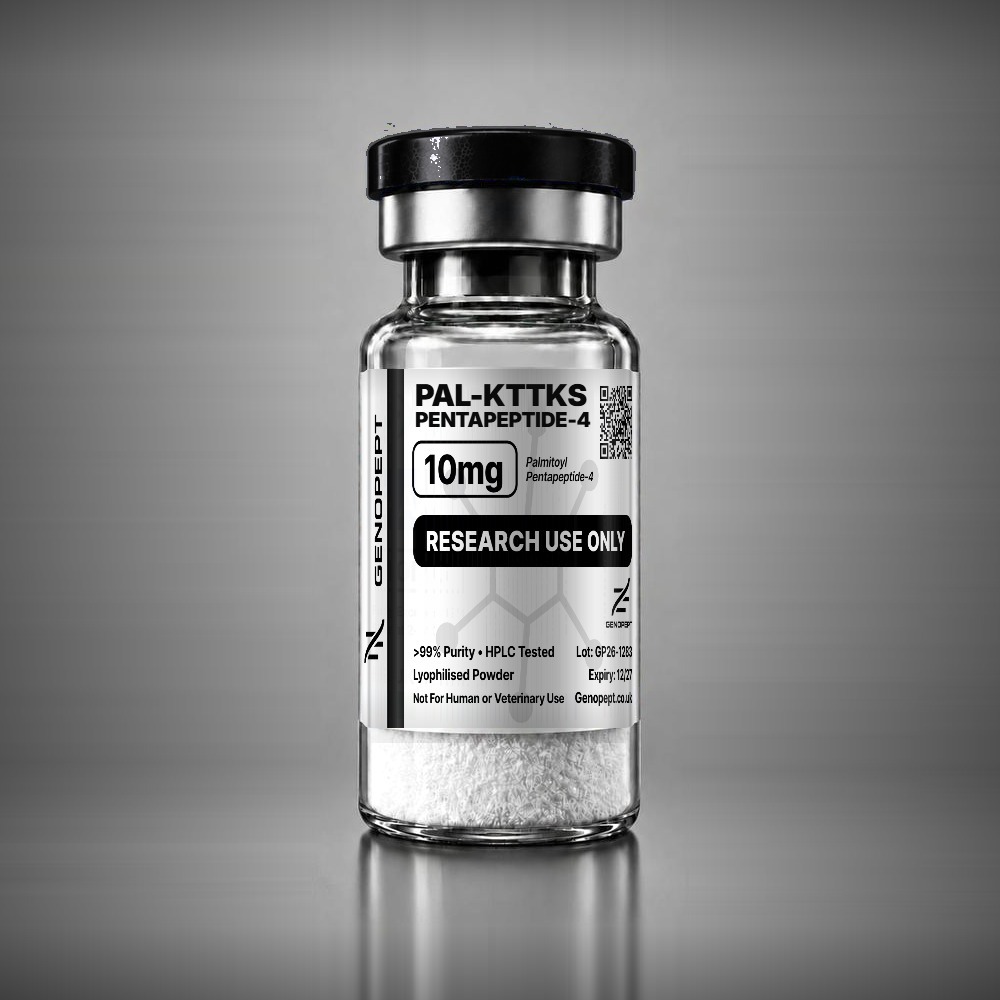
What is Palmitoyl Pentapeptide-4 (Pal-KTTKS) 10mg?
Palmitoyl Pentapeptide-4 (Pal-KTTKS) is a synthetic signal peptide made of the five-amino-acid sequence Lys-Thr-Thr-Lys-Ser (KTTKS), a fragment of the C-terminal propeptide of type I procollagen, joined at its N-terminus to palmitic acid. The palmitoyl chain increases the lipophilicity of the otherwise hydrophilic peptide, which improves its stability and its penetration into lipid-rich cell membranes and stratum corneum models. GenoPept supplies palmitoyl pentapeptide-4 UK laboratories as a 10mg lyophilised research peptide.
The unmodified KTTKS sequence was identified in published research as a fragment capable of stimulating extracellular-matrix production in cultured fibroblasts, and the palmitoylated form was subsequently developed as a more bioavailable version for cosmetic-science research. It is one of the most cited peptides in dermatological cell-culture literature.
Palmitoyl Pentapeptide-4 (Pal-KTTKS) 10mg research applications
Palmitoyl pentapeptide-4 is used in dermatological cell biology, extracellular-matrix research and cosmetic-science formulation studies. The applications below summarise in-vitro and ex-vivo work and are not claims about effects in people.
Fibroblast collagen synthesis models
Cell-culture research investigates palmitoyl pentapeptide-4 as a stimulus for type I and type III collagen, fibronectin and glycosaminoglycan production in human dermal fibroblasts, using it as a reference matrikine-type signal peptide.
Extracellular-matrix remodelling
Research explores how the peptide influences the balance between matrix synthesis and matrix metalloproteinase (MMP) activity in fibroblast and skin-equivalent models, including models of ultraviolet-induced matrix degradation.
Reconstructed skin and ex-vivo skin explants
Three-dimensional skin equivalents and ex-vivo explants are used to assess palmitoyl pentapeptide-4 penetration, dermal-epidermal junction protein expression and histological changes in the dermal matrix.
Lipidation and delivery research
Palmitoyl pentapeptide-4 is a model compound for studying how N-terminal fatty-acid conjugation changes peptide solubility, membrane partitioning, stability and skin penetration in formulation science.
Combination studies with other cosmetic peptides
The peptide is frequently co-investigated with copper peptides, acetyl octapeptide-3 and hyaluronic acid in in-vitro models to compare or combine matrix-stimulating and signalling mechanisms.
Mechanism of action (preclinical)
Palmitoyl pentapeptide-4 acts as a matrikine, a peptide fragment of an extracellular-matrix protein that signals back to cells. In fibroblast cultures the KTTKS sequence has been reported to upregulate expression of type I collagen, type III collagen and fibronectin, and to stimulate production of glycosaminoglycans, effects thought to involve feedback signalling normally triggered by collagen breakdown products.
The mechanism is believed to involve modulation of transforming growth factor-beta (TGF-beta) signalling and downstream matrix gene transcription, although the precise receptor has not been fully defined in the published literature. The palmitoyl group does not contribute to signalling directly but increases the peptide’s ability to reach fibroblasts in lipid-rich environments.
Palmitoyl Pentapeptide-4 (Pal-KTTKS) 10mg product specifications
| Specification | Detail |
|---|---|
| Compound | Palmitoyl pentapeptide-4 (Pal-KTTKS), N-palmitoylated collagen-derived signal peptide |
| Also known as | Pal-KTTKS, Palmitoyl-Lys-Thr-Thr-Lys-Ser, Palmitoyl pentapeptide-3 (older INCI name), Palmitoyl oligopeptide |
| Sequence / class | 5-amino-acid synthetic peptide (Lys-Thr-Thr-Lys-Ser) N-terminally acylated with palmitic acid; fragment of type I procollagen |
| CAS number | 214047-00-4 |
| Molecular formula | C39H75N7O10 |
| Molecular weight | 802.1 g/mol |
| Form | Lyophilised (freeze-dried) powder in a sealed, sterile glass vial with black cap; lot number and expiry on the label |
| Available sizes | 10mg |
| Purity | ≥99% (HPLC) |
| Verification | Independent third-party HPLC purity and LC-MS identity testing (Puralytix, ISO/IEC 17025); batch Certificate of Analysis |
| Storage (unopened) | –20 °C long term; 2–8 °C short term; protect from light |
| Intended use | In-vitro laboratory research only. Not for human or veterinary use, not a medicine, not for diagnostic or therapeutic use |
Available sizes
Palmitoyl pentapeptide-4 is currently supplied in a single research vial size that suits cell-culture, skin-model and formulation studies:
- 10mg vial
Laboratories running larger studies can order it in bulk boxes of 10 vials at 20–50% below single-vial pricing through our bulk and wholesale page, with UK-only retail delivery.
Reconstitution, handling and storage (laboratory)
This compound is supplied as a lyophilised powder and should be stored unopened at –20 °C for long-term holding, or at 2–8 °C for short periods, always protected from light. The palmitoyl chain makes this peptide less water-soluble than unmodified peptides; gentle swirling and, where a protocol permits, a small proportion of co-solvent may be needed to achieve a clear solution.
To reconstitute for in-vitro work, add bacteriostatic water or another sterile diluent slowly down the inside wall of the vial, then swirl gently until the powder dissolves. Never shake the vial, because shear can damage the molecule. After reconstitution keep the solution at 2–8 °C and use it within the period stated in the laboratory protocol. UK laboratories can also read our guides on how to reconstitute research peptides and how to store research peptides.
Quality assurance and Certificate of Analysis
Every batch of Palmitoyl pentapeptide-4 sold by GenoPept is tested by an independent third-party laboratory, Puralytix (ISO/IEC 17025 accredited), using HPLC for purity and LC-MS for identity confirmation. The resulting batch Certificate of Analysis (COA) is linked from the “View Certificate of Analysis” button on this page, and the complete library is available at genopept.co.uk/coa-certificates.
For palmitoyl pentapeptide-4 the LC-MS identity check confirms the mass of the palmitoylated pentapeptide, distinguishing it from the free KTTKS sequence, while HPLC quantifies purity. Our article on what a Certificate of Analysis shows explains how to read the purity chromatogram and mass spectrum. Orders are dispatched from the UK by tracked Royal Mail Special Delivery (£10, free on orders over £200), with automatic basket discounts of 5% over £300, 10% over £500 and 15% over £1,000. We accept bank transfer and crypto.
Related research compounds
- Acetyl Octapeptide-3 10mg – a SNARE-complex-targeting cosmetic peptide often co-investigated in skin-model research.
- GHK-Cu Copper Peptide – a copper-binding tripeptide studied for extracellular-matrix and wound-model signalling.
- Hyaluronic Acid 5mg – the principal dermal glycosaminoglycan for hydration and matrix research.
- AHK-Cu – a copper tripeptide studied in fibroblast and hair-follicle models.
Palmitoyl Pentapeptide-4 (Pal-KTTKS) 10mg frequently asked questions
What is palmitoyl pentapeptide-4 used for in research?
Palmitoyl pentapeptide-4 is used in dermal fibroblast cultures, reconstructed skin equivalents and ex-vivo skin explants to study collagen, fibronectin and glycosaminoglycan synthesis, matrix remodelling and the effects of peptide lipidation on delivery. It serves as a reference matrikine-type signal peptide in cosmetic-science research. All applications are in-vitro or ex-vivo.
How is palmitoyl pentapeptide-4 supplied and what purity is it?
GenoPept supplies palmitoyl pentapeptide-4 as a 10mg lyophilised powder in a sealed, sterile glass vial with a black cap and batch-identified label. Purity is ≥99%, verified for every batch by Puralytix (ISO/IEC 17025) using HPLC for purity and LC-MS for identity. The batch Certificate of Analysis can be viewed from the button on this product page.
How should palmitoyl pentapeptide-4 be stored?
Keep unopened vials at –20 °C for long-term storage, or at 2–8 °C for short periods, protected from light. After reconstitution with bacteriostatic water or a sterile diluent appropriate to the assay, store the solution at 2–8 °C and use it within the period stated in your laboratory protocol. Because of the palmitoyl chain, avoid vigorous shaking and check for complete dissolution before use.
Is palmitoyl pentapeptide-4 for human use?
No. Palmitoyl pentapeptide-4 from GenoPept is sold strictly for in-vitro laboratory research. It is not for human or veterinary use, it is not a medicine or cosmetic product, and it is not for diagnostic or therapeutic purposes. We do not provide application or usage guidance, and nothing on this page should be read as advice.
What is the difference between palmitoyl pentapeptide-4 and KTTKS?
KTTKS is the unmodified five-amino-acid collagen fragment, which is water-soluble but penetrates lipid membranes poorly and degrades quickly. Palmitoyl pentapeptide-4 is the same sequence with a 16-carbon palmitic acid attached to the N-terminus, which increases lipophilicity, stability and penetration into skin models. The signalling sequence is identical, so the two are compared in research on peptide lipidation and delivery.
Research use only. Palmitoyl pentapeptide-4 is supplied strictly for in-vitro laboratory research. It is not for human or veterinary use, it is not a medicine, and it is not for diagnostic or therapeutic use. Nothing on this page is medical advice. Read our research use only policy and guide to research peptides and UK law before ordering.
Research guides: Cosmetic Peptides for Skin Research
Reviews
There are no reviews yet.