
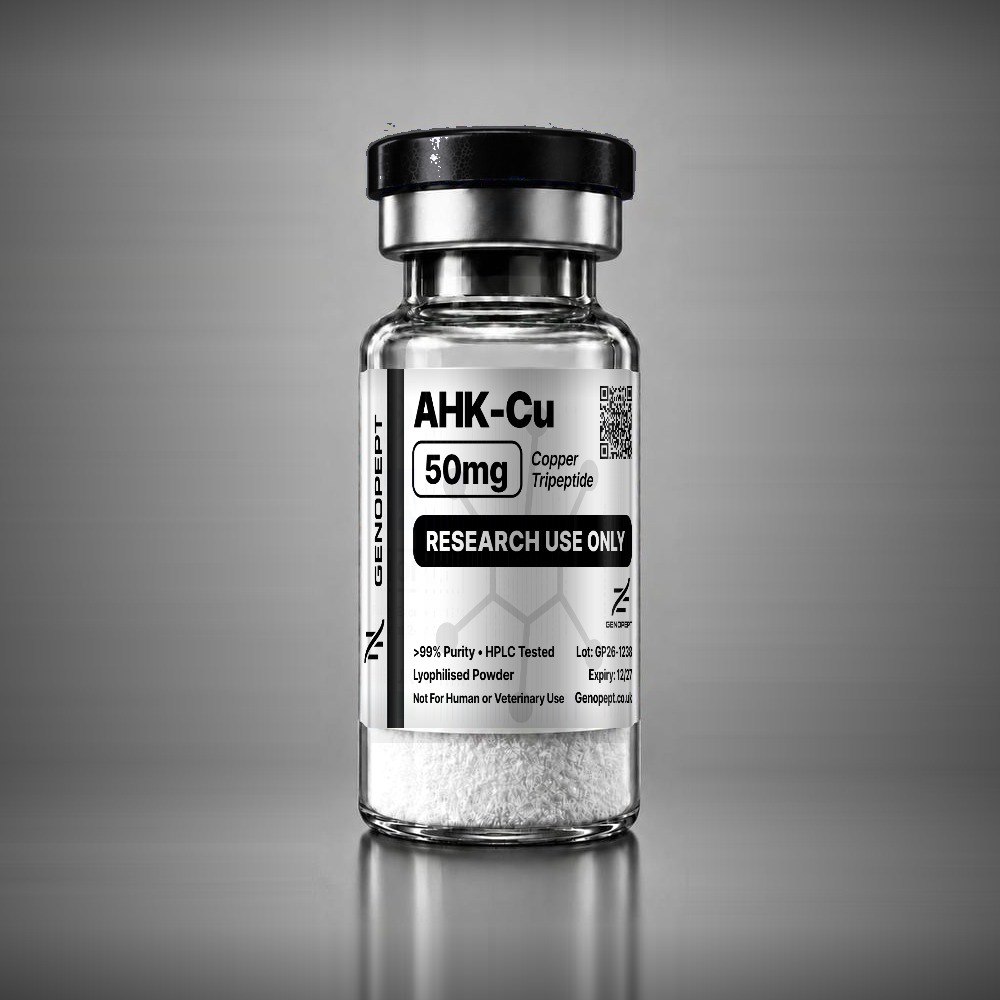
What is AHK-Cu?
AHK-Cu is a copper(II) complex of the tripeptide L-alanyl-L-histidyl-L-lysine (Ala-His-Lys). It is a close structural analogue of the naturally occurring copper peptide GHK-Cu, differing only in the substitution of alanine for glycine at the N-terminus, and is listed in cosmetic ingredient nomenclature as copper tripeptide-3.
The histidine and lysine residues coordinate the copper ion in the same way as in GHK-Cu, allowing the peptide to bind and deliver copper to cells. AHK-Cu is best known in the research literature for studies on human dermal papilla cells and hair follicles, where it has been investigated for effects on cell proliferation and follicle growth in culture.
GenoPept supplies AHK-Cu as a lyophilised powder in 50mg and 100mg vials for in-vitro laboratory research in the UK, each batch verified by an independent laboratory.
AHK-Cu research applications
AHK-Cu research is preclinical, centred on cell culture and ex-vivo tissue models. The main directions of published work are described below and none are approved uses.
Hair follicle and dermal papilla models
AHK-Cu has been investigated in cultured human dermal papilla cells and isolated hair follicles, where researchers report increased cell proliferation, elongation of follicles and expression of vascular endothelial growth factor (VEGF).
Collagen and fibroblast studies
In fibroblast cultures the peptide is studied for stimulation of collagen synthesis and cell viability, paralleling the wider copper peptide literature.
Angiogenesis-related signalling
Reported increases in VEGF and decreases in transforming growth factor beta-1 (TGF-β1) in cell models are examined as a possible route by which copper peptides affect follicle vascular supply.
Comparative copper peptide research
Laboratories frequently run AHK-Cu alongside GHK-Cu to compare how the alanine-for-glycine substitution changes copper binding, cell uptake and downstream gene expression.
Mechanism of action (preclinical)
Like GHK-Cu, AHK-Cu functions primarily as a copper-carrying tripeptide. The imidazole ring of histidine and the amino groups chelate Cu(II), and the complex is thought to supply copper to copper-dependent enzymes such as lysyl oxidase and superoxide dismutase that support matrix cross-linking and antioxidant defence.
In dermal papilla cell studies, AHK-Cu has been reported to increase VEGF secretion and reduce TGF-β1, a cytokine associated with follicle regression, while promoting cell proliferation. Whether these effects are driven by copper delivery, by the peptide itself, or both is still under investigation, and all findings are preclinical.
AHK-Cu product specifications
The values below refer to the copper complex free base and are drawn from public chemical databases; the hydrochloride salt is listed separately under CAS 682809-81-0. LC-MS identity testing confirms each batch.
| Specification | Detail |
|---|---|
| Compound | AHK-Cu (copper tripeptide-3), copper(II) complex of L-alanyl-L-histidyl-L-lysine |
| Also known as | Copper tripeptide-3, Ala-His-Lys-Cu, AHK copper peptide, Alanyl-histidyl-lysine copper, Copper tripeptide 3 |
| Sequence / class | Copper(II) complex of the 3-amino-acid synthetic peptide Ala-His-Lys |
| CAS number | 767286-83-9 |
| Molecular formula | C15H24CuN6O4 |
| Molecular weight | 415.9 g/mol |
| Form | Lyophilised powder, sealed sterile glass vial, black cap, lot and expiry on label |
| Available sizes | 50mg, 100mg |
| Purity | ≥99% (HPLC) |
| Verification | Batch HPLC purity and LC-MS identity by independent ISO/IEC 17025 laboratory; batch COA |
| Storage (unopened) | –20 °C long term; 2–8 °C short term; protect from light |
| Intended use | In-vitro laboratory research only; not for human or veterinary use |
Available sizes
AHK-Cu is offered in two vial sizes to suit different scales of cell-culture and formulation work:
- 50mg vial – suited to pilot and single-assay studies
- 100mg vial – for larger or repeated experiments
Bulk boxes of 10 vials save 20–50% against single-vial pricing; see the bulk and wholesale page for details. Orders of £200 or more qualify for free tracked UK delivery.
Reconstitution, handling and storage (laboratory)
Unopened vials should be stored at –20 °C for long-term storage, or at 2–8 °C for short periods, always protected from light. Keep vials sealed until the day they are needed.
To reconstitute, allow the vial to reach room temperature, then add bacteriostatic water or another sterile diluent slowly down the inside wall of the vial. Swirl gently until the powder dissolves; never shake, because shear can damage peptide chains. AHK-Cu reconstitutes to a blue-tinted solution; a 50mg vial in 5 ml of diluent gives a 10 mg/ml stock for further dilution to your working concentration.
Once in solution, keep the vial at 2–8 °C and use it within the period stated in your laboratory protocol. See our guides on how to reconstitute research peptides and how to store research peptides.
Quality assurance and Certificate of Analysis
Every batch supplied by GenoPept is tested by Puralytix, an independent ISO/IEC 17025 accredited laboratory, using HPLC to confirm purity of at least 99% and LC-MS to confirm identity against the expected molecular mass. The results are issued as a batch Certificate of Analysis (COA).
Use the “View Certificate of Analysis” button on this page to open the COA for the current batch, or browse the complete library at genopept.co.uk/coa-certificates. Our guide on what a Certificate of Analysis shows explains how to read the chromatogram and mass spectrum. Vials carry lot number and expiry so results trace to the exact material supplied.
Related research compounds
- GHK-Cu Copper Peptide – the parent copper tripeptide and the usual comparator in AHK-Cu studies.
- GLOW Blend (BPC-157 + TB-500 + GHK-Cu) – a copper-peptide research blend for skin and remodelling models.
- Palmitoyl Pentapeptide-4 (Pal-KTTKS) – another matrix-signalling peptide for cosmetic-science research.
- Hyaluronic Acid 5mg – a dermal matrix component often used alongside copper peptides in skin models.
AHK-Cu frequently asked questions
What is AHK-Cu used for in research?
AHK-Cu is used in preclinical research on hair follicle biology and dermal cell proliferation. Typical systems are cultured human dermal papilla cells, isolated hair follicles and fibroblast cultures, with end points such as VEGF expression, TGF-β1 levels and collagen synthesis. It is also used in comparative copper peptide studies with GHK-Cu. GenoPept supplies AHK-Cu solely for in-vitro laboratory research.
How is AHK-Cu supplied and what purity is it?
GenoPept supplies AHK-Cu as lyophilised powder in sealed, sterile glass vials with black caps in 50mg and 100mg sizes. Every batch is tested by an independent ISO/IEC 17025 laboratory by HPLC for purity of at least 99% and by LC-MS for identity. The current batch Certificate of Analysis can be opened from the button on this page.
How should AHK-Cu be stored?
Store unopened AHK-Cu vials at –20 °C for long-term storage or 2–8 °C for short-term use, protected from light. After reconstitution with bacteriostatic water, keep the solution at 2–8 °C and use it within the period specified in your laboratory protocol. Avoid repeated freeze-thaw cycles and metal containers that could compete for the copper ion.
Is AHK-Cu for human use?
No. AHK-Cu from GenoPept is for in-vitro laboratory research only. It is not a medicine or a finished cosmetic product, is not approved for human or veterinary use, and is not for diagnostic or therapeutic purposes. We do not provide application or dosing guidance, and buyers must confirm they are purchasing for legitimate research.
What is the difference between AHK-Cu and GHK-Cu?
GHK-Cu is the copper complex of the naturally occurring plasma tripeptide glycyl-histidyl-lysine, with a large literature on collagen and wound remodelling. AHK-Cu swaps the glycine for alanine and is studied mainly in hair follicle and dermal papilla models, where it has been reported to raise VEGF and lower TGF-β1. Both are copper-delivery peptides, but GHK-Cu is the more widely characterised of the two.
Research use only. This product is supplied strictly for in-vitro laboratory research in the UK. It is not for human or veterinary use, is not a medicine, and is not for diagnostic or therapeutic use. Nothing on this page is medical advice. See our research use only policy and UK legal guide.
Research guides: Cosmetic Peptides for Skin Research · GHK-Cu (Copper Peptide) Research Guide
Reviews
There are no reviews yet.